
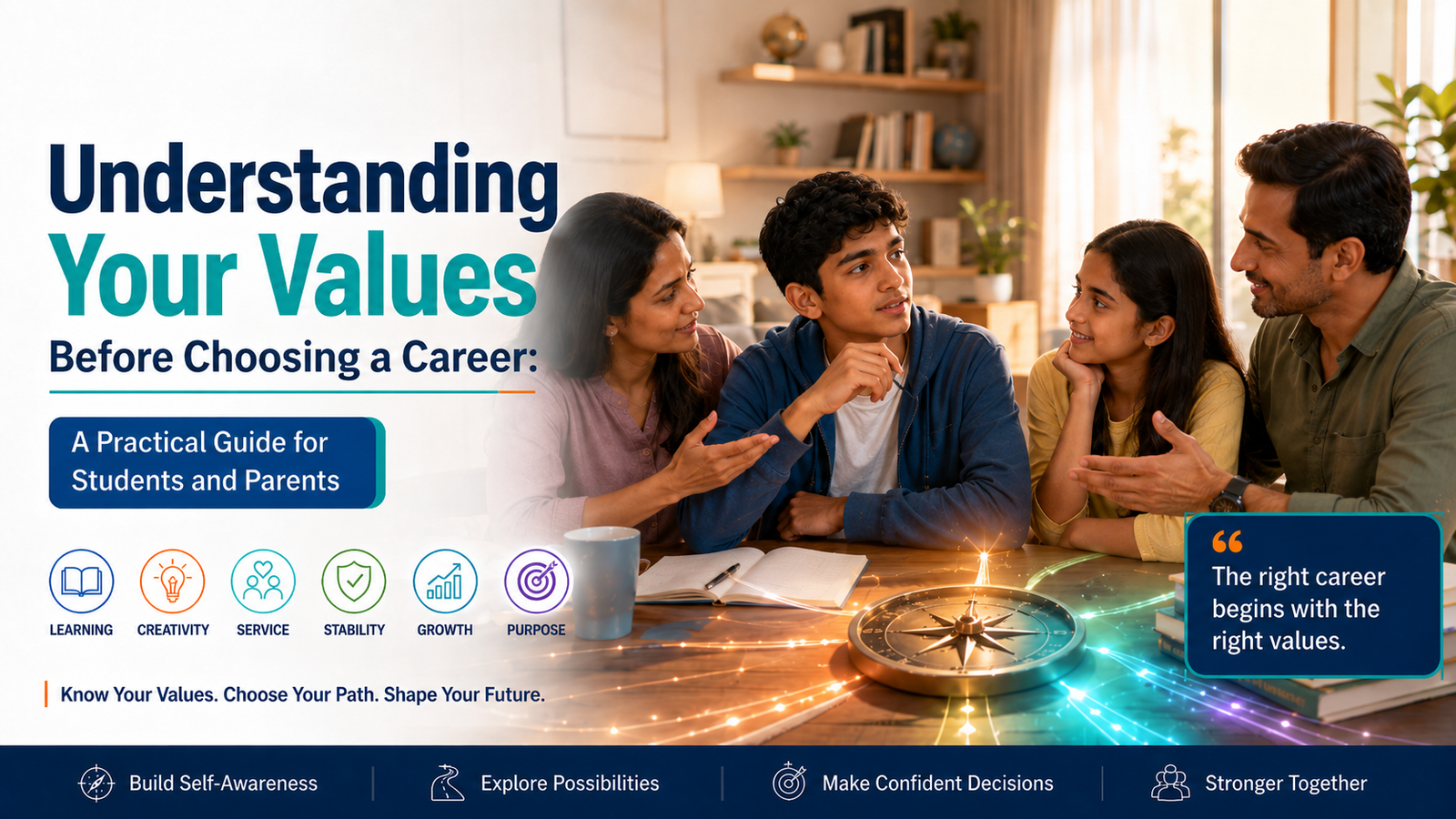
Before choosing a career, pause to understand what truly matters to you. This blog will help students and parents explore values, choices, and future possibilities with clarity, confidence, and thoughtful guidance. Read ahead to make career decisions more meaningful, balanced, and future-ready.
Many students begin career planning by asking, “Which stream should I choose?”, “Which career has more scope?”, “Which course gives better salary?”, or “What is the safest option?”
These are important questions. But they are not the first questions.
Before choosing a career, students must ask something deeper: “What kind of life do I want to build, and what kind of work will help me grow with meaning?”
This is where values become important.
Values are the principles, priorities, and inner preferences that guide our decisions. They influence what we respect, what motivates us, what we can tolerate, and what gives us satisfaction. A student may value creativity, stability, independence, service, recognition, learning, family responsibility, innovation, leadership, or social impact. None of these values is superior to the other. The purpose is not to label values as right or wrong. The purpose is to understand them clearly.
Career confusion often happens not because students lack options, but because they lack self-understanding. When students choose careers only by marks, trends, peer pressure, or family expectations, they may enter a path that looks successful from outside but feels disconnected from within.
A good career decision requires both outer awareness and inner clarity.
Outer awareness helps students understand courses, careers, industries, future skills, and opportunities. Inner clarity helps them understand interests, strengths, personality, motivation, and values. Together, these create a more balanced and future-ready career decision.
Values are the things that matter deeply to a person. In career planning, values help answer questions such as:
What kind of work environment suits me?
Do I prefer security or exploration?
Do I enjoy helping people directly?
Do I need creativity in my work?
Do I want recognition, independence, stability, flexibility, or impact?
How important are income, work-life balance, learning, leadership, and contribution?
For example, two students may both be interested in science. One may value research, discovery, and deep thinking. Another may value direct human service and emotional connection. The first student may feel drawn toward scientific research, data science, biotechnology, or innovation-led roles. The second may feel more connected to medicine, psychology, healthcare, social work, or counselling-related fields.
The subject may be similar, but the value direction may be different.
This is why career guidance should not stop at “What are you good at?” It should also explore “What matters to you?”
Careers today are changing quickly. New technologies, artificial intelligence, global competition, digital work, and emerging industries are reshaping the future of work. Students may not work in one fixed role for life. They may change roles, upgrade skills, shift industries, and design careers in multiple phases.
In such a world, values become an internal compass.
Skills may change. Job titles may change. Industries may change. But values help students make meaningful choices across changing circumstances.
A student who values learning will keep upgrading.
A student who values service will search for contribution.
A student who values creativity will look for original expression.
A student who values stability will plan with structure.
A student who values independence may explore entrepreneurship, freelancing, research, or flexible professional paths.
Values do not decide the entire career alone. But they help students evaluate options more wisely.
In India, career decisions often involve the family. Parents care deeply about security, social respect, financial stability, and long-term wellbeing. Students may care about passion, identity, freedom, creativity, or meaningful work. Sometimes these priorities appear to conflict.
But they do not have to become a conflict.
A culturally respectful career conversation does not reject parental wisdom. It also does not silence the student’s individuality. The better approach is dialogue.
Parents may ask:
“What kind of life will this career help you build?”
“What effort are you willing to put into this path?”
“What risks are involved, and how can we plan for them?”
“What alternatives should we keep open?”
Students may ask themselves:
“Am I choosing this career only to please others?”
“Am I avoiding a career only because I fear hard work?”
“Do I understand the realities of this path?”
“Can I explain my choice with maturity and evidence?”
Values-based career planning does not mean ignoring practical realities. It means combining personal meaning with informed planning.
Ron was a Class 10 student in Indore. His marks were good, especially in mathematics and science. Naturally, many relatives assumed he would take Science and prepare for engineering. His father believed engineering would provide stability. His mother wanted him to choose a path where he could grow with confidence.
Ron was confused. He liked technology but did not enjoy mechanical problem-solving for long hours. He loved explaining concepts to friends, designing presentations, writing short scripts for school events, and organizing group activities. He also cared deeply about fairness and helping younger students learn.
When asked what career he wanted, he said, “Maybe engineering, maybe business, maybe design. I don’t know.”
Instead of forcing a quick answer, his counsellor asked him to list situations where he felt most alive. Ron wrote:
When I explain something and others understand.
When I create something visually.
When I lead a team activity.
When I solve a problem that helps people.
When I learn about technology but use it creatively.
Then he listed what he valued:
Learning
Creativity
Communication
Helping others
Respect
Financial independence
Flexibility
This changed the conversation.
The question was no longer, “Science or Commerce?” The question became, “Which path can combine technology, communication, creativity, problem-solving, and future opportunity?”
Ron explored multiple options: design and technology, product management, UX design, business analytics, digital learning, entrepreneurship, communication-led technology roles, and management pathways. He still chose Science in Class 11, but now with a broader roadmap. He decided to build skills in coding, design thinking, communication, and business understanding. He also agreed with his parents to review his direction after one year based on performance, interest, and exposure.
The decision became calmer because it was not based only on pressure. It was based on self-awareness, family discussion, practical exploration, and values clarity.
This is what values-based guidance can do. It does not always change the subject choice immediately. But it improves the quality of thinking behind the choice.
Many students choose careers because they are popular in society. But popularity does not guarantee personal fit.
Income matters. Financial stability is important. But salary without interest, values, and capability alignment can create long-term dissatisfaction.
Parents may provide valuable perspective, but students must also develop ownership of their career journey.
Passion needs skill, discipline, market understanding, and adaptability. Values-based planning is practical, not romantic.
Even if a student chooses a traditional career, future skills such as communication, critical thinking, digital literacy, adaptability, and emotional intelligence remain essential.
At SkiillNext, career guidance is not seen as a one-time answer. It is a developmental process that helps individuals gain clarity through Knowledge, Integrated Intelligence, and Lifelong Learning.
Students need accurate information about careers, courses, subject combinations, skill requirements, future trends, and real work environments. Without knowledge, values may remain vague dreams.
For example, a student who values helping people should explore medicine, psychology, teaching, law, public policy, social entrepreneurship, human resources, counselling, community development, and healthcare technology. The value is one, but the pathways are many.
Integrated Intelligence means combining self-awareness, career awareness, emotional understanding, practical reasoning, and future readiness. A student should not choose a career only because they like it today. They should understand whether their strengths, values, learning style, personality, and future opportunities align with that path.
This creates a more complete decision.
Values can mature with age and exposure. A 15-year-old may value recognition. At 25, the same person may value mastery, autonomy, or purpose. Career planning should therefore remain flexible. Students should review their choices periodically instead of treating one decision as permanent.
Before shortlisting careers, students should write down 8–10 values that matter to them. Examples include stability, creativity, service, independence, income, learning, leadership, flexibility, innovation, family responsibility, or social impact.
Then reduce the list to the top five. This simple exercise brings surprising clarity.
Parents should avoid saying, “This value is impractical” or “This career has no scope” too quickly. Students should also avoid dismissing parents as old-fashioned. A meaningful discussion begins when both sides listen first and evaluate later.
Every career has a work environment. A student who values freedom may struggle in highly rigid settings. A student who values structure may feel uncomfortable in uncertain freelance work. A student who values creativity may need roles that allow expression and experimentation.
Career fit is not only about the job title. It is also about the lifestyle, culture, responsibility, and daily work pattern.
Students should not depend only on imagination. They can test values through internships, projects, volunteering, online courses, career talks, interviews with professionals, competitions, clubs, reading, or shadowing experiences.
A student who says, “I want to help people,” may volunteer in a teaching activity. A student who says, “I love technology,” may build a small project. A student who values leadership may organize a school initiative.
Experience makes values more real.
Values-based career planning is not a one-day activity. Students should review their direction at key stages: after Class 10, during Class 11–12, before graduation, after internships, and during early career years.
The question should not be, “Did I make the perfect decision?” The better question is, “What am I learning about myself, and how can I make a better next decision?”
Students can answer these questions in a notebook:
What activities make me feel deeply engaged?
What kind of problems do I enjoy solving?
What do I want people to appreciate me for?
What kind of lifestyle do I imagine for myself?
What responsibilities do I want to honour toward my family?
What kind of work would make me feel proud after ten years?
What am I willing to work hard for, even when it becomes difficult?
Parents can answer:
What strengths do I genuinely see in my child?
Am I guiding from wisdom or fear?
Have I explained my concerns clearly?
Am I allowing my child to explore responsibly?
What support does my child need to make a mature decision?
When students and parents reflect together, career planning becomes a partnership rather than a pressure point.
Choosing a career is one of the most important developmental decisions in a student’s life. But it should not be reduced to marks, trends, comparison, or fear.
A meaningful career decision begins with self-understanding.
Values help students understand what kind of work may give them energy, satisfaction, discipline, and direction. They help parents understand the child beyond academic performance. They help families move from pressure to partnership. They help career guidance become more human, practical, and future-ready.
The best career decisions are not made by ignoring reality. They are made by connecting reality with identity.
When students understand their values, they do not merely choose a course. They begin designing a life of clarity, confidence, contribution, and lifelong growth.
That is the deeper purpose of career guidance. And that is the direction SkiillNext aims to support.
Many students begin career planning by asking, “Which stream should I choose?”, “Which career has more scope?”, “Which course gives better salary?”, or “What is the safest option?”
These are important questions. But they are not the first questions.
Before choosing a career, students must ask something deeper: “What kind of life do I want to build, and what kind of work will help me grow with meaning?”
This is where values become important.
Values are the principles, priorities, and inner preferences that guide our decisions. They influence what we respect, what motivates us, what we can tolerate, and what gives us satisfaction. A student may value creativity, stability, independence, service, recognition, learning, family responsibility, innovation, leadership, or social impact. None of these values is superior to the other. The purpose is not to label values as right or wrong. The purpose is to understand them clearly.
Career confusion often happens not because students lack options, but because they lack self-understanding. When students choose careers only by marks, trends, peer pressure, or family expectations, they may enter a path that looks successful from outside but feels disconnected from within.
A good career decision requires both outer awareness and inner clarity.
Outer awareness helps students understand courses, careers, industries, future skills, and opportunities. Inner clarity helps them understand interests, strengths, personality, motivation, and values. Together, these create a more balanced and future-ready career decision.
Values are the things that matter deeply to a person. In career planning, values help answer questions such as:
What kind of work environment suits me?
Do I prefer security or exploration?
Do I enjoy helping people directly?
Do I need creativity in my work?
Do I want recognition, independence, stability, flexibility, or impact?
How important are income, work-life balance, learning, leadership, and contribution?
For example, two students may both be interested in science. One may value research, discovery, and deep thinking. Another may value direct human service and emotional connection. The first student may feel drawn toward scientific research, data science, biotechnology, or innovation-led roles. The second may feel more connected to medicine, psychology, healthcare, social work, or counselling-related fields.
The subject may be similar, but the value direction may be different.
This is why career guidance should not stop at “What are you good at?” It should also explore “What matters to you?”
Careers today are changing quickly. New technologies, artificial intelligence, global competition, digital work, and emerging industries are reshaping the future of work. Students may not work in one fixed role for life. They may change roles, upgrade skills, shift industries, and design careers in multiple phases.
In such a world, values become an internal compass.
Skills may change. Job titles may change. Industries may change. But values help students make meaningful choices across changing circumstances.
A student who values learning will keep upgrading.
A student who values service will search for contribution.
A student who values creativity will look for original expression.
A student who values stability will plan with structure.
A student who values independence may explore entrepreneurship, freelancing, research, or flexible professional paths.
Values do not decide the entire career alone. But they help students evaluate options more wisely.
In India, career decisions often involve the family. Parents care deeply about security, social respect, financial stability, and long-term wellbeing. Students may care about passion, identity, freedom, creativity, or meaningful work. Sometimes these priorities appear to conflict.
But they do not have to become a conflict.
A culturally respectful career conversation does not reject parental wisdom. It also does not silence the student’s individuality. The better approach is dialogue.
Parents may ask:
“What kind of life will this career help you build?”
“What effort are you willing to put into this path?”
“What risks are involved, and how can we plan for them?”
“What alternatives should we keep open?”
Students may ask themselves:
“Am I choosing this career only to please others?”
“Am I avoiding a career only because I fear hard work?”
“Do I understand the realities of this path?”
“Can I explain my choice with maturity and evidence?”
Values-based career planning does not mean ignoring practical realities. It means combining personal meaning with informed planning.
Ron was a Class 10 student in Indore. His marks were good, especially in mathematics and science. Naturally, many relatives assumed he would take Science and prepare for engineering. His father believed engineering would provide stability. His mother wanted him to choose a path where he could grow with confidence.
Ron was confused. He liked technology but did not enjoy mechanical problem-solving for long hours. He loved explaining concepts to friends, designing presentations, writing short scripts for school events, and organizing group activities. He also cared deeply about fairness and helping younger students learn.
When asked what career he wanted, he said, “Maybe engineering, maybe business, maybe design. I don’t know.”
Instead of forcing a quick answer, his counsellor asked him to list situations where he felt most alive. Ron wrote:
When I explain something and others understand.
When I create something visually.
When I lead a team activity.
When I solve a problem that helps people.
When I learn about technology but use it creatively.
Then he listed what he valued:
Learning
Creativity
Communication
Helping others
Respect
Financial independence
Flexibility
This changed the conversation.
The question was no longer, “Science or Commerce?” The question became, “Which path can combine technology, communication, creativity, problem-solving, and future opportunity?”
Ron explored multiple options: design and technology, product management, UX design, business analytics, digital learning, entrepreneurship, communication-led technology roles, and management pathways. He still chose Science in Class 11, but now with a broader roadmap. He decided to build skills in coding, design thinking, communication, and business understanding. He also agreed with his parents to review his direction after one year based on performance, interest, and exposure.
The decision became calmer because it was not based only on pressure. It was based on self-awareness, family discussion, practical exploration, and values clarity.
This is what values-based guidance can do. It does not always change the subject choice immediately. But it improves the quality of thinking behind the choice.
Many students choose careers because they are popular in society. But popularity does not guarantee personal fit.
Income matters. Financial stability is important. But salary without interest, values, and capability alignment can create long-term dissatisfaction.
Parents may provide valuable perspective, but students must also develop ownership of their career journey.
Passion needs skill, discipline, market understanding, and adaptability. Values-based planning is practical, not romantic.
Even if a student chooses a traditional career, future skills such as communication, critical thinking, digital literacy, adaptability, and emotional intelligence remain essential.
At SkiillNext, career guidance is not seen as a one-time answer. It is a developmental process that helps individuals gain clarity through Knowledge, Integrated Intelligence, and Lifelong Learning.
Students need accurate information about careers, courses, subject combinations, skill requirements, future trends, and real work environments. Without knowledge, values may remain vague dreams.
For example, a student who values helping people should explore medicine, psychology, teaching, law, public policy, social entrepreneurship, human resources, counselling, community development, and healthcare technology. The value is one, but the pathways are many.
Integrated Intelligence means combining self-awareness, career awareness, emotional understanding, practical reasoning, and future readiness. A student should not choose a career only because they like it today. They should understand whether their strengths, values, learning style, personality, and future opportunities align with that path.
This creates a more complete decision.
Values can mature with age and exposure. A 15-year-old may value recognition. At 25, the same person may value mastery, autonomy, or purpose. Career planning should therefore remain flexible. Students should review their choices periodically instead of treating one decision as permanent.
Before shortlisting careers, students should write down 8–10 values that matter to them. Examples include stability, creativity, service, independence, income, learning, leadership, flexibility, innovation, family responsibility, or social impact.
Then reduce the list to the top five. This simple exercise brings surprising clarity.
Parents should avoid saying, “This value is impractical” or “This career has no scope” too quickly. Students should also avoid dismissing parents as old-fashioned. A meaningful discussion begins when both sides listen first and evaluate later.
Every career has a work environment. A student who values freedom may struggle in highly rigid settings. A student who values structure may feel uncomfortable in uncertain freelance work. A student who values creativity may need roles that allow expression and experimentation.
Career fit is not only about the job title. It is also about the lifestyle, culture, responsibility, and daily work pattern.
Students should not depend only on imagination. They can test values through internships, projects, volunteering, online courses, career talks, interviews with professionals, competitions, clubs, reading, or shadowing experiences.
A student who says, “I want to help people,” may volunteer in a teaching activity. A student who says, “I love technology,” may build a small project. A student who values leadership may organize a school initiative.
Experience makes values more real.
Values-based career planning is not a one-day activity. Students should review their direction at key stages: after Class 10, during Class 11–12, before graduation, after internships, and during early career years.
The question should not be, “Did I make the perfect decision?” The better question is, “What am I learning about myself, and how can I make a better next decision?”
Students can answer these questions in a notebook:
What activities make me feel deeply engaged?
What kind of problems do I enjoy solving?
What do I want people to appreciate me for?
What kind of lifestyle do I imagine for myself?
What responsibilities do I want to honour toward my family?
What kind of work would make me feel proud after ten years?
What am I willing to work hard for, even when it becomes difficult?
Parents can answer:
What strengths do I genuinely see in my child?
Am I guiding from wisdom or fear?
Have I explained my concerns clearly?
Am I allowing my child to explore responsibly?
What support does my child need to make a mature decision?
When students and parents reflect together, career planning becomes a partnership rather than a pressure point.
Choosing a career is one of the most important developmental decisions in a student’s life. But it should not be reduced to marks, trends, comparison, or fear.
A meaningful career decision begins with self-understanding.
Values help students understand what kind of work may give them energy, satisfaction, discipline, and direction. They help parents understand the child beyond academic performance. They help families move from pressure to partnership. They help career guidance become more human, practical, and future-ready.
The best career decisions are not made by ignoring reality. They are made by connecting reality with identity.
When students understand their values, they do not merely choose a course. They begin designing a life of clarity, confidence, contribution, and lifelong growth.
That is the deeper purpose of career guidance. And that is the direction SkiillNext aims to support.