
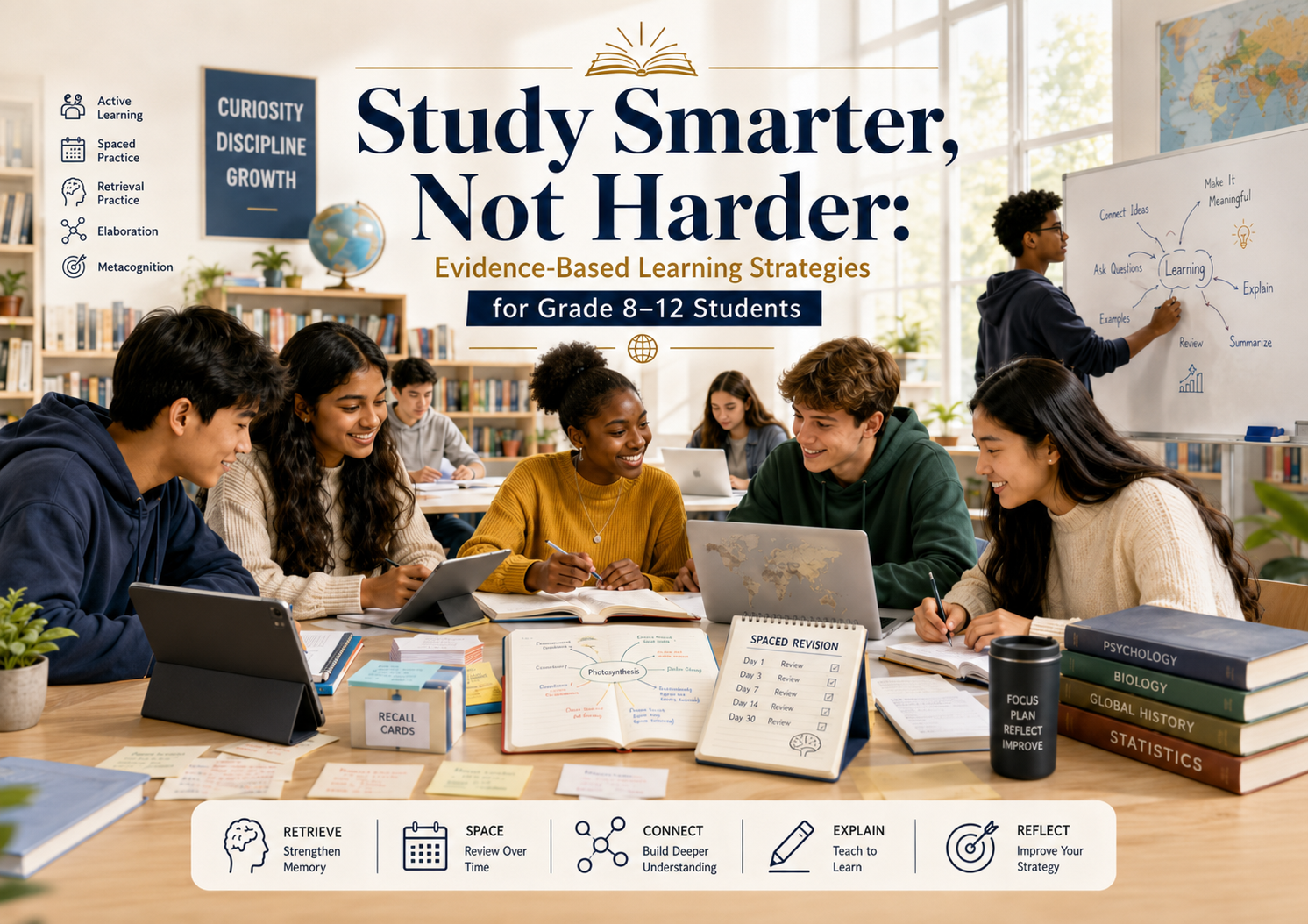
Learning does not have to feel overwhelming. This guide will help students and parents understand simple, evidence-based study strategies that make learning clearer, smarter, and more effective. Read the full blog to discover how small changes in daily study habits can build confidence, improve performance, and support lifelong growth.
Rose, a Grade 10 student from Chicago, had a familiar problem. She spent long hours at her desk, highlighted almost every line in her science textbook, watched study videos late at night, and still felt unsure before tests.
Across the world in Mumbai, Shaan, a Grade 11 student preparing for school exams and competitive entrance pathways, faced a similar struggle. His notebooks looked neat. His timetable looked full. His parents could see that he was working hard. But when Shaan sat for mock tests, he often forgot formulas, confused concepts, or made avoidable mistakes.
Rose and Shaan lived in different countries, followed different school systems, and had different academic pressures. But they shared one common challenge: they were studying hard without always studying smart.
For students from Grade 8 to 12, this matters deeply. These years are not only about marks. They are about building learning habits, thinking skills, confidence, self-awareness, and future readiness. Whether a student is preparing for board exams in India, advanced placement courses in the United States, international curricula, school assessments, Olympiads, entrance exams, or skill-based learning, the real question is not only, “How many hours did I study?”
The better question is: “Did I use learning strategies that actually help my brain understand, remember, apply, and improve?”
Research in cognitive psychology has consistently shown that some learning techniques are more effective than others. A major review of learning techniques found that practice testing and distributed practice are among the most useful strategies students can adopt across learning conditions. This is encouraging because smart learning does not require expensive tools. It requires better methods, consistency, and reflection.
At SkiillNext, learning is seen as a lifelong capability, not just an exam activity. Content and guidance should help students gain clarity, confidence, future readiness, and lifelong growth through Knowledge, Integrated Intelligence, and Lifelong Learning. This blog follows that same purpose: to help students and parents understand how smarter learning can become part of everyday academic life.
Studying smarter does not mean studying less carelessly. It means studying with better design.
A smart learner asks:
Rose believed that reading the chapter again and again meant she was learning. Shaan believed that solving the same type of maths problem repeatedly meant he had mastered the topic. But both later discovered a simple truth: familiarity is not the same as mastery.
A paragraph may look familiar when you reread it, but that does not mean you can explain it in your own words. A formula may look easy when the solution is in front of you, but that does not mean you can choose and apply it correctly in a new problem.
Smart studying helps students move from passive exposure to active learning. It turns “I have seen this before” into “I can recall it, explain it, apply it, and improve it.”
Grade 8 to 12 is a transition period. Students move from basic understanding to deeper academic thinking. Subjects become more layered. Science requires conceptual clarity. Mathematics needs problem-solving. Social science needs connection and interpretation. Languages require expression. Commerce, humanities, and STEM subjects demand analysis, memory, and application.
In India, these years also bring subject selection, board exam preparation, stream decisions, career conversations, entrance exam awareness, and pressure from family expectations. Globally, students experience similar pressure through academic tracking, college readiness, competitive applications, and future career uncertainty.
This is why study habits cannot remain random.
NCERT’s learning outcomes perspective emphasizes that learners construct knowledge through engagement with the world around them and that education should focus on the process of learning, not only the product. This aligns strongly with modern learning science. Students need to do more than collect information. They need to process, question, apply, reflect, and grow.
For Rose, this meant changing from colourful notes to active recall. For Shaan, it meant changing from long hours to focused cycles of practice, feedback, and correction.
Retrieval practice means trying to bring information out of memory instead of only putting information in.
For example, after studying a biology topic, Rose closed her textbook and asked herself:
“What are the steps of photosynthesis?”
“Why is chlorophyll important?”
“What would happen if sunlight were missing?”
At first, she felt uncomfortable. She could not recall everything. But that discomfort was useful. It showed her what she had not yet mastered.
Research on test-enhanced learning shows that taking memory tests does not only assess knowledge; it can also improve long-term retention. This is why self-quizzing, flashcards, blank-page recall, oral explanation, and practice tests can be more powerful than rereading alone.
After studying a topic, close the book and write what you remember.
Convert headings into questions.
Use flashcards for definitions, formulas, dates, and concepts.
Solve questions without looking at examples.
Teach the topic aloud to a friend, parent, sibling, or even an imaginary class.
Shaan started using a “blank page test” after every physics chapter. He wrote formulas, concepts, diagrams, and common mistakes from memory. Then he checked the textbook. This helped him see the difference between “I read it” and “I know it.”
Many students revise only before exams. This is called massed practice or cramming. It may help for very short-term recall, but it often fails when students need long-term understanding.
Spaced practice means spreading revision across days and weeks.
A major review on distributed practice found strong evidence that spaced learning episodes improve verbal recall compared with massed practice. The basic idea is simple: the brain benefits when it revisits information after some forgetting has begun.
Rose changed her study routine from “study one subject for five hours on Sunday” to “review the same topic for 25 minutes across four different days.” Her learning became lighter, but stronger.
Day 1: Learn the topic.
Day 2: Quick recall and 5 questions.
Day 4: Revise weak points.
Day 7: Take a mini-test.
Day 14: Mix it with older topics.
Before exam: Use active revision, not just rereading.
For Indian students preparing for board exams, this can be especially useful. Instead of revising an entire syllabus at the end, students can keep older chapters alive through weekly recall cycles.
Shaan was confident in mathematics when he practised one type of problem at a time. But in tests, questions appeared in mixed order. He often knew the formula but could not identify which method to use.
This is where interleaving helps.
Interleaving means mixing related problem types during practice instead of completing one block of identical questions. Research on mathematics learning shows that interleaved practice can help students learn to choose the right strategy based on the problem itself.
For example, instead of practising 20 similar quadratic equation problems together, a student can mix:
This may feel harder at first. But it builds discrimination: the ability to identify what kind of problem is in front of you and what method is needed.
Mix question types after basic understanding is complete.
Create “mixed revision sets” every weekend.
Practise old and new topics together.
Use previous mistakes to design mixed practice.
For science, mix concept questions, diagrams, numericals, and application questions.
Rose used interleaving in chemistry by mixing balancing equations, periodic table trends, bonding questions, and short explanations. She stopped asking, “Which chapter is this from?” and started asking, “What is the concept behind this question?”
That shift is smart learning.
Self-explanation means explaining a concept to yourself while learning. It pushes the brain to connect ideas instead of memorising isolated points.
A review of effective learning techniques notes that elaborative interrogation and self-explanation can support learning by prompting students to answer “why” questions.
For Grade 8 to 12 students, this is extremely useful.
Instead of only memorising “The heart pumps blood,” a student asks:
Why does the body need blood circulation?
How does oxygen reach cells?
What happens if circulation is blocked?
How is this connected to respiration?
Instead of memorising a history date, a student asks:
Why did this event happen?
What changed after it?
Who was affected?
How is it connected to today?
After learning any concept, ask:
Shaan began using this method in economics. Instead of memorising definitions, he explained demand, supply, inflation, and markets using examples from local shops, online shopping, and family budgeting. His answers became clearer because his understanding became more real.
Many students feel bad when they make mistakes. Smart learners use mistakes as feedback.
Rose created a “mistake notebook.” Shaan created an “error tracker.” They both wrote:
This turned mistakes from emotional stress into learning data.
A student who simply writes “I made silly mistakes” may not improve. But a student who writes “I lost marks because I skipped units in physics numericals” can take action.
Concept gap: I did not understand the idea.
Recall gap: I forgot the fact, formula, or step.
Application gap: I knew the concept but could not use it.
Careless error: I rushed or did not check.
Question-reading error: I misunderstood what was asked.
Time error: I spent too long on one question.
Reflection supports self-regulated learning. OECD’s work on student learning strategies highlights the importance of self-monitoring, critical thinking, and proactive learning behaviours for readiness for lifelong learning.
This is exactly what students need beyond exams: the ability to observe themselves, adjust strategies, and keep improving.
Students often treat sleep as optional during exams. But learning is not only about time spent with books. The brain needs rest to consolidate memory.
Research on sleep and memory suggests that sleep deprivation before and after learning can negatively affect memory for newly learned material. This does not mean students should become casual about effort. It means effort must be supported by recovery.
Rose noticed that late-night studying made her feel productive, but the next day she forgot more. Shaan realised that studying after midnight often increased errors in morning practice tests. Both shifted to more consistent sleep and shorter, focused study blocks.
Study for 30–45 minutes.
Take a 5–10 minute break.
Keep the phone away during focus time.
Use one clear goal per session.
End each session with 3–5 recall questions.
Sleep enough to support attention, memory, and emotional balance.
For students from Grade 8 to 12, this is not just academic advice. It is a life skill.
Here is a practical routine students can adapt.
Start with one clear priority subject.
Use active recall after learning.
Solve 5–10 questions without help.
Write one doubt or weak area.
Review one older topic for 10–15 minutes.
One day for mixed practice.
One day for error review.
One day for long-answer writing or concept explanation.
One day for revisiting difficult topics.
One short reflection: What improved this week? What needs attention?
Do not only reread notes.
Use mock tests, recall sheets, formula maps, diagrams, and mixed questions.
Review mistakes more than comfort topics.
Practise writing answers within time limits.
Protect sleep and focus.
This approach helps students move from pressure-based preparation to process-based preparation.
At SkiillNext, studying smarter is not only about scoring better. It is about becoming a better learner.
Students need strong academic foundations. They must understand concepts, facts, methods, vocabulary, formulas, and subject structures.
Students also need to connect knowledge with thinking, emotion, self-awareness, decision-making, time management, and communication. A student who knows the syllabus but cannot manage stress, reflect on mistakes, or choose the right strategy may struggle despite hard work.
The future will reward learners who can keep learning, unlearning, adapting, and growing. School learning habits become the foundation for college, career, professional skills, entrepreneurship, research, technology, and life decisions.
This is why SkiillNext encourages students and parents to see learning as a complete growth journey. The goal is not to create fear around marks. The goal is to build clarity, confidence, capability, and future readiness.
Parents can support this by asking better questions:
Instead of: “How many hours did you study?”
Ask: “What did you understand today?”
Instead of: “Why did you lose marks?”
Ask: “What pattern did you notice in your mistakes?”
Instead of: “Are you ready for the exam?”
Ask: “Which topic needs one more round of retrieval practice?”
These questions create a healthier learning environment at home.
After studying, close the book and test yourself. If you cannot recall it, you have found your next learning target.
Do not wait for exam week. Revise topics after one day, a few days, one week, and two weeks.
Use interleaving to prepare for real exams where questions do not arrive chapter-wise.
If you can explain a concept simply, you probably understand it better.
Mistakes are not proof of failure. They are signals for improvement.
Do not write “Study science.” Write “Revise respiration diagram and answer five application questions.”
Keep distractions away during study blocks. Deep focus for 40 minutes is often better than distracted study for two hours.
Students need support, not constant pressure. Parents can help by creating routine, calm discussion, and reflection-based encouragement.
By the end of the term, Rose and Shaan had not become perfect students. That was never the goal.
Rose still found some science chapters difficult. Shaan still made mistakes in maths and physics. But something important changed. They no longer judged learning only by hours spent. They started judging it by understanding, recall, application, reflection, and improvement.
That is the heart of studying smarter.
For students from Grade 8 to 12, smarter learning can reduce confusion, improve retention, strengthen exam preparation, and build future-ready habits. For parents, it offers a more constructive way to support children without turning every academic conversation into pressure. For educators and counsellors, it reinforces the need to teach learning strategies, not only subject content.
In a fast-changing world, students need more than marks. They need the ability to learn deeply, think clearly, adapt confidently, and continue growing.
SkiillNext supports this journey by helping students and parents gain clarity, develop better learning habits, understand strengths, make informed academic and career decisions, and build lifelong learning capabilities.
If you are a student trying to improve your study routine, or a parent looking for thoughtful guidance for your child, SkiillNext invites you to explore its learning, career guidance, and future-readiness resources. The journey to better learning does not begin with pressure. It begins with the right understanding, the right strategy, and the confidence to grow one step at a time.
Rose, a Grade 10 student from Chicago, had a familiar problem. She spent long hours at her desk, highlighted almost every line in her science textbook, watched study videos late at night, and still felt unsure before tests.
Across the world in Mumbai, Shaan, a Grade 11 student preparing for school exams and competitive entrance pathways, faced a similar struggle. His notebooks looked neat. His timetable looked full. His parents could see that he was working hard. But when Shaan sat for mock tests, he often forgot formulas, confused concepts, or made avoidable mistakes.
Rose and Shaan lived in different countries, followed different school systems, and had different academic pressures. But they shared one common challenge: they were studying hard without always studying smart.
For students from Grade 8 to 12, this matters deeply. These years are not only about marks. They are about building learning habits, thinking skills, confidence, self-awareness, and future readiness. Whether a student is preparing for board exams in India, advanced placement courses in the United States, international curricula, school assessments, Olympiads, entrance exams, or skill-based learning, the real question is not only, “How many hours did I study?”
The better question is: “Did I use learning strategies that actually help my brain understand, remember, apply, and improve?”
Research in cognitive psychology has consistently shown that some learning techniques are more effective than others. A major review of learning techniques found that practice testing and distributed practice are among the most useful strategies students can adopt across learning conditions. This is encouraging because smart learning does not require expensive tools. It requires better methods, consistency, and reflection.
At SkiillNext, learning is seen as a lifelong capability, not just an exam activity. Content and guidance should help students gain clarity, confidence, future readiness, and lifelong growth through Knowledge, Integrated Intelligence, and Lifelong Learning. This blog follows that same purpose: to help students and parents understand how smarter learning can become part of everyday academic life.
Studying smarter does not mean studying less carelessly. It means studying with better design.
A smart learner asks:
Rose believed that reading the chapter again and again meant she was learning. Shaan believed that solving the same type of maths problem repeatedly meant he had mastered the topic. But both later discovered a simple truth: familiarity is not the same as mastery.
A paragraph may look familiar when you reread it, but that does not mean you can explain it in your own words. A formula may look easy when the solution is in front of you, but that does not mean you can choose and apply it correctly in a new problem.
Smart studying helps students move from passive exposure to active learning. It turns “I have seen this before” into “I can recall it, explain it, apply it, and improve it.”
Grade 8 to 12 is a transition period. Students move from basic understanding to deeper academic thinking. Subjects become more layered. Science requires conceptual clarity. Mathematics needs problem-solving. Social science needs connection and interpretation. Languages require expression. Commerce, humanities, and STEM subjects demand analysis, memory, and application.
In India, these years also bring subject selection, board exam preparation, stream decisions, career conversations, entrance exam awareness, and pressure from family expectations. Globally, students experience similar pressure through academic tracking, college readiness, competitive applications, and future career uncertainty.
This is why study habits cannot remain random.
NCERT’s learning outcomes perspective emphasizes that learners construct knowledge through engagement with the world around them and that education should focus on the process of learning, not only the product. This aligns strongly with modern learning science. Students need to do more than collect information. They need to process, question, apply, reflect, and grow.
For Rose, this meant changing from colourful notes to active recall. For Shaan, it meant changing from long hours to focused cycles of practice, feedback, and correction.
Retrieval practice means trying to bring information out of memory instead of only putting information in.
For example, after studying a biology topic, Rose closed her textbook and asked herself:
“What are the steps of photosynthesis?”
“Why is chlorophyll important?”
“What would happen if sunlight were missing?”
At first, she felt uncomfortable. She could not recall everything. But that discomfort was useful. It showed her what she had not yet mastered.
Research on test-enhanced learning shows that taking memory tests does not only assess knowledge; it can also improve long-term retention. This is why self-quizzing, flashcards, blank-page recall, oral explanation, and practice tests can be more powerful than rereading alone.
After studying a topic, close the book and write what you remember.
Convert headings into questions.
Use flashcards for definitions, formulas, dates, and concepts.
Solve questions without looking at examples.
Teach the topic aloud to a friend, parent, sibling, or even an imaginary class.
Shaan started using a “blank page test” after every physics chapter. He wrote formulas, concepts, diagrams, and common mistakes from memory. Then he checked the textbook. This helped him see the difference between “I read it” and “I know it.”
Many students revise only before exams. This is called massed practice or cramming. It may help for very short-term recall, but it often fails when students need long-term understanding.
Spaced practice means spreading revision across days and weeks.
A major review on distributed practice found strong evidence that spaced learning episodes improve verbal recall compared with massed practice. The basic idea is simple: the brain benefits when it revisits information after some forgetting has begun.
Rose changed her study routine from “study one subject for five hours on Sunday” to “review the same topic for 25 minutes across four different days.” Her learning became lighter, but stronger.
Day 1: Learn the topic.
Day 2: Quick recall and 5 questions.
Day 4: Revise weak points.
Day 7: Take a mini-test.
Day 14: Mix it with older topics.
Before exam: Use active revision, not just rereading.
For Indian students preparing for board exams, this can be especially useful. Instead of revising an entire syllabus at the end, students can keep older chapters alive through weekly recall cycles.
Shaan was confident in mathematics when he practised one type of problem at a time. But in tests, questions appeared in mixed order. He often knew the formula but could not identify which method to use.
This is where interleaving helps.
Interleaving means mixing related problem types during practice instead of completing one block of identical questions. Research on mathematics learning shows that interleaved practice can help students learn to choose the right strategy based on the problem itself.
For example, instead of practising 20 similar quadratic equation problems together, a student can mix:
This may feel harder at first. But it builds discrimination: the ability to identify what kind of problem is in front of you and what method is needed.
Mix question types after basic understanding is complete.
Create “mixed revision sets” every weekend.
Practise old and new topics together.
Use previous mistakes to design mixed practice.
For science, mix concept questions, diagrams, numericals, and application questions.
Rose used interleaving in chemistry by mixing balancing equations, periodic table trends, bonding questions, and short explanations. She stopped asking, “Which chapter is this from?” and started asking, “What is the concept behind this question?”
That shift is smart learning.
Self-explanation means explaining a concept to yourself while learning. It pushes the brain to connect ideas instead of memorising isolated points.
A review of effective learning techniques notes that elaborative interrogation and self-explanation can support learning by prompting students to answer “why” questions.
For Grade 8 to 12 students, this is extremely useful.
Instead of only memorising “The heart pumps blood,” a student asks:
Why does the body need blood circulation?
How does oxygen reach cells?
What happens if circulation is blocked?
How is this connected to respiration?
Instead of memorising a history date, a student asks:
Why did this event happen?
What changed after it?
Who was affected?
How is it connected to today?
After learning any concept, ask:
Shaan began using this method in economics. Instead of memorising definitions, he explained demand, supply, inflation, and markets using examples from local shops, online shopping, and family budgeting. His answers became clearer because his understanding became more real.
Many students feel bad when they make mistakes. Smart learners use mistakes as feedback.
Rose created a “mistake notebook.” Shaan created an “error tracker.” They both wrote:
This turned mistakes from emotional stress into learning data.
A student who simply writes “I made silly mistakes” may not improve. But a student who writes “I lost marks because I skipped units in physics numericals” can take action.
Concept gap: I did not understand the idea.
Recall gap: I forgot the fact, formula, or step.
Application gap: I knew the concept but could not use it.
Careless error: I rushed or did not check.
Question-reading error: I misunderstood what was asked.
Time error: I spent too long on one question.
Reflection supports self-regulated learning. OECD’s work on student learning strategies highlights the importance of self-monitoring, critical thinking, and proactive learning behaviours for readiness for lifelong learning.
This is exactly what students need beyond exams: the ability to observe themselves, adjust strategies, and keep improving.
Students often treat sleep as optional during exams. But learning is not only about time spent with books. The brain needs rest to consolidate memory.
Research on sleep and memory suggests that sleep deprivation before and after learning can negatively affect memory for newly learned material. This does not mean students should become casual about effort. It means effort must be supported by recovery.
Rose noticed that late-night studying made her feel productive, but the next day she forgot more. Shaan realised that studying after midnight often increased errors in morning practice tests. Both shifted to more consistent sleep and shorter, focused study blocks.
Study for 30–45 minutes.
Take a 5–10 minute break.
Keep the phone away during focus time.
Use one clear goal per session.
End each session with 3–5 recall questions.
Sleep enough to support attention, memory, and emotional balance.
For students from Grade 8 to 12, this is not just academic advice. It is a life skill.
Here is a practical routine students can adapt.
Start with one clear priority subject.
Use active recall after learning.
Solve 5–10 questions without help.
Write one doubt or weak area.
Review one older topic for 10–15 minutes.
One day for mixed practice.
One day for error review.
One day for long-answer writing or concept explanation.
One day for revisiting difficult topics.
One short reflection: What improved this week? What needs attention?
Do not only reread notes.
Use mock tests, recall sheets, formula maps, diagrams, and mixed questions.
Review mistakes more than comfort topics.
Practise writing answers within time limits.
Protect sleep and focus.
This approach helps students move from pressure-based preparation to process-based preparation.
At SkiillNext, studying smarter is not only about scoring better. It is about becoming a better learner.
Students need strong academic foundations. They must understand concepts, facts, methods, vocabulary, formulas, and subject structures.
Students also need to connect knowledge with thinking, emotion, self-awareness, decision-making, time management, and communication. A student who knows the syllabus but cannot manage stress, reflect on mistakes, or choose the right strategy may struggle despite hard work.
The future will reward learners who can keep learning, unlearning, adapting, and growing. School learning habits become the foundation for college, career, professional skills, entrepreneurship, research, technology, and life decisions.
This is why SkiillNext encourages students and parents to see learning as a complete growth journey. The goal is not to create fear around marks. The goal is to build clarity, confidence, capability, and future readiness.
Parents can support this by asking better questions:
Instead of: “How many hours did you study?”
Ask: “What did you understand today?”
Instead of: “Why did you lose marks?”
Ask: “What pattern did you notice in your mistakes?”
Instead of: “Are you ready for the exam?”
Ask: “Which topic needs one more round of retrieval practice?”
These questions create a healthier learning environment at home.
After studying, close the book and test yourself. If you cannot recall it, you have found your next learning target.
Do not wait for exam week. Revise topics after one day, a few days, one week, and two weeks.
Use interleaving to prepare for real exams where questions do not arrive chapter-wise.
If you can explain a concept simply, you probably understand it better.
Mistakes are not proof of failure. They are signals for improvement.
Do not write “Study science.” Write “Revise respiration diagram and answer five application questions.”
Keep distractions away during study blocks. Deep focus for 40 minutes is often better than distracted study for two hours.
Students need support, not constant pressure. Parents can help by creating routine, calm discussion, and reflection-based encouragement.
By the end of the term, Rose and Shaan had not become perfect students. That was never the goal.
Rose still found some science chapters difficult. Shaan still made mistakes in maths and physics. But something important changed. They no longer judged learning only by hours spent. They started judging it by understanding, recall, application, reflection, and improvement.
That is the heart of studying smarter.
For students from Grade 8 to 12, smarter learning can reduce confusion, improve retention, strengthen exam preparation, and build future-ready habits. For parents, it offers a more constructive way to support children without turning every academic conversation into pressure. For educators and counsellors, it reinforces the need to teach learning strategies, not only subject content.
In a fast-changing world, students need more than marks. They need the ability to learn deeply, think clearly, adapt confidently, and continue growing.
SkiillNext supports this journey by helping students and parents gain clarity, develop better learning habits, understand strengths, make informed academic and career decisions, and build lifelong learning capabilities.
If you are a student trying to improve your study routine, or a parent looking for thoughtful guidance for your child, SkiillNext invites you to explore its learning, career guidance, and future-readiness resources. The journey to better learning does not begin with pressure. It begins with the right understanding, the right strategy, and the confidence to grow one step at a time.