
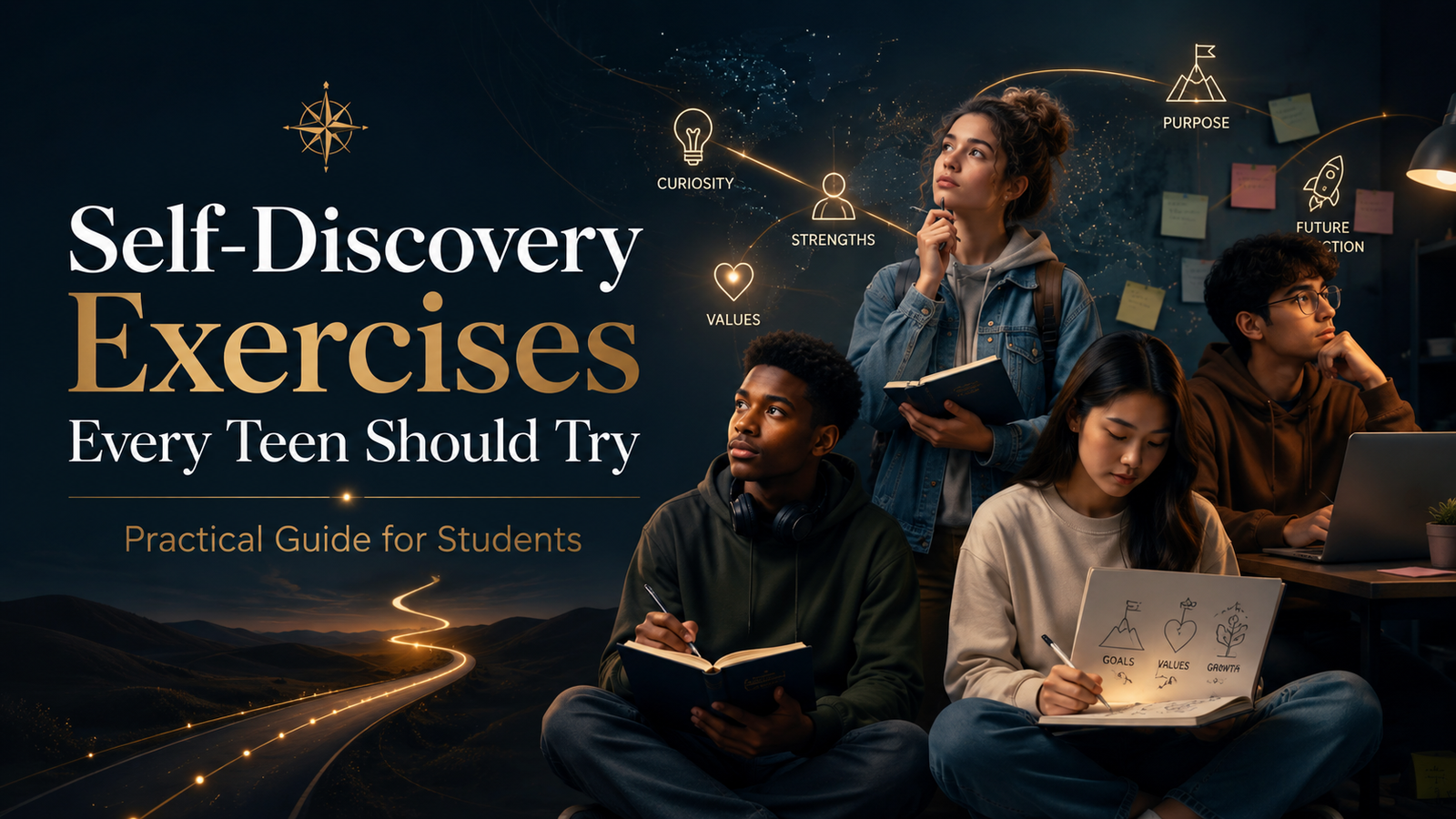
Before you rush to decide who you should become, take a moment to understand who you are becoming. This blog will guide you through simple, thoughtful self-discovery exercises that can help you know yourself better, make wiser choices, and move toward your future with more clarity and confidence.
Some questions do not appear in exam papers, but they still shape your life.
Who am I?
What am I good at?
Why do I feel confused sometimes?
What kind of future will suit me?
Am I choosing something because I want it, or because everyone around me expects it?
Almost every teenager carries these questions quietly. Some ask them openly. Some hide them behind smiles, busy schedules, social media, exam preparation, or casual jokes with friends.
Imagine a student named Aarav. He studies well, participates in school activities, and everyone says he has “potential.” Yet when someone asks, “What do you want to do in life?” he feels a small pressure inside. He likes science, enjoys designing posters, helps friends solve problems, and loves watching business stories. But he cannot put these pieces together.
Aarav is not lazy. He is not confused in a negative way. He is growing.
Adolescence is a unique stage between childhood and adulthood. The World Health Organization describes adolescence as a period of rapid physical, cognitive, and psychosocial growth that affects how young people feel, think, make decisions, and interact with the world. This is why self-discovery matters. It helps you notice your inner patterns before the world starts defining you only through marks, ranks, trends, or career labels.
Self-discovery does not mean finding one final answer about yourself. It means learning how to observe yourself honestly, kindly, and practically.
Teenage life today is intense. Students compare themselves with classmates, influencers, siblings, toppers, athletes, coders, creators, and sometimes even strangers online. Globally, students face academic pressure, digital distraction, identity questions, peer influence, and uncertainty about future careers. In India, many teens also navigate board exams, stream selection, competitive exams, family expectations, and the desire to make parents proud.
This is not easy.
Research and educational frameworks increasingly recognize that student development is not only academic. Social and emotional learning frameworks such as CASEL identify self-awareness as part of the broader set of competencies that support student learning and development. WHO also highlights adolescence as a crucial period for developing social and emotional habits, including coping skills, problem-solving, interpersonal skills, and emotion management.
India’s education direction also reflects this shift. NEP-linked discussions emphasize holistic development, life skills, socio-emotional consideration, independent thinking, and moving beyond rote memorization. Pariksha Pe Charcha, as described by PIB, also connects student well-being with stress-free exams, emotional resilience, time management, mindfulness, and holistic development.
Self-discovery gives students an inner compass. It does not remove challenges, but it helps students respond to them with greater awareness.
Self-discovery is the practice of understanding your strengths, interests, values, emotions, habits, learning patterns, motivations, and choices.
It is not a personality label.
It is not a one-time test.
It is not a race to finalize your career.
It is not a reason to judge yourself.
A teen may say, “I am not good at maths,” but self-discovery asks, “Is it maths I dislike, or the way I study it? Do I struggle with concepts, speed, confidence, or practice?” Another student may say, “I want to become a doctor,” but self-discovery asks, “What attracts me—helping people, biology, respect, financial security, family expectation, or the idea of stability?”
These questions do not create confusion. They create clarity.
Indian wisdom has a beautiful idea called swadhyaya, or self-study. In a modern student’s life, this can simply mean: observe yourself without harsh judgment. Notice your thoughts, choices, reactions, strengths, and growth areas. You do not need to become perfect. You only need to become more aware.
Take a notebook and write for ten minutes. Do not worry about grammar, neatness, or perfect answers. Start with these prompts:
What made me feel energetic this week?
What made me feel tired or irritated?
When did I feel proud of myself?
What did I avoid, and why?
What did I learn about myself?
This exercise helps you notice patterns. Maybe you feel alive during group discussions but drained by memorization. Maybe you enjoy solving real-life problems more than reading theory. Maybe you feel confident when you prepare early, but anxious when you delay work.
Do this once or twice a week. Over time, your journal becomes a mirror.
Many students think strengths are only subjects: maths, science, English, coding, commerce, arts, sports. But strengths can also include listening, organizing, explaining, observing, designing, leading, questioning, remembering, negotiating, or caring.
Make three columns:
Activities that energize me
Activities I do well
Activities others appreciate in me
Now compare the columns. If an activity appears in all three, it may be a strong signal. For example, if you enjoy explaining concepts, perform well in presentations, and friends come to you for help, communication may be one of your natural strengths.
This exercise is useful for students from Grade 8 onward because it connects self-awareness with future skill development.
Values are the things that matter deeply to you. They influence your choices even when you do not notice them.
Choose five values from this list:
Learning, creativity, stability, independence, service, achievement, respect, family, freedom, leadership, teamwork, honesty, curiosity, discipline, kindness, innovation, financial security, recognition, adventure.
Now answer:
Why did I choose these values?
Where do these values show up in my daily life?
Which value do I sometimes ignore because of pressure?
Which value should guide my next important decision?
A student who values creativity may feel restless in purely repetitive tasks. A student who values service may enjoy healthcare, teaching, social impact, counselling, psychology, public service, or community work. A student who values independence may prefer careers with problem-solving, entrepreneurship, research, consulting, or flexible work.
Values do not decide your career alone, but they help you understand what kind of life may feel meaningful.
Interest becomes clearer when you test it.
Choose one interest and turn it into a small seven-day experiment.
If you like psychology, watch one beginner-friendly talk, read one article, observe one real-life behaviour pattern, and write what you learned.
If you like coding, build one tiny project instead of only watching tutorials.
If you like design, redesign a school poster or create a study infographic.
If you like business, study one local shop, family business, startup, or brand campaign.
If you like biology, explore how it connects with medicine, biotechnology, nutrition, neuroscience, sports science, or environmental science.
At the end, ask:
Did this interest grow after action?
Did I enjoy the process or only the idea?
What skill does this interest require?
Would I like to explore the next level?
This exercise protects students from choosing careers only because they sound attractive from the outside.
Many teens know what they scored, but not what they felt.
Once a day, pause for two minutes and complete this sentence:
“Right now, I feel ______ because ______.”
Use simple words: calm, nervous, excited, bored, jealous, proud, lonely, confused, grateful, angry, hopeful.
Then ask:
What is this emotion trying to tell me?
Do I need rest, preparation, conversation, practice, help, or perspective?
This exercise develops emotional self-awareness. It can support better decision-making, healthier friendships, and calmer study habits. It also reminds students that emotions are information, not enemies.
A sensitive note: If difficult emotions feel intense, frequent, unsafe, or overwhelming, students should speak to a trusted adult, parent, teacher, counsellor, or mental health professional. Self-discovery exercises can support reflection, but they do not replace professional support when needed.
Write a letter from your future self to your present self. Imagine yourself five years from now.
Start like this:
“Dear me, I know you are trying to understand your path. Here is what I want you to remember…”
Write about the kind of person you want to become, not only the career you want to pursue. Mention your habits, friendships, learning style, health, confidence, family relationships, skills, and contribution to society.
This exercise shifts your thinking from “What job will I get?” to “What kind of person am I building?”
That question is powerful.
Self-discovery must be kind. Teenagers are still growing. Your answers may change, and that is normal.
Do not use one bad exam, one comparison, one rejection, or one teacher’s comment to define your entire identity. Do not allow social media to become your mirror. Do not force yourself to know everything too early.
Globally, UNICEF emphasizes adolescent development as an investment in young people’s ability to build bright futures for themselves, their families, and society. This matters because self-discovery is not selfish. When students understand themselves better, they can learn better, choose better, relate better, and contribute better.
The goal is not to become self-absorbed. The goal is to become self-aware.
At SkiillNext, self-discovery is not treated as a casual activity. It is a foundation for clarity, confidence, future readiness, integrated intelligence, and lifelong learning.
A student’s growth should connect five areas:
Self-Awareness: What are my strengths, interests, values, emotions, and learning patterns?
Career Awareness: What opportunities exist in the world, and how do they connect with me?
Future Skills: What capabilities will help me adapt in a changing world?
Integrated Intelligence: How do I combine knowledge, emotional understanding, practical thinking, communication, and decision-making?
Lifelong Learning: How do I keep growing beyond school, exams, and one career choice?
SkiillNext encourages students to move from confusion to structured exploration. Instead of asking, “What should I become?” start asking:
What am I learning about myself?
Which strengths should I build further?
Which interests deserve real exploration?
Which skills will help me in many careers?
Which decisions need guidance, not guesswork?
This approach helps students avoid rushed decisions. It also helps them involve parents and mentors in a more meaningful way.
You are still developing. Say, “I am learning how I learn,” instead of “I am weak.” Say, “I need more practice,” instead of “I cannot do this.”
Comparison usually shows you someone else’s highlight. Observation shows you your own pattern. Your path needs awareness, not constant comparison.
A career interest becomes clearer through action. Read, volunteer, interview someone, build a small project, attend a workshop, or explore a beginner course.
Speak with parents, teachers, counsellors, mentors, seniors, and professionals. One thoughtful conversation can reduce months of confusion.
It is good to dream big. It is better to connect dreams with habits, skills, discipline, emotional strength, and realistic planning.
Self-discovery is not a one-day worksheet. Review your strengths, interests, values, and goals every three to six months. Growth becomes clearer when you track it.
You are not supposed to have your whole life figured out as a teenager.
You are supposed to explore, reflect, learn, ask better questions, make small choices, correct direction, and grow with awareness. Self-discovery gives you a calm place to begin.
Your marks matter, but they are not your whole story. Your career matters, but it should not be chosen only through pressure. Your future matters, but it does not need to be built through fear.
Start with one notebook. One question. One honest answer. One small experiment.
Over time, you will begin to see patterns. You will understand what energizes you, what challenges you, what matters to you, and what kind of guidance you need.
And when you feel ready to explore your strengths, interests, values, learning patterns, and future possibilities in a structured way, SkiillNext can support you with thoughtful guidance, practical frameworks, and a future-ready approach to personal and career growth.
Self-discovery is not about becoming someone else.
It is about understanding yourself well enough to grow into your best possible self.
Some questions do not appear in exam papers, but they still shape your life.
Who am I?
What am I good at?
Why do I feel confused sometimes?
What kind of future will suit me?
Am I choosing something because I want it, or because everyone around me expects it?
Almost every teenager carries these questions quietly. Some ask them openly. Some hide them behind smiles, busy schedules, social media, exam preparation, or casual jokes with friends.
Imagine a student named Aarav. He studies well, participates in school activities, and everyone says he has “potential.” Yet when someone asks, “What do you want to do in life?” he feels a small pressure inside. He likes science, enjoys designing posters, helps friends solve problems, and loves watching business stories. But he cannot put these pieces together.
Aarav is not lazy. He is not confused in a negative way. He is growing.
Adolescence is a unique stage between childhood and adulthood. The World Health Organization describes adolescence as a period of rapid physical, cognitive, and psychosocial growth that affects how young people feel, think, make decisions, and interact with the world. This is why self-discovery matters. It helps you notice your inner patterns before the world starts defining you only through marks, ranks, trends, or career labels.
Self-discovery does not mean finding one final answer about yourself. It means learning how to observe yourself honestly, kindly, and practically.
Teenage life today is intense. Students compare themselves with classmates, influencers, siblings, toppers, athletes, coders, creators, and sometimes even strangers online. Globally, students face academic pressure, digital distraction, identity questions, peer influence, and uncertainty about future careers. In India, many teens also navigate board exams, stream selection, competitive exams, family expectations, and the desire to make parents proud.
This is not easy.
Research and educational frameworks increasingly recognize that student development is not only academic. Social and emotional learning frameworks such as CASEL identify self-awareness as part of the broader set of competencies that support student learning and development. WHO also highlights adolescence as a crucial period for developing social and emotional habits, including coping skills, problem-solving, interpersonal skills, and emotion management.
India’s education direction also reflects this shift. NEP-linked discussions emphasize holistic development, life skills, socio-emotional consideration, independent thinking, and moving beyond rote memorization. Pariksha Pe Charcha, as described by PIB, also connects student well-being with stress-free exams, emotional resilience, time management, mindfulness, and holistic development.
Self-discovery gives students an inner compass. It does not remove challenges, but it helps students respond to them with greater awareness.
Self-discovery is the practice of understanding your strengths, interests, values, emotions, habits, learning patterns, motivations, and choices.
It is not a personality label.
It is not a one-time test.
It is not a race to finalize your career.
It is not a reason to judge yourself.
A teen may say, “I am not good at maths,” but self-discovery asks, “Is it maths I dislike, or the way I study it? Do I struggle with concepts, speed, confidence, or practice?” Another student may say, “I want to become a doctor,” but self-discovery asks, “What attracts me—helping people, biology, respect, financial security, family expectation, or the idea of stability?”
These questions do not create confusion. They create clarity.
Indian wisdom has a beautiful idea called swadhyaya, or self-study. In a modern student’s life, this can simply mean: observe yourself without harsh judgment. Notice your thoughts, choices, reactions, strengths, and growth areas. You do not need to become perfect. You only need to become more aware.
Take a notebook and write for ten minutes. Do not worry about grammar, neatness, or perfect answers. Start with these prompts:
What made me feel energetic this week?
What made me feel tired or irritated?
When did I feel proud of myself?
What did I avoid, and why?
What did I learn about myself?
This exercise helps you notice patterns. Maybe you feel alive during group discussions but drained by memorization. Maybe you enjoy solving real-life problems more than reading theory. Maybe you feel confident when you prepare early, but anxious when you delay work.
Do this once or twice a week. Over time, your journal becomes a mirror.
Many students think strengths are only subjects: maths, science, English, coding, commerce, arts, sports. But strengths can also include listening, organizing, explaining, observing, designing, leading, questioning, remembering, negotiating, or caring.
Make three columns:
Activities that energize me
Activities I do well
Activities others appreciate in me
Now compare the columns. If an activity appears in all three, it may be a strong signal. For example, if you enjoy explaining concepts, perform well in presentations, and friends come to you for help, communication may be one of your natural strengths.
This exercise is useful for students from Grade 8 onward because it connects self-awareness with future skill development.
Values are the things that matter deeply to you. They influence your choices even when you do not notice them.
Choose five values from this list:
Learning, creativity, stability, independence, service, achievement, respect, family, freedom, leadership, teamwork, honesty, curiosity, discipline, kindness, innovation, financial security, recognition, adventure.
Now answer:
Why did I choose these values?
Where do these values show up in my daily life?
Which value do I sometimes ignore because of pressure?
Which value should guide my next important decision?
A student who values creativity may feel restless in purely repetitive tasks. A student who values service may enjoy healthcare, teaching, social impact, counselling, psychology, public service, or community work. A student who values independence may prefer careers with problem-solving, entrepreneurship, research, consulting, or flexible work.
Values do not decide your career alone, but they help you understand what kind of life may feel meaningful.
Interest becomes clearer when you test it.
Choose one interest and turn it into a small seven-day experiment.
If you like psychology, watch one beginner-friendly talk, read one article, observe one real-life behaviour pattern, and write what you learned.
If you like coding, build one tiny project instead of only watching tutorials.
If you like design, redesign a school poster or create a study infographic.
If you like business, study one local shop, family business, startup, or brand campaign.
If you like biology, explore how it connects with medicine, biotechnology, nutrition, neuroscience, sports science, or environmental science.
At the end, ask:
Did this interest grow after action?
Did I enjoy the process or only the idea?
What skill does this interest require?
Would I like to explore the next level?
This exercise protects students from choosing careers only because they sound attractive from the outside.
Many teens know what they scored, but not what they felt.
Once a day, pause for two minutes and complete this sentence:
“Right now, I feel ______ because ______.”
Use simple words: calm, nervous, excited, bored, jealous, proud, lonely, confused, grateful, angry, hopeful.
Then ask:
What is this emotion trying to tell me?
Do I need rest, preparation, conversation, practice, help, or perspective?
This exercise develops emotional self-awareness. It can support better decision-making, healthier friendships, and calmer study habits. It also reminds students that emotions are information, not enemies.
A sensitive note: If difficult emotions feel intense, frequent, unsafe, or overwhelming, students should speak to a trusted adult, parent, teacher, counsellor, or mental health professional. Self-discovery exercises can support reflection, but they do not replace professional support when needed.
Write a letter from your future self to your present self. Imagine yourself five years from now.
Start like this:
“Dear me, I know you are trying to understand your path. Here is what I want you to remember…”
Write about the kind of person you want to become, not only the career you want to pursue. Mention your habits, friendships, learning style, health, confidence, family relationships, skills, and contribution to society.
This exercise shifts your thinking from “What job will I get?” to “What kind of person am I building?”
That question is powerful.
Self-discovery must be kind. Teenagers are still growing. Your answers may change, and that is normal.
Do not use one bad exam, one comparison, one rejection, or one teacher’s comment to define your entire identity. Do not allow social media to become your mirror. Do not force yourself to know everything too early.
Globally, UNICEF emphasizes adolescent development as an investment in young people’s ability to build bright futures for themselves, their families, and society. This matters because self-discovery is not selfish. When students understand themselves better, they can learn better, choose better, relate better, and contribute better.
The goal is not to become self-absorbed. The goal is to become self-aware.
At SkiillNext, self-discovery is not treated as a casual activity. It is a foundation for clarity, confidence, future readiness, integrated intelligence, and lifelong learning.
A student’s growth should connect five areas:
Self-Awareness: What are my strengths, interests, values, emotions, and learning patterns?
Career Awareness: What opportunities exist in the world, and how do they connect with me?
Future Skills: What capabilities will help me adapt in a changing world?
Integrated Intelligence: How do I combine knowledge, emotional understanding, practical thinking, communication, and decision-making?
Lifelong Learning: How do I keep growing beyond school, exams, and one career choice?
SkiillNext encourages students to move from confusion to structured exploration. Instead of asking, “What should I become?” start asking:
What am I learning about myself?
Which strengths should I build further?
Which interests deserve real exploration?
Which skills will help me in many careers?
Which decisions need guidance, not guesswork?
This approach helps students avoid rushed decisions. It also helps them involve parents and mentors in a more meaningful way.
You are still developing. Say, “I am learning how I learn,” instead of “I am weak.” Say, “I need more practice,” instead of “I cannot do this.”
Comparison usually shows you someone else’s highlight. Observation shows you your own pattern. Your path needs awareness, not constant comparison.
A career interest becomes clearer through action. Read, volunteer, interview someone, build a small project, attend a workshop, or explore a beginner course.
Speak with parents, teachers, counsellors, mentors, seniors, and professionals. One thoughtful conversation can reduce months of confusion.
It is good to dream big. It is better to connect dreams with habits, skills, discipline, emotional strength, and realistic planning.
Self-discovery is not a one-day worksheet. Review your strengths, interests, values, and goals every three to six months. Growth becomes clearer when you track it.
You are not supposed to have your whole life figured out as a teenager.
You are supposed to explore, reflect, learn, ask better questions, make small choices, correct direction, and grow with awareness. Self-discovery gives you a calm place to begin.
Your marks matter, but they are not your whole story. Your career matters, but it should not be chosen only through pressure. Your future matters, but it does not need to be built through fear.
Start with one notebook. One question. One honest answer. One small experiment.
Over time, you will begin to see patterns. You will understand what energizes you, what challenges you, what matters to you, and what kind of guidance you need.
And when you feel ready to explore your strengths, interests, values, learning patterns, and future possibilities in a structured way, SkiillNext can support you with thoughtful guidance, practical frameworks, and a future-ready approach to personal and career growth.
Self-discovery is not about becoming someone else.
It is about understanding yourself well enough to grow into your best possible self.