
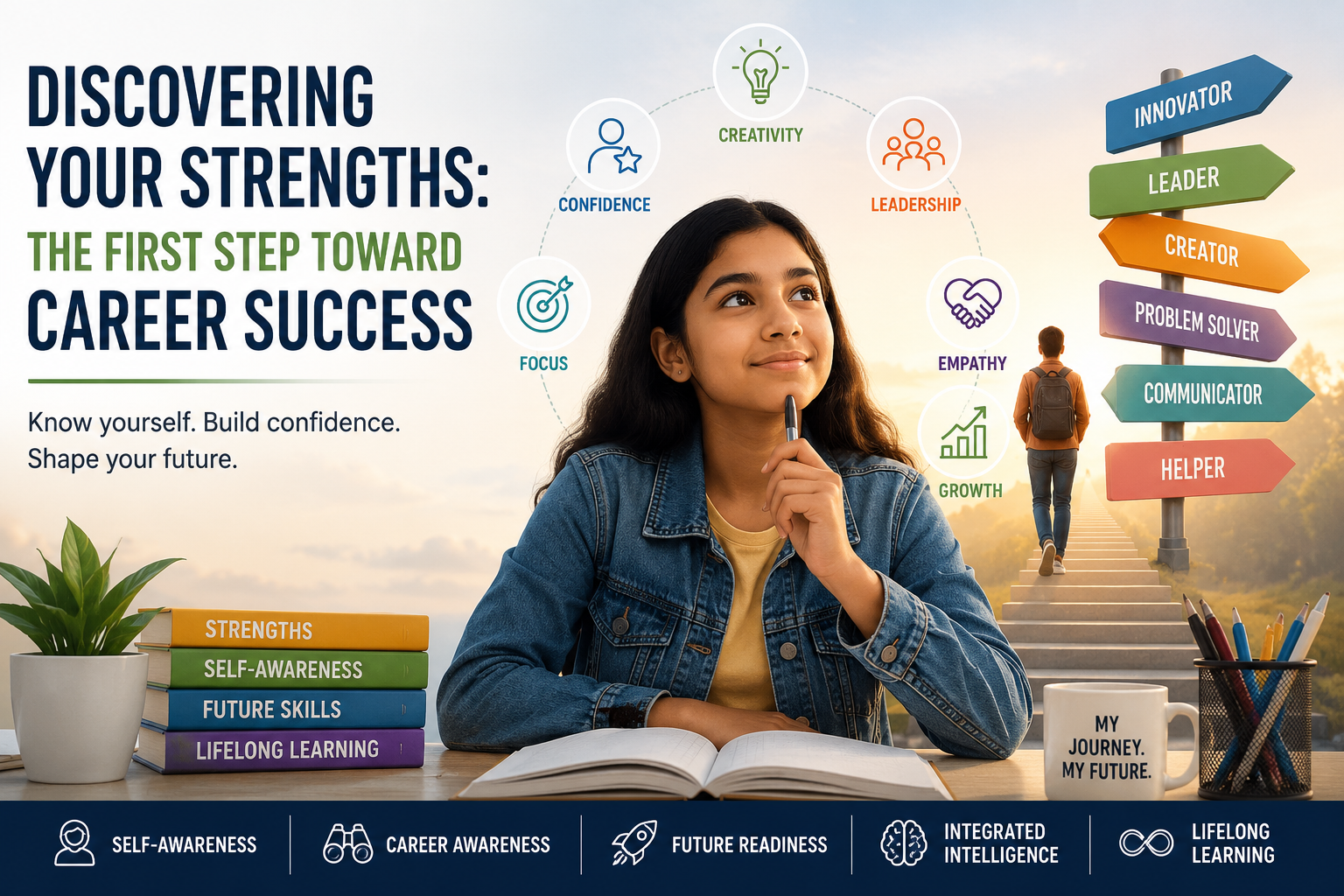
Career success begins with self-awareness. By discovering their strengths, students can build confidence, make informed decisions, and prepare for a future full of opportunities. This article explores how understanding strengths can support learning, career planning, and lifelong growth.
Many students are asked an important question long before they are ready to answer it:
“What do you want to become when you grow up?”
Some answer confidently. Many feel uncertain. Others change their answers every few months.
The challenge is that career decisions are often approached from the outside-in—focusing on jobs, courses, marks, or market trends. However, meaningful career planning begins from the inside-out.
Before exploring careers, students must first understand themselves.
What are their strengths?
What comes naturally to them?
What energizes them?
What kinds of challenges do they enjoy solving?
At SkiillNext, self-awareness is considered the foundation of career awareness, future readiness, integrated intelligence, and lifelong learning. Research consistently shows that individuals who understand their strengths tend to demonstrate greater confidence, engagement, resilience, academic success, and career satisfaction.
In a world being transformed by artificial intelligence, automation, and rapid change, knowing your strengths may become one of the most valuable advantages you can develop.
This article explores why discovering strengths matters, how students can identify them, and how parents can support the journey.
This topic directly aligns with SkiillNext’s focus on Self-Awareness, Career Guidance, Future Skills, Learning & Education, and Human Development.
For decades, educational success was often measured by marks, grades, and examinations.
Today, the world demands much more.
Employers increasingly value:
These capabilities develop differently in different individuals.
Two students with similar grades may have completely different strengths and future pathways.
One may excel at design thinking.
Another may thrive in leadership roles.
A third may possess strong analytical abilities.
A fourth may be highly empathetic and suited to helping professions.
Understanding these differences early helps students make better educational and career decisions.
Without self-awareness, students often:
Strength discovery is therefore not a luxury. It is becoming a necessity.
Many people confuse strengths with skills.
They are related but different.
Strengths are natural patterns of thinking, feeling, and behaving that can be developed into consistent performance.
Examples:
Skills are learned abilities.
Examples:
A student may learn a skill, but when that skill aligns with a natural strength, performance and enjoyment often increase dramatically.
For example:
A student with natural curiosity may enjoy research.
A student with strong communication abilities may enjoy debating.
A student with creativity may excel in design, storytelling, or innovation.
The objective is not to identify one “best” strength.
The objective is to understand the unique combination of strengths that make each individual different.
Reality:
Every student possesses strengths.
Academic achievement is only one form of capability.
Many successful individuals were not top-ranked students.
Reality:
Core tendencies may remain stable, but strengths develop and evolve through experience.
Reality:
Marks measure only a limited set of abilities.
They rarely capture creativity, emotional intelligence, leadership, adaptability, or resilience.
Reality:
Human diversity is valuable.
Different strengths create different contributions.
Reality:
Success usually results from a combination of:
Ask:
Energy often provides clues about strengths.
Consider:
These may indicate natural strengths.
Think about:
What contributed to those successes?
Parents, teachers, friends, and mentors often notice strengths that students overlook.
Questions to ask:
Well-designed assessments can help students understand:
Assessments should support self-discovery rather than label individuals.
Students discover strengths through experiences.
Try:
Exploration creates awareness.
Tasks that rely solely on repetition are increasingly being automated.
Human strengths such as creativity, empathy, judgment, and critical thinking are becoming more valuable.
Future professionals may have multiple careers throughout their lives.
Understanding strengths helps individuals adapt to changing opportunities.
Education is gradually moving away from one-size-fits-all approaches.
Strength-based development supports personalized growth.
Global workforce studies increasingly emphasize:
These capabilities often emerge from underlying strengths.
Tasks that rely solely on repetition are increasingly being automated.
Human strengths such as creativity, empathy, judgment, and critical thinking are becoming more valuable.
Future professionals may have multiple careers throughout their lives.
Understanding strengths helps individuals adapt to changing opportunities.
Education is gradually moving away from one-size-fits-all approaches.
Strength-based development supports personalized growth.
Global workforce studies increasingly emphasize:
These capabilities often emerge from underlying strengths.
The future workplace will reward people who can:
Technical knowledge alone may become insufficient.
Students who understand their strengths can:
Strength awareness is becoming a future-readiness advantage.
If you are a student, remember:
You do not need to have your entire future figured out.
Instead, focus on understanding yourself.
Ask:
Career planning begins with self-discovery.
The goal is progress, not perfection.
Parents play a crucial role in helping children discover strengths.
However, support should focus on observation rather than expectation.
Every child develops differently.
A strength-focused approach helps children build confidence and ownership of their growth.
Across the world, education and careers are changing faster than ever before. New technologies, emerging industries, and evolving ways of working mean that students are preparing for opportunities that may not even exist today. In this environment, understanding your strengths becomes a powerful advantage. Students who know what energizes them, motivates them, and helps them perform at their best are better equipped to navigate uncertainty and adapt to change.
Many students begin by asking, “Which career should I choose?” A more valuable question is, “Who am I becoming?” Career decisions are most effective when they are built on self-awareness. Understanding your strengths helps you identify learning pathways, explore suitable opportunities, and make decisions with greater confidence rather than simply following trends, expectations, or peer influence.
Natural strengths become truly valuable when they are developed into capabilities. Curiosity can become research expertise. Creativity can become innovation. Communication can become leadership. Empathy can become the ability to support and influence others. Future-ready individuals continuously transform their strengths into skills, competencies, and meaningful contributions.
The future belongs not only to those who know more, but also to those who can think critically, collaborate effectively, adapt continuously, and learn throughout life. At SkiillNext, this is called Integrated Intelligence—the ability to combine knowledge, emotional awareness, communication, problem-solving, and lifelong learning to navigate an increasingly complex world.
Strength discovery is not a one-time activity. It is an ongoing journey of reflection, learning, experimentation, and growth. As students gain new experiences, their understanding of themselves deepens. The goal is not to find a perfect career path but to develop the self-awareness, confidence, and adaptability needed to create a meaningful and successful future in a constantly changing world.
In an increasingly complex and rapidly changing world, students do not need more pressure to choose the “perfect” career. They need better understanding of themselves.
Discovering strengths is not about finding a single talent or predicting a fixed future. It is about building self-awareness, confidence, direction, and adaptability.
When students understand who they are, they can make more informed educational choices, develop relevant capabilities, and prepare for opportunities that may not even exist today.
The first step toward career success is not choosing a profession.
The first step is discovering yourself.
And that journey begins with understanding your strengths.
Strengths are natural tendencies, while skills are learned abilities. Skills often grow faster when aligned with strengths.
Strength discovery can begin in primary school and continue throughout life. Grades 6–12 are particularly important years for self-awareness development.
Yes. While some natural tendencies remain consistent, strengths evolve through learning, experiences, and practice.
Marks provide useful information but do not capture all strengths such as creativity, empathy, leadership, resilience, or communication.
Parents can observe behaviors, encourage exploration, provide feedback, and create opportunities for diverse experiences.
When professionally administered and interpreted, psychometric assessments can provide valuable insights into interests, personality, abilities, and potential development areas.
Strengths help individuals learn effectively, adapt to change, build confidence, and make more informed educational and career decisions.
Start exploring different activities, seek feedback, reflect regularly, and remain open to learning about yourself through experiences.
Many students are asked an important question long before they are ready to answer it:
“What do you want to become when you grow up?”
Some answer confidently. Many feel uncertain. Others change their answers every few months.
The challenge is that career decisions are often approached from the outside-in—focusing on jobs, courses, marks, or market trends. However, meaningful career planning begins from the inside-out.
Before exploring careers, students must first understand themselves.
What are their strengths?
What comes naturally to them?
What energizes them?
What kinds of challenges do they enjoy solving?
At SkiillNext, self-awareness is considered the foundation of career awareness, future readiness, integrated intelligence, and lifelong learning. Research consistently shows that individuals who understand their strengths tend to demonstrate greater confidence, engagement, resilience, academic success, and career satisfaction.
In a world being transformed by artificial intelligence, automation, and rapid change, knowing your strengths may become one of the most valuable advantages you can develop.
This article explores why discovering strengths matters, how students can identify them, and how parents can support the journey.
This topic directly aligns with SkiillNext’s focus on Self-Awareness, Career Guidance, Future Skills, Learning & Education, and Human Development.
For decades, educational success was often measured by marks, grades, and examinations.
Today, the world demands much more.
Employers increasingly value:
These capabilities develop differently in different individuals.
Two students with similar grades may have completely different strengths and future pathways.
One may excel at design thinking.
Another may thrive in leadership roles.
A third may possess strong analytical abilities.
A fourth may be highly empathetic and suited to helping professions.
Understanding these differences early helps students make better educational and career decisions.
Without self-awareness, students often:
Strength discovery is therefore not a luxury. It is becoming a necessity.
Many people confuse strengths with skills.
They are related but different.
Strengths are natural patterns of thinking, feeling, and behaving that can be developed into consistent performance.
Examples:
Skills are learned abilities.
Examples:
A student may learn a skill, but when that skill aligns with a natural strength, performance and enjoyment often increase dramatically.
For example:
A student with natural curiosity may enjoy research.
A student with strong communication abilities may enjoy debating.
A student with creativity may excel in design, storytelling, or innovation.
The objective is not to identify one “best” strength.
The objective is to understand the unique combination of strengths that make each individual different.
Reality:
Every student possesses strengths.
Academic achievement is only one form of capability.
Many successful individuals were not top-ranked students.
Reality:
Core tendencies may remain stable, but strengths develop and evolve through experience.
Reality:
Marks measure only a limited set of abilities.
They rarely capture creativity, emotional intelligence, leadership, adaptability, or resilience.
Reality:
Human diversity is valuable.
Different strengths create different contributions.
Reality:
Success usually results from a combination of:
Ask:
Energy often provides clues about strengths.
Consider:
These may indicate natural strengths.
Think about:
What contributed to those successes?
Parents, teachers, friends, and mentors often notice strengths that students overlook.
Questions to ask:
Well-designed assessments can help students understand:
Assessments should support self-discovery rather than label individuals.
Students discover strengths through experiences.
Try:
Exploration creates awareness.
Tasks that rely solely on repetition are increasingly being automated.
Human strengths such as creativity, empathy, judgment, and critical thinking are becoming more valuable.
Future professionals may have multiple careers throughout their lives.
Understanding strengths helps individuals adapt to changing opportunities.
Education is gradually moving away from one-size-fits-all approaches.
Strength-based development supports personalized growth.
Global workforce studies increasingly emphasize:
These capabilities often emerge from underlying strengths.
Tasks that rely solely on repetition are increasingly being automated.
Human strengths such as creativity, empathy, judgment, and critical thinking are becoming more valuable.
Future professionals may have multiple careers throughout their lives.
Understanding strengths helps individuals adapt to changing opportunities.
Education is gradually moving away from one-size-fits-all approaches.
Strength-based development supports personalized growth.
Global workforce studies increasingly emphasize:
These capabilities often emerge from underlying strengths.
The future workplace will reward people who can:
Technical knowledge alone may become insufficient.
Students who understand their strengths can:
Strength awareness is becoming a future-readiness advantage.
If you are a student, remember:
You do not need to have your entire future figured out.
Instead, focus on understanding yourself.
Ask:
Career planning begins with self-discovery.
The goal is progress, not perfection.
Parents play a crucial role in helping children discover strengths.
However, support should focus on observation rather than expectation.
Every child develops differently.
A strength-focused approach helps children build confidence and ownership of their growth.
Across the world, education and careers are changing faster than ever before. New technologies, emerging industries, and evolving ways of working mean that students are preparing for opportunities that may not even exist today. In this environment, understanding your strengths becomes a powerful advantage. Students who know what energizes them, motivates them, and helps them perform at their best are better equipped to navigate uncertainty and adapt to change.
Many students begin by asking, “Which career should I choose?” A more valuable question is, “Who am I becoming?” Career decisions are most effective when they are built on self-awareness. Understanding your strengths helps you identify learning pathways, explore suitable opportunities, and make decisions with greater confidence rather than simply following trends, expectations, or peer influence.
Natural strengths become truly valuable when they are developed into capabilities. Curiosity can become research expertise. Creativity can become innovation. Communication can become leadership. Empathy can become the ability to support and influence others. Future-ready individuals continuously transform their strengths into skills, competencies, and meaningful contributions.
The future belongs not only to those who know more, but also to those who can think critically, collaborate effectively, adapt continuously, and learn throughout life. At SkiillNext, this is called Integrated Intelligence—the ability to combine knowledge, emotional awareness, communication, problem-solving, and lifelong learning to navigate an increasingly complex world.
Strength discovery is not a one-time activity. It is an ongoing journey of reflection, learning, experimentation, and growth. As students gain new experiences, their understanding of themselves deepens. The goal is not to find a perfect career path but to develop the self-awareness, confidence, and adaptability needed to create a meaningful and successful future in a constantly changing world.
In an increasingly complex and rapidly changing world, students do not need more pressure to choose the “perfect” career. They need better understanding of themselves.
Discovering strengths is not about finding a single talent or predicting a fixed future. It is about building self-awareness, confidence, direction, and adaptability.
When students understand who they are, they can make more informed educational choices, develop relevant capabilities, and prepare for opportunities that may not even exist today.
The first step toward career success is not choosing a profession.
The first step is discovering yourself.
And that journey begins with understanding your strengths.
Strengths are natural tendencies, while skills are learned abilities. Skills often grow faster when aligned with strengths.
Strength discovery can begin in primary school and continue throughout life. Grades 6–12 are particularly important years for self-awareness development.
Yes. While some natural tendencies remain consistent, strengths evolve through learning, experiences, and practice.
Marks provide useful information but do not capture all strengths such as creativity, empathy, leadership, resilience, or communication.
Parents can observe behaviors, encourage exploration, provide feedback, and create opportunities for diverse experiences.
When professionally administered and interpreted, psychometric assessments can provide valuable insights into interests, personality, abilities, and potential development areas.
Strengths help individuals learn effectively, adapt to change, build confidence, and make more informed educational and career decisions.
Start exploring different activities, seek feedback, reflect regularly, and remain open to learning about yourself through experiences.