
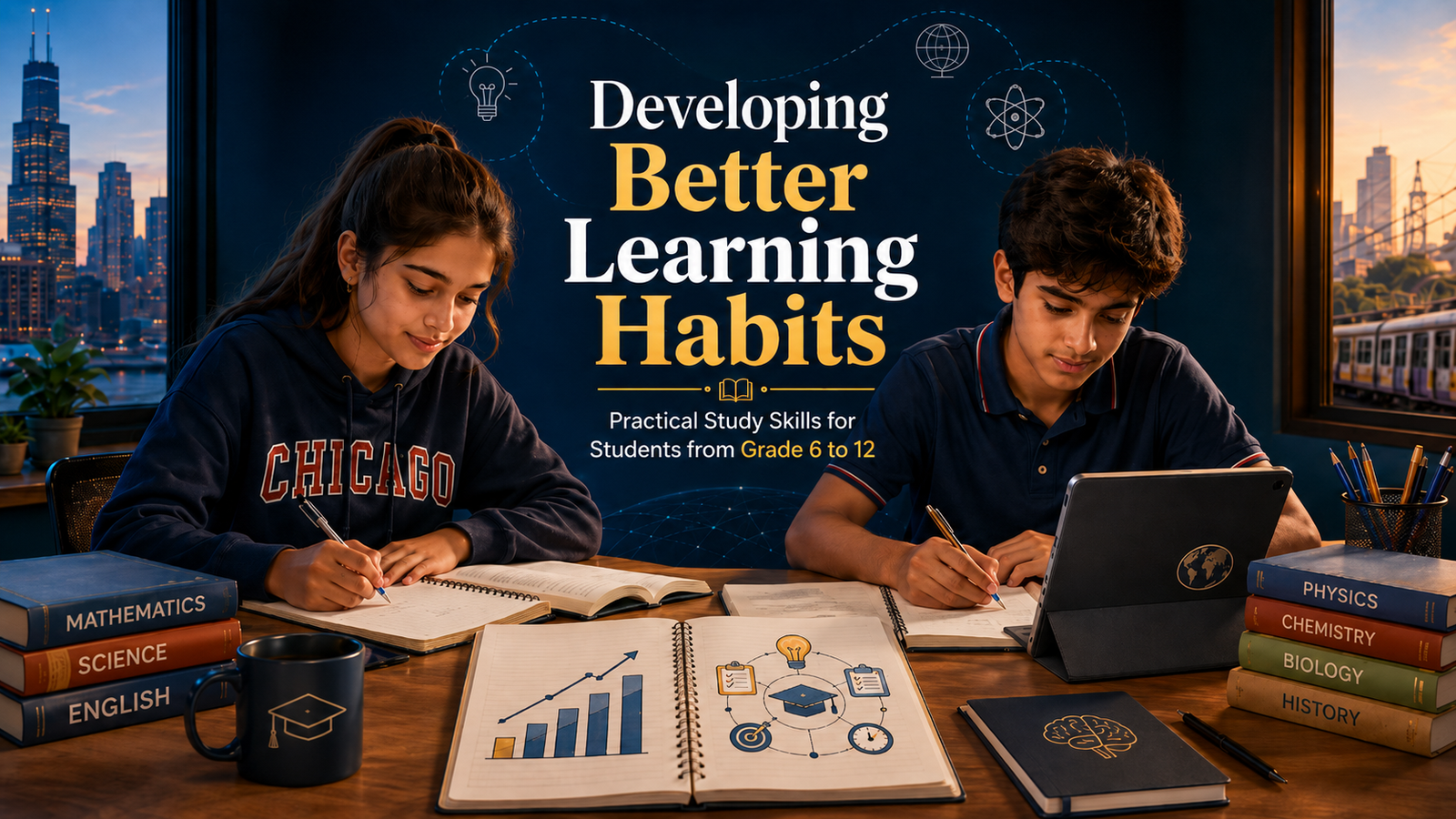
Better learning habits can make studying easier, more meaningful, and more effective. Read this full guide to discover practical ways students can improve focus, revision, confidence, skill development, and lifelong learning—one small habit at a time.
Rose, a Grade 8 student from Chicago, loved science videos but often delayed homework until late evening. Shaan, a Grade 10 student from Mumbai, worked hard, attended coaching classes, made notes, and revised before exams, but still felt confused about why some concepts did not stay in his memory.
They lived in different countries, followed different school systems, and studied in different environments. Yet both faced a similar question:
“How can I learn better, not just study harder?”
This is one of the most important questions for students from Grade 6 to Grade 12.
In middle school, students begin to handle more subjects, more homework, more digital distractions, and more expectations. In secondary and senior secondary classes, the pressure increases with board exams, competitive exams, stream choices, career planning, projects, and future goals.
But successful learning is not only about intelligence. It is about habits.
Research in cognitive and educational psychology suggests that certain learning techniques, especially practice testing and distributed practice, are more effective than passive rereading or last-minute cramming. Good learning habits help students remember better, understand deeper, manage time wisely, and build confidence.
At SkiillNext, learning is seen as part of a larger journey of Knowledge, Integrated Intelligence, and Lifelong Learning—not only for exams, but for life.
Learning habits are the repeated actions students use to understand, practise, revise, and apply knowledge.
They include:
How a student plans study time.
How a student reads a chapter.
How a student takes notes.
How a student revises.
How a student asks questions.
How a student manages distractions.
How a student reflects after mistakes.
How a student connects school learning with real life.
Rose thought learning meant “finishing assignments.” Shaan thought learning meant “studying more hours.” Both were partly right, but incomplete.
Better learning habits are not about sitting with books for long hours. They are about using time and attention effectively.
A student can study for three hours and learn very little if the study is passive. Another student can study for 60 focused minutes and learn deeply if the session includes questioning, recalling, practising, and correcting mistakes.
From Grade 6 onward, students move from basic learning to more independent learning. They are expected to understand concepts, manage multiple subjects, complete projects, prepare for tests, participate in activities, and slowly think about future choices.
In these years, students should build curiosity, reading discipline, basic time management, neat note-making, regular revision, and comfort with asking questions.
Rose’s teacher once told her, “You do not need to become perfect. You need to become regular.” That sentence changed how Rose looked at studying.
Instead of waiting for tests, she began revising for 15 minutes every day. Her confidence improved because she no longer felt surprised before exams.
In India, Grade 9 and 10 are especially important because students begin preparing seriously for board exams and future stream selection. Shaan was in Grade 10, and he often felt pressure from marks, coaching, family expectations, and career discussions.
At this stage, students need stronger habits: planning weekly goals, practising previous questions, understanding mistakes, improving writing speed, and learning how to revise systematically.
In Grade 11 and 12, the academic load becomes deeper. Students may prepare for board exams, entrance exams, international applications, portfolios, skill certifications, internships, or career decisions.
Students at this level need self-regulated learning: setting goals, monitoring progress, changing strategy when something is not working, and balancing academics with well-being. OECD describes self-regulated learning as a process in which students activate and sustain thoughts and behaviours systematically to support learning.
This is where learning habits become future skills.
Rose’s challenge was distraction. She opened her laptop to study, but within 20 minutes she moved from homework to videos, chats, and random browsing.
Shaan’s challenge was overload. He had school, tuition, assignments, tests, and family expectations. He studied a lot, but he rarely paused to ask, “What exactly am I not understanding?”
Rose needed structure. Shaan needed reflection.
Rose began using a simple routine:
First, she wrote one clear study goal.
Then she studied for 25 minutes.
After that, she closed the book and recalled five things from memory.
Finally, she marked what she could not remember.
Shaan began using an error notebook. Every time he made a mistake in mathematics or science, he wrote three things: the question type, the mistake, and the correct method.
Within a few weeks, both noticed something important. Their marks improved slowly, but their confidence improved faster.
That is the power of better learning habits. They change the student’s relationship with learning.
Many students sit to study without knowing what they want to achieve. They say, “I will study science,” or “I will revise maths.” These goals are too broad.
A better goal is specific:
“I will solve 10 algebra questions on linear equations.”
“I will revise the causes of the French Revolution and write five key points.”
“I will practise one unseen passage and check my mistakes.”
“I will learn 15 new biology terms and test myself.”
Clear goals reduce confusion. They help the brain focus.
For Grade 6 to 8 students, goals should be small and visible. For Grade 9 to 12 students, goals should include revision, practice, and performance improvement.
Many students read the same page again and again and believe they are revising. But recognition is not the same as memory.
Active recall means trying to bring information back from memory without looking at the book.
For example:
Close the textbook and explain the concept aloud.
Write what you remember from a chapter.
Make flashcards.
Take a short self-test.
Teach the topic to a friend or parent.
Write possible exam questions.
Research on learning techniques has found practice testing to be one of the more effective strategies for improving student learning.
Rose used active recall after every study session. At first, she remembered only a few points. But after a week, she became faster and more confident.
Active recall works because it trains the brain to retrieve information, not just recognise it.
Cramming may help students remember something for a short time, but it usually does not create strong long-term learning.
Distributed practice means spreading study and revision across days or weeks instead of doing everything at once.
For example, if Shaan had a science test on Friday, he stopped waiting until Thursday night. He revised the chapter for 20 minutes on Monday, practised diagrams on Tuesday, solved questions on Wednesday, and tested himself on Thursday.
This reduced stress and improved memory.
Studies on spacing suggest that spreading learning sessions over time can improve memory strength and retention.
For Indian students preparing for board exams, this habit is especially useful. The syllabus is large, and last-minute revision often creates anxiety. A weekly revision cycle can make preparation calmer and more effective.
A good routine removes the daily debate: “Should I study now or later?”
Students do not need a perfect timetable. They need a realistic rhythm.
A Grade 6 student may begin with 45 to 60 minutes of focused homework and revision. A Grade 9 student may need two focused study blocks. A Grade 12 student may need deeper subject-wise planning.
A practical routine can include:
Schoolwork review
Homework completion
Active recall
Practice questions
Reading time
Skill learning
Breaks
Sleep preparation
The routine should not be overloaded. A tired student does not learn better simply by sitting longer.
The goal is consistency, not punishment.
Good notes are not copied textbooks. They are thinking tools.
Students can use different note formats:
Cornell notes for concepts
Mind maps for chapters
Tables for comparisons
Timelines for history
Formula sheets for mathematics and physics
Vocabulary lists for languages
Error logs for problem-solving subjects
Rose used drawings and arrows for science. Shaan used step-by-step solution notes for mathematics.
Both approaches worked because they helped them process the material.
Students should ask while making notes:
What is the main idea?
What are the key terms?
What example explains this?
What question can come from this?
Where do I get confused?
Notes should make revision easier, not heavier.
Today’s students learn in a digital world. Technology can help learning through videos, simulations, online quizzes, AI tools, dictionaries, coding platforms, and educational apps.
But the same device can also break attention.
Rose realised that her problem was not lack of ability. It was interrupted attention.
She made three changes:
She kept her phone away during study blocks.
She used the laptop only for the task she had written down.
She watched educational videos only after reading the topic once.
Students should use technology as a learning tool, not as a constant interruption.
For Grade 11 and 12 students, digital discipline becomes even more important because entrance preparation, online classes, and self-study often depend on devices.
Many students feel bad after mistakes. Better learners study their mistakes.
Shaan’s error notebook became his biggest improvement tool.
He wrote:
What was the mistake?
Why did it happen?
Was it a concept mistake, calculation mistake, reading mistake, or time-pressure mistake?
How will I avoid it next time?
This helped him see patterns. He realised that many of his errors were not because he “didn’t know maths,” but because he skipped steps under pressure.
Reflection turns mistakes into feedback.
This habit is useful for every class, but especially for Grade 9 to 12 students preparing for exams where accuracy, speed, and presentation matter.
Learning habits should not be limited to textbooks.
Students also need communication, creativity, critical thinking, digital literacy, emotional awareness, collaboration, and adaptability.
India’s National Education Policy 2020 also emphasizes holistic development, flexibility, physical and psychological well-being, and skill-based learning, especially as students move into secondary education.
A Grade 6 student can develop reading and curiosity.
A Grade 7 student can learn presentation and teamwork.
A Grade 8 student can explore coding, art, writing, music, sports, or design.
A Grade 9 student can build problem-solving and self-management.
A Grade 10 student can connect subjects with career interests.
A Grade 11 student can develop deeper subject mastery and future skills.
A Grade 12 student can prepare for academic transitions, career choices, and independent learning.
Better learning habits prepare students not only for marks, but for life.
Many students sacrifice sleep before exams. This may look like dedication, but it can reduce attention, memory, mood, and performance.
The American Academy of Sleep Medicine recommends 9 to 12 hours of sleep for children aged 6 to 12 and 8 to 10 hours for teenagers aged 13 to 18 for optimal health.
Students should treat sleep as part of learning.
A simple evening routine can help:
Finish heavy studying earlier.
Revise lightly before bedtime.
Avoid late-night scrolling.
Pack the school bag in advance.
Sleep at a regular time.
A rested brain learns better than an exhausted brain.
Every student has different strengths, interests, attention patterns, motivation levels, and learning preferences.
Some students understand better through diagrams. Some need discussion. Some like writing. Some learn through examples. Some need movement and activity. Some need quiet.
However, students and parents should be careful with the popular idea that a child has one fixed “learning style” and should only study in that style. Reviews of learning styles research have found weak evidence for matching teaching strictly to a preferred style, and the American Psychological Association has warned that belief in fixed learning styles may be misleading.
A better approach is this:
Know your learning preferences.
Understand your strengths and challenges.
Use different learning strategies depending on the subject.
Develop weaker areas instead of avoiding them.
Take guidance when patterns are unclear.
This is where a psychometric assessment can help—not by putting a student into a box, but by helping the student and parents understand learning tendencies, interests, strengths, motivation, personality patterns, and areas needing support.
SkiillNext encourages students and parents to use psychometric testing as a reflective guidance tool. It can help students understand how they learn, what motivates them, where they may struggle, and what kind of academic and skill-development support may suit them better.
Build reading time, homework discipline, neat notebooks, curiosity, and basic revision.
Start weekly planning, learn note-making, ask questions in class, and practise short self-tests.
Develop independent study blocks, project planning, digital discipline, and concept explanation.
Strengthen subject-wise planning, active recall, writing practice, and error correction.
Use revision calendars, previous questions, mock tests, mistake analysis, and stream-awareness reflection.
Develop deeper subject mastery, long-term planning, skill development, and self-regulated learning.
Balance board preparation, entrance preparation, career planning, stress management, and independent learning.
At SkiillNext, developing better learning habits is not seen as a short-term exam trick. It is part of a student’s growth journey.
A student who learns how to learn can:
Understand subjects better.
Build confidence gradually.
Prepare for exams with less panic.
Explore interests more clearly.
Develop future-ready skills.
Make better academic and career decisions.
Become a lifelong learner.
SkiillNext supports students through a human-centered approach that connects self-awareness, academic growth, career awareness, future readiness, and lifelong learning.
For students like Rose and Shaan, the real breakthrough is not only better marks. It is the moment they begin to say:
“I understand how I learn.”
“I know where I need help.”
“I can improve with the right habits.”
“I can prepare for my future step by step.”
That is where learning becomes empowering.
Parents also play an important role. Instead of asking only, “How many marks did you get?” they can ask:
What did you understand today?
What was difficult?
What strategy helped you?
What mistake taught you something?
What support do you need?
These questions build reflection, not fear.
Rose from Chicago and Shaan from Mumbai did not become better learners because they studied all day. They improved because they changed how they learned.
They planned better.
They revised earlier.
They tested themselves.
They reflected on mistakes.
They protected attention.
They understood their own learning patterns.
They started building skills beyond textbooks.
For students from Grade 6 to Grade 12, better learning habits can create a powerful foundation for academic success, personal confidence, skill development, and future readiness.
Learning is not only about preparing for the next test. It is about preparing for life.
If you are a student, start with one habit today.
If you are a parent, support one habit patiently.
If you feel confused about how you learn best, connect with SkiillNext and consider a psychometric assessment to understand your learning preferences, strengths, interests, and growth areas more clearly.
Better learning begins with better self-understanding.
And better self-understanding can become the first step toward lifelong growth.
Rose, a Grade 8 student from Chicago, loved science videos but often delayed homework until late evening. Shaan, a Grade 10 student from Mumbai, worked hard, attended coaching classes, made notes, and revised before exams, but still felt confused about why some concepts did not stay in his memory.
They lived in different countries, followed different school systems, and studied in different environments. Yet both faced a similar question:
“How can I learn better, not just study harder?”
This is one of the most important questions for students from Grade 6 to Grade 12.
In middle school, students begin to handle more subjects, more homework, more digital distractions, and more expectations. In secondary and senior secondary classes, the pressure increases with board exams, competitive exams, stream choices, career planning, projects, and future goals.
But successful learning is not only about intelligence. It is about habits.
Research in cognitive and educational psychology suggests that certain learning techniques, especially practice testing and distributed practice, are more effective than passive rereading or last-minute cramming. Good learning habits help students remember better, understand deeper, manage time wisely, and build confidence.
At SkiillNext, learning is seen as part of a larger journey of Knowledge, Integrated Intelligence, and Lifelong Learning—not only for exams, but for life.
Learning habits are the repeated actions students use to understand, practise, revise, and apply knowledge.
They include:
How a student plans study time.
How a student reads a chapter.
How a student takes notes.
How a student revises.
How a student asks questions.
How a student manages distractions.
How a student reflects after mistakes.
How a student connects school learning with real life.
Rose thought learning meant “finishing assignments.” Shaan thought learning meant “studying more hours.” Both were partly right, but incomplete.
Better learning habits are not about sitting with books for long hours. They are about using time and attention effectively.
A student can study for three hours and learn very little if the study is passive. Another student can study for 60 focused minutes and learn deeply if the session includes questioning, recalling, practising, and correcting mistakes.
From Grade 6 onward, students move from basic learning to more independent learning. They are expected to understand concepts, manage multiple subjects, complete projects, prepare for tests, participate in activities, and slowly think about future choices.
In these years, students should build curiosity, reading discipline, basic time management, neat note-making, regular revision, and comfort with asking questions.
Rose’s teacher once told her, “You do not need to become perfect. You need to become regular.” That sentence changed how Rose looked at studying.
Instead of waiting for tests, she began revising for 15 minutes every day. Her confidence improved because she no longer felt surprised before exams.
In India, Grade 9 and 10 are especially important because students begin preparing seriously for board exams and future stream selection. Shaan was in Grade 10, and he often felt pressure from marks, coaching, family expectations, and career discussions.
At this stage, students need stronger habits: planning weekly goals, practising previous questions, understanding mistakes, improving writing speed, and learning how to revise systematically.
In Grade 11 and 12, the academic load becomes deeper. Students may prepare for board exams, entrance exams, international applications, portfolios, skill certifications, internships, or career decisions.
Students at this level need self-regulated learning: setting goals, monitoring progress, changing strategy when something is not working, and balancing academics with well-being. OECD describes self-regulated learning as a process in which students activate and sustain thoughts and behaviours systematically to support learning.
This is where learning habits become future skills.
Rose’s challenge was distraction. She opened her laptop to study, but within 20 minutes she moved from homework to videos, chats, and random browsing.
Shaan’s challenge was overload. He had school, tuition, assignments, tests, and family expectations. He studied a lot, but he rarely paused to ask, “What exactly am I not understanding?”
Rose needed structure. Shaan needed reflection.
Rose began using a simple routine:
First, she wrote one clear study goal.
Then she studied for 25 minutes.
After that, she closed the book and recalled five things from memory.
Finally, she marked what she could not remember.
Shaan began using an error notebook. Every time he made a mistake in mathematics or science, he wrote three things: the question type, the mistake, and the correct method.
Within a few weeks, both noticed something important. Their marks improved slowly, but their confidence improved faster.
That is the power of better learning habits. They change the student’s relationship with learning.
Many students sit to study without knowing what they want to achieve. They say, “I will study science,” or “I will revise maths.” These goals are too broad.
A better goal is specific:
“I will solve 10 algebra questions on linear equations.”
“I will revise the causes of the French Revolution and write five key points.”
“I will practise one unseen passage and check my mistakes.”
“I will learn 15 new biology terms and test myself.”
Clear goals reduce confusion. They help the brain focus.
For Grade 6 to 8 students, goals should be small and visible. For Grade 9 to 12 students, goals should include revision, practice, and performance improvement.
Many students read the same page again and again and believe they are revising. But recognition is not the same as memory.
Active recall means trying to bring information back from memory without looking at the book.
For example:
Close the textbook and explain the concept aloud.
Write what you remember from a chapter.
Make flashcards.
Take a short self-test.
Teach the topic to a friend or parent.
Write possible exam questions.
Research on learning techniques has found practice testing to be one of the more effective strategies for improving student learning.
Rose used active recall after every study session. At first, she remembered only a few points. But after a week, she became faster and more confident.
Active recall works because it trains the brain to retrieve information, not just recognise it.
Cramming may help students remember something for a short time, but it usually does not create strong long-term learning.
Distributed practice means spreading study and revision across days or weeks instead of doing everything at once.
For example, if Shaan had a science test on Friday, he stopped waiting until Thursday night. He revised the chapter for 20 minutes on Monday, practised diagrams on Tuesday, solved questions on Wednesday, and tested himself on Thursday.
This reduced stress and improved memory.
Studies on spacing suggest that spreading learning sessions over time can improve memory strength and retention.
For Indian students preparing for board exams, this habit is especially useful. The syllabus is large, and last-minute revision often creates anxiety. A weekly revision cycle can make preparation calmer and more effective.
A good routine removes the daily debate: “Should I study now or later?”
Students do not need a perfect timetable. They need a realistic rhythm.
A Grade 6 student may begin with 45 to 60 minutes of focused homework and revision. A Grade 9 student may need two focused study blocks. A Grade 12 student may need deeper subject-wise planning.
A practical routine can include:
Schoolwork review
Homework completion
Active recall
Practice questions
Reading time
Skill learning
Breaks
Sleep preparation
The routine should not be overloaded. A tired student does not learn better simply by sitting longer.
The goal is consistency, not punishment.
Good notes are not copied textbooks. They are thinking tools.
Students can use different note formats:
Cornell notes for concepts
Mind maps for chapters
Tables for comparisons
Timelines for history
Formula sheets for mathematics and physics
Vocabulary lists for languages
Error logs for problem-solving subjects
Rose used drawings and arrows for science. Shaan used step-by-step solution notes for mathematics.
Both approaches worked because they helped them process the material.
Students should ask while making notes:
What is the main idea?
What are the key terms?
What example explains this?
What question can come from this?
Where do I get confused?
Notes should make revision easier, not heavier.
Today’s students learn in a digital world. Technology can help learning through videos, simulations, online quizzes, AI tools, dictionaries, coding platforms, and educational apps.
But the same device can also break attention.
Rose realised that her problem was not lack of ability. It was interrupted attention.
She made three changes:
She kept her phone away during study blocks.
She used the laptop only for the task she had written down.
She watched educational videos only after reading the topic once.
Students should use technology as a learning tool, not as a constant interruption.
For Grade 11 and 12 students, digital discipline becomes even more important because entrance preparation, online classes, and self-study often depend on devices.
Many students feel bad after mistakes. Better learners study their mistakes.
Shaan’s error notebook became his biggest improvement tool.
He wrote:
What was the mistake?
Why did it happen?
Was it a concept mistake, calculation mistake, reading mistake, or time-pressure mistake?
How will I avoid it next time?
This helped him see patterns. He realised that many of his errors were not because he “didn’t know maths,” but because he skipped steps under pressure.
Reflection turns mistakes into feedback.
This habit is useful for every class, but especially for Grade 9 to 12 students preparing for exams where accuracy, speed, and presentation matter.
Learning habits should not be limited to textbooks.
Students also need communication, creativity, critical thinking, digital literacy, emotional awareness, collaboration, and adaptability.
India’s National Education Policy 2020 also emphasizes holistic development, flexibility, physical and psychological well-being, and skill-based learning, especially as students move into secondary education.
A Grade 6 student can develop reading and curiosity.
A Grade 7 student can learn presentation and teamwork.
A Grade 8 student can explore coding, art, writing, music, sports, or design.
A Grade 9 student can build problem-solving and self-management.
A Grade 10 student can connect subjects with career interests.
A Grade 11 student can develop deeper subject mastery and future skills.
A Grade 12 student can prepare for academic transitions, career choices, and independent learning.
Better learning habits prepare students not only for marks, but for life.
Many students sacrifice sleep before exams. This may look like dedication, but it can reduce attention, memory, mood, and performance.
The American Academy of Sleep Medicine recommends 9 to 12 hours of sleep for children aged 6 to 12 and 8 to 10 hours for teenagers aged 13 to 18 for optimal health.
Students should treat sleep as part of learning.
A simple evening routine can help:
Finish heavy studying earlier.
Revise lightly before bedtime.
Avoid late-night scrolling.
Pack the school bag in advance.
Sleep at a regular time.
A rested brain learns better than an exhausted brain.
Every student has different strengths, interests, attention patterns, motivation levels, and learning preferences.
Some students understand better through diagrams. Some need discussion. Some like writing. Some learn through examples. Some need movement and activity. Some need quiet.
However, students and parents should be careful with the popular idea that a child has one fixed “learning style” and should only study in that style. Reviews of learning styles research have found weak evidence for matching teaching strictly to a preferred style, and the American Psychological Association has warned that belief in fixed learning styles may be misleading.
A better approach is this:
Know your learning preferences.
Understand your strengths and challenges.
Use different learning strategies depending on the subject.
Develop weaker areas instead of avoiding them.
Take guidance when patterns are unclear.
This is where a psychometric assessment can help—not by putting a student into a box, but by helping the student and parents understand learning tendencies, interests, strengths, motivation, personality patterns, and areas needing support.
SkiillNext encourages students and parents to use psychometric testing as a reflective guidance tool. It can help students understand how they learn, what motivates them, where they may struggle, and what kind of academic and skill-development support may suit them better.
Build reading time, homework discipline, neat notebooks, curiosity, and basic revision.
Start weekly planning, learn note-making, ask questions in class, and practise short self-tests.
Develop independent study blocks, project planning, digital discipline, and concept explanation.
Strengthen subject-wise planning, active recall, writing practice, and error correction.
Use revision calendars, previous questions, mock tests, mistake analysis, and stream-awareness reflection.
Develop deeper subject mastery, long-term planning, skill development, and self-regulated learning.
Balance board preparation, entrance preparation, career planning, stress management, and independent learning.
At SkiillNext, developing better learning habits is not seen as a short-term exam trick. It is part of a student’s growth journey.
A student who learns how to learn can:
Understand subjects better.
Build confidence gradually.
Prepare for exams with less panic.
Explore interests more clearly.
Develop future-ready skills.
Make better academic and career decisions.
Become a lifelong learner.
SkiillNext supports students through a human-centered approach that connects self-awareness, academic growth, career awareness, future readiness, and lifelong learning.
For students like Rose and Shaan, the real breakthrough is not only better marks. It is the moment they begin to say:
“I understand how I learn.”
“I know where I need help.”
“I can improve with the right habits.”
“I can prepare for my future step by step.”
That is where learning becomes empowering.
Parents also play an important role. Instead of asking only, “How many marks did you get?” they can ask:
What did you understand today?
What was difficult?
What strategy helped you?
What mistake taught you something?
What support do you need?
These questions build reflection, not fear.
Rose from Chicago and Shaan from Mumbai did not become better learners because they studied all day. They improved because they changed how they learned.
They planned better.
They revised earlier.
They tested themselves.
They reflected on mistakes.
They protected attention.
They understood their own learning patterns.
They started building skills beyond textbooks.
For students from Grade 6 to Grade 12, better learning habits can create a powerful foundation for academic success, personal confidence, skill development, and future readiness.
Learning is not only about preparing for the next test. It is about preparing for life.
If you are a student, start with one habit today.
If you are a parent, support one habit patiently.
If you feel confused about how you learn best, connect with SkiillNext and consider a psychometric assessment to understand your learning preferences, strengths, interests, and growth areas more clearly.
Better learning begins with better self-understanding.
And better self-understanding can become the first step toward lifelong growth.