
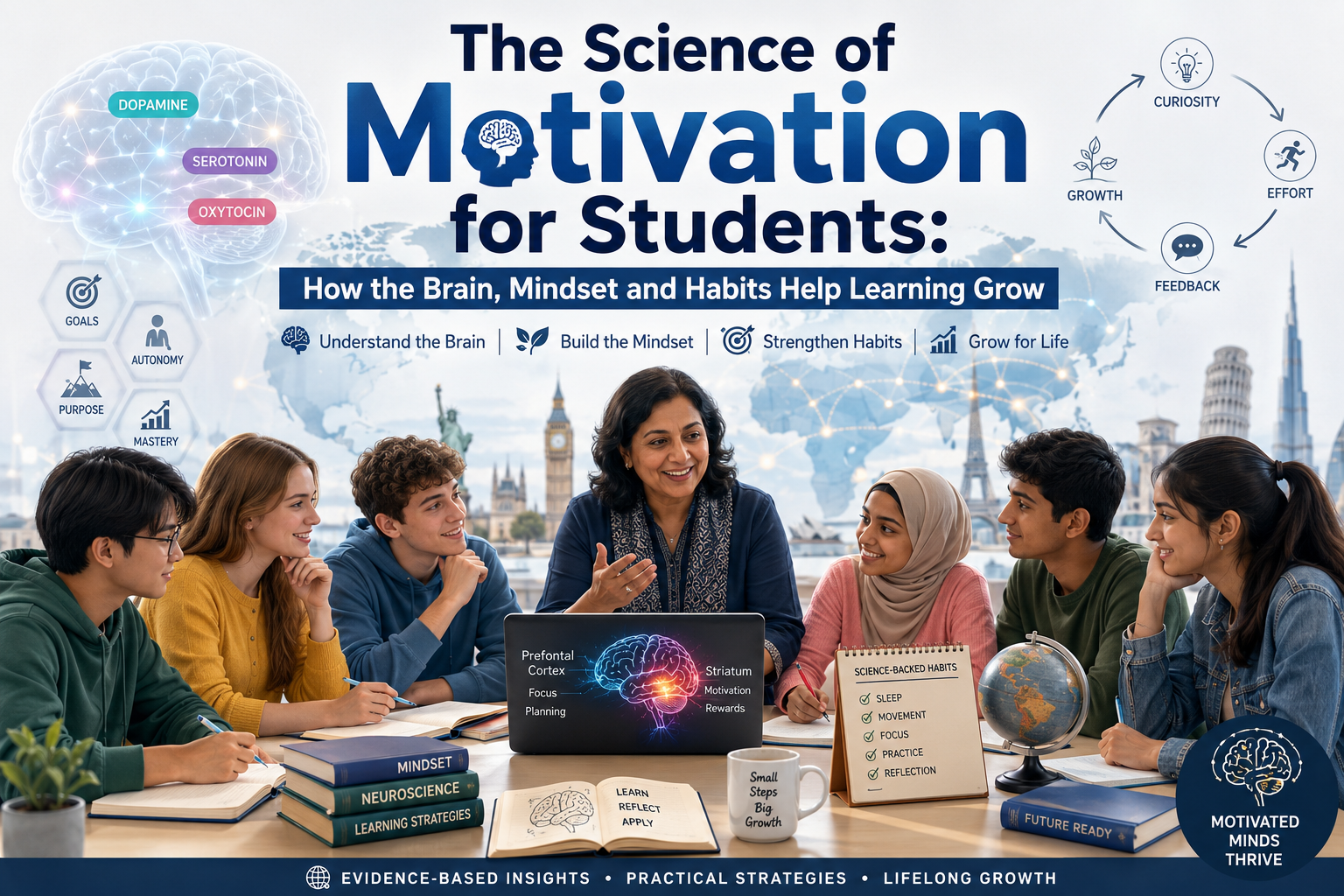
Understanding motivation can help students study with more clarity, confidence, and consistency. Read this full blog to discover simple brain-based strategies that make learning feel more meaningful, manageable, and growth-focused.
Every student has heard advice like “work harder,” “stay focused,” or “be motivated.” Parents also worry when a child loses interest in studies, avoids assignments, delays revision, or says, “I don’t feel like studying.”
But motivation is not a switch that students can simply turn on. It is a combination of brain chemistry, emotions, belief, purpose, habits, environment, confidence, and support. Some days motivation feels strong. Some days it feels low. That is normal.
The good news is that motivation can be understood and developed. Students do not need to wait for inspiration. They can learn how motivation works and use simple strategies to make learning easier to begin, easier to continue, and more meaningful.
For parents, this understanding is equally important. Motivation grows better through clarity, encouragement, structure, and trust than through fear, comparison, or constant pressure. Across the world, whether a student is preparing for school exams, competitive tests, college admission, skill development, or personal growth, the basic science remains similar: the brain learns better when it feels safe, purposeful, capable, and supported.
Motivation is the inner drive that helps a student start, continue, and complete a task. It answers three important questions:
Why should I do this?
Can I do this?
How do I begin?
Many students think motivation means feeling excited all the time. That is not true. Real motivation is not always emotional excitement. Often, it is a quiet commitment to take the next step even when the task feels difficult.
There are two broad types of motivation.
External motivation comes from outside: marks, grades, rewards, praise, deadlines, competitions, or fear of consequences. It can help students start, especially for routine tasks.
Internal motivation comes from inside: curiosity, personal goals, interest, meaning, self-improvement, and the satisfaction of progress. This type of motivation is usually more sustainable.
Students need both. Marks and deadlines matter, but they should not be the only reason to learn. When students connect learning with personal growth, future possibilities, confidence, and self-respect, motivation becomes deeper.
Self-Determination Theory, a widely used motivation framework in education, explains that learners are more positively involved when three psychological needs are supported: autonomy, competence, and relatedness. In simple words, students feel more motivated when they have some choice, feel capable of improving, and feel supported by people around them.
Neuroscience helps us understand why starting a task can feel hard and why small progress can build momentum.
One important brain chemical involved in motivation is dopamine. Many people call dopamine the “pleasure chemical,” but that is too simple. Dopamine is also involved in reward, learning, attention, memory, and motivation.
Think of dopamine as part of the brain’s “this may be worth doing” system. When a student expects progress, solves a problem, finishes a small task, or receives useful feedback, the brain gets a signal that the effort has value. This does not mean students should chase constant rewards. It means progress should be visible.
That is why small wins matter.
A student who says, “I will study science for three hours,” may feel overwhelmed. But a student who says, “I will revise one diagram and answer five questions,” gives the brain a clear and achievable target. Once the first step is completed, the next step becomes easier.
In neuroscience, learning is also connected with prediction and feedback. The brain keeps comparing what it expected with what actually happened. Research on reward prediction error shows that the brain learns from the difference between expected and received outcomes. For students, this means feedback is powerful when it helps them understand: “What did I expect? What happened? What should I try next?”
Practical takeaway: motivation grows when students can see progress. Use checklists, short study goals, practice scores, revision trackers, or “today I improved in…” notes. Progress should not be measured only by final marks.
A student’s motivation grows when three needs are nourished.
Autonomy does not mean students do whatever they want. It means they feel some ownership. For example, a parent may say, “You need to complete mathematics practice today. Would you like to do it before dinner or after a 30-minute break?” This gives structure and choice.
Students can build autonomy by choosing study order, revision methods, note-making styles, practice timing, or learning goals. Choice increases ownership.
Many students lose motivation not because they are lazy, but because they feel ineffective. When a subject feels too difficult, the brain may start avoiding it to protect the student from discomfort.
Competence grows through the right level of challenge. If work is too easy, students get bored. If it is too hard, they may feel defeated. The best learning zone is slightly challenging but manageable with effort, strategy, and support.
Parents and teachers can support competence by praising strategy, consistency, correction, and improvement — not only marks.
Students are not machines. Motivation is deeply social. A child who feels judged, compared, or constantly criticized may become defensive. A child who feels seen and supported is more likely to try again.
Relatedness does not mean lowering expectations. It means combining expectations with warmth. The message should be: “We believe in your growth, and we will help you build the process.”
One of the most encouraging ideas in learning science is neuroplasticity. In simple words, the brain changes with experience. When students practise, make mistakes, correct them, and try again, the brain strengthens useful connections.
This is closely linked with growth mindset — the belief that abilities can improve through effort, better strategies, feedback, and practice. A growth mindset does not mean “anyone can become anything instantly.” It means improvement is possible when effort is guided properly.
Research reviews connect growth mindset and intrinsic motivation with learning, resilience, effort, and academic engagement. A large study published in Nature found that a short growth mindset intervention improved grades among lower-achieving students and increased overall enrolment in advanced mathematics courses in a nationally representative sample of students in U.S. secondary education.
For students, the message is powerful: difficulty is not proof that you are incapable. Difficulty is often a signal that your brain is working on something new.
Instead of saying:
“I am bad at maths.”
Try:
“I have not yet mastered this topic. What strategy should I try next?”
Instead of saying:
“I made mistakes, so I failed.”
Try:
“My mistakes are giving me information about what to practise.”
This language matters. The brain responds differently when a challenge is seen as a threat versus when it is seen as a learning opportunity.
Motivation is not only psychological. It is also biological.
A student who sleeps poorly, eats irregularly, sits with digital distractions, and studies only under pressure will naturally struggle to feel motivated. The brain needs energy, rest, and rhythm.
Sleep is especially important. The CDC notes that adequate sleep helps students stay focused, improve concentration, and support academic performance. It also lists recommended sleep ranges of 9–12 hours for ages 6–12 and 8–10 hours for ages 13–18.
Stress also affects motivation. A little stress can help students prepare and act, but too much stress can harm concentration, sleep, mood, and confidence. The World Health Organization explains that stress is a natural human response to challenges, but excessive stress can affect the mind and body and make concentration difficult.
This is why motivation should not be built only around pressure. Students need a stable routine that includes study, rest, movement, recreation, sleep, and emotional support.
Effective study habits also reduce motivational struggle. Spaced practice — studying over time with breaks between sessions — is more useful for long-term learning than last-minute cramming. Indiana University’s teaching resource explains that spaced practice helps students revisit key concepts and move information from working memory toward long-term memory.
Practical takeaway: when the system improves, motivation improves. A student does not need perfect discipline. They need repeatable routines.
Parents play a major role in shaping a student’s motivational environment. The goal is not to push every moment. The goal is to create a home climate where effort, reflection, and improvement are normal.
Here are practical ways parents can help:
Ask process-based questions.
Instead of “How many marks did you get?” ask “What did you understand better this week?” or “Which mistake helped you learn something?”
Avoid comparison.
Comparison may create short-term pressure but often weakens self-belief. Compare the student with their own previous effort, not with siblings, cousins, classmates, or neighbours.
Create structure, not control.
A daily routine, study space, device boundaries, sleep rhythm, and revision plan help motivation. But excessive control can reduce ownership.
Celebrate effort with strategy.
Do not only say, “Good job.” Say, “Your revision plan worked because you practised questions before the test.”
Normalize difficulty.
Parents can say, “It is okay that this chapter feels difficult. Let us break it into smaller parts.”
Listen before advising.
Sometimes a student’s lack of motivation hides confusion, fear, tiredness, boredom, or lack of direction. Listening helps identify the real issue.
Motivation improves when students feel guided, not judged.
At SkiillNext, motivation is not seen as a temporary emotional boost. It is seen as part of a student’s long-term growth system.
Students should understand how learning works. When they know that the brain grows through practice, feedback, sleep, and repetition, they stop seeing difficulty as personal failure.
Motivation is not only about academics. It includes emotional intelligence, self-awareness, habits, decision-making, environment, purpose, and future readiness. Students need to understand themselves: What energizes me? What distracts me? What goals matter to me? What support do I need?
The world is changing quickly. Students who learn how to motivate themselves, manage effort, recover from setbacks, and keep improving will be better prepared not only for exams, but for careers and life.
A simple SkiillNext motivation framework for students:
This approach turns motivation from a feeling into a learnable life skill.
Motivation is not a mystery and it is not limited to naturally “bright” or “disciplined” students. It is a skillful combination of brain-friendly learning, emotional safety, meaningful goals, visible progress, supportive relationships, and healthy routines.
Students can build motivation by starting small, tracking progress, learning from mistakes, protecting sleep, and connecting studies with personal growth. Parents can support motivation by creating structure, encouraging effort, avoiding comparison, and helping children feel capable of improvement.
The most powerful message for every student is this: you do not need to wait to feel motivated before you begin. Begin with one small step, and motivation will often meet you on the way.
At SkiillNext, the purpose of motivation is not only better marks. It is clarity, confidence, future readiness, and lifelong growth — through Knowledge, Integrated Intelligence, and Lifelong Learning.
Every student has heard advice like “work harder,” “stay focused,” or “be motivated.” Parents also worry when a child loses interest in studies, avoids assignments, delays revision, or says, “I don’t feel like studying.”
But motivation is not a switch that students can simply turn on. It is a combination of brain chemistry, emotions, belief, purpose, habits, environment, confidence, and support. Some days motivation feels strong. Some days it feels low. That is normal.
The good news is that motivation can be understood and developed. Students do not need to wait for inspiration. They can learn how motivation works and use simple strategies to make learning easier to begin, easier to continue, and more meaningful.
For parents, this understanding is equally important. Motivation grows better through clarity, encouragement, structure, and trust than through fear, comparison, or constant pressure. Across the world, whether a student is preparing for school exams, competitive tests, college admission, skill development, or personal growth, the basic science remains similar: the brain learns better when it feels safe, purposeful, capable, and supported.
Motivation is the inner drive that helps a student start, continue, and complete a task. It answers three important questions:
Why should I do this?
Can I do this?
How do I begin?
Many students think motivation means feeling excited all the time. That is not true. Real motivation is not always emotional excitement. Often, it is a quiet commitment to take the next step even when the task feels difficult.
There are two broad types of motivation.
External motivation comes from outside: marks, grades, rewards, praise, deadlines, competitions, or fear of consequences. It can help students start, especially for routine tasks.
Internal motivation comes from inside: curiosity, personal goals, interest, meaning, self-improvement, and the satisfaction of progress. This type of motivation is usually more sustainable.
Students need both. Marks and deadlines matter, but they should not be the only reason to learn. When students connect learning with personal growth, future possibilities, confidence, and self-respect, motivation becomes deeper.
Self-Determination Theory, a widely used motivation framework in education, explains that learners are more positively involved when three psychological needs are supported: autonomy, competence, and relatedness. In simple words, students feel more motivated when they have some choice, feel capable of improving, and feel supported by people around them.
Neuroscience helps us understand why starting a task can feel hard and why small progress can build momentum.
One important brain chemical involved in motivation is dopamine. Many people call dopamine the “pleasure chemical,” but that is too simple. Dopamine is also involved in reward, learning, attention, memory, and motivation.
Think of dopamine as part of the brain’s “this may be worth doing” system. When a student expects progress, solves a problem, finishes a small task, or receives useful feedback, the brain gets a signal that the effort has value. This does not mean students should chase constant rewards. It means progress should be visible.
That is why small wins matter.
A student who says, “I will study science for three hours,” may feel overwhelmed. But a student who says, “I will revise one diagram and answer five questions,” gives the brain a clear and achievable target. Once the first step is completed, the next step becomes easier.
In neuroscience, learning is also connected with prediction and feedback. The brain keeps comparing what it expected with what actually happened. Research on reward prediction error shows that the brain learns from the difference between expected and received outcomes. For students, this means feedback is powerful when it helps them understand: “What did I expect? What happened? What should I try next?”
Practical takeaway: motivation grows when students can see progress. Use checklists, short study goals, practice scores, revision trackers, or “today I improved in…” notes. Progress should not be measured only by final marks.
A student’s motivation grows when three needs are nourished.
Autonomy does not mean students do whatever they want. It means they feel some ownership. For example, a parent may say, “You need to complete mathematics practice today. Would you like to do it before dinner or after a 30-minute break?” This gives structure and choice.
Students can build autonomy by choosing study order, revision methods, note-making styles, practice timing, or learning goals. Choice increases ownership.
Many students lose motivation not because they are lazy, but because they feel ineffective. When a subject feels too difficult, the brain may start avoiding it to protect the student from discomfort.
Competence grows through the right level of challenge. If work is too easy, students get bored. If it is too hard, they may feel defeated. The best learning zone is slightly challenging but manageable with effort, strategy, and support.
Parents and teachers can support competence by praising strategy, consistency, correction, and improvement — not only marks.
Students are not machines. Motivation is deeply social. A child who feels judged, compared, or constantly criticized may become defensive. A child who feels seen and supported is more likely to try again.
Relatedness does not mean lowering expectations. It means combining expectations with warmth. The message should be: “We believe in your growth, and we will help you build the process.”
One of the most encouraging ideas in learning science is neuroplasticity. In simple words, the brain changes with experience. When students practise, make mistakes, correct them, and try again, the brain strengthens useful connections.
This is closely linked with growth mindset — the belief that abilities can improve through effort, better strategies, feedback, and practice. A growth mindset does not mean “anyone can become anything instantly.” It means improvement is possible when effort is guided properly.
Research reviews connect growth mindset and intrinsic motivation with learning, resilience, effort, and academic engagement. A large study published in Nature found that a short growth mindset intervention improved grades among lower-achieving students and increased overall enrolment in advanced mathematics courses in a nationally representative sample of students in U.S. secondary education.
For students, the message is powerful: difficulty is not proof that you are incapable. Difficulty is often a signal that your brain is working on something new.
Instead of saying:
“I am bad at maths.”
Try:
“I have not yet mastered this topic. What strategy should I try next?”
Instead of saying:
“I made mistakes, so I failed.”
Try:
“My mistakes are giving me information about what to practise.”
This language matters. The brain responds differently when a challenge is seen as a threat versus when it is seen as a learning opportunity.
Motivation is not only psychological. It is also biological.
A student who sleeps poorly, eats irregularly, sits with digital distractions, and studies only under pressure will naturally struggle to feel motivated. The brain needs energy, rest, and rhythm.
Sleep is especially important. The CDC notes that adequate sleep helps students stay focused, improve concentration, and support academic performance. It also lists recommended sleep ranges of 9–12 hours for ages 6–12 and 8–10 hours for ages 13–18.
Stress also affects motivation. A little stress can help students prepare and act, but too much stress can harm concentration, sleep, mood, and confidence. The World Health Organization explains that stress is a natural human response to challenges, but excessive stress can affect the mind and body and make concentration difficult.
This is why motivation should not be built only around pressure. Students need a stable routine that includes study, rest, movement, recreation, sleep, and emotional support.
Effective study habits also reduce motivational struggle. Spaced practice — studying over time with breaks between sessions — is more useful for long-term learning than last-minute cramming. Indiana University’s teaching resource explains that spaced practice helps students revisit key concepts and move information from working memory toward long-term memory.
Practical takeaway: when the system improves, motivation improves. A student does not need perfect discipline. They need repeatable routines.
Parents play a major role in shaping a student’s motivational environment. The goal is not to push every moment. The goal is to create a home climate where effort, reflection, and improvement are normal.
Here are practical ways parents can help:
Ask process-based questions.
Instead of “How many marks did you get?” ask “What did you understand better this week?” or “Which mistake helped you learn something?”
Avoid comparison.
Comparison may create short-term pressure but often weakens self-belief. Compare the student with their own previous effort, not with siblings, cousins, classmates, or neighbours.
Create structure, not control.
A daily routine, study space, device boundaries, sleep rhythm, and revision plan help motivation. But excessive control can reduce ownership.
Celebrate effort with strategy.
Do not only say, “Good job.” Say, “Your revision plan worked because you practised questions before the test.”
Normalize difficulty.
Parents can say, “It is okay that this chapter feels difficult. Let us break it into smaller parts.”
Listen before advising.
Sometimes a student’s lack of motivation hides confusion, fear, tiredness, boredom, or lack of direction. Listening helps identify the real issue.
Motivation improves when students feel guided, not judged.
At SkiillNext, motivation is not seen as a temporary emotional boost. It is seen as part of a student’s long-term growth system.
Students should understand how learning works. When they know that the brain grows through practice, feedback, sleep, and repetition, they stop seeing difficulty as personal failure.
Motivation is not only about academics. It includes emotional intelligence, self-awareness, habits, decision-making, environment, purpose, and future readiness. Students need to understand themselves: What energizes me? What distracts me? What goals matter to me? What support do I need?
The world is changing quickly. Students who learn how to motivate themselves, manage effort, recover from setbacks, and keep improving will be better prepared not only for exams, but for careers and life.
A simple SkiillNext motivation framework for students:
This approach turns motivation from a feeling into a learnable life skill.
Motivation is not a mystery and it is not limited to naturally “bright” or “disciplined” students. It is a skillful combination of brain-friendly learning, emotional safety, meaningful goals, visible progress, supportive relationships, and healthy routines.
Students can build motivation by starting small, tracking progress, learning from mistakes, protecting sleep, and connecting studies with personal growth. Parents can support motivation by creating structure, encouraging effort, avoiding comparison, and helping children feel capable of improvement.
The most powerful message for every student is this: you do not need to wait to feel motivated before you begin. Begin with one small step, and motivation will often meet you on the way.
At SkiillNext, the purpose of motivation is not only better marks. It is clarity, confidence, future readiness, and lifelong growth — through Knowledge, Integrated Intelligence, and Lifelong Learning.