
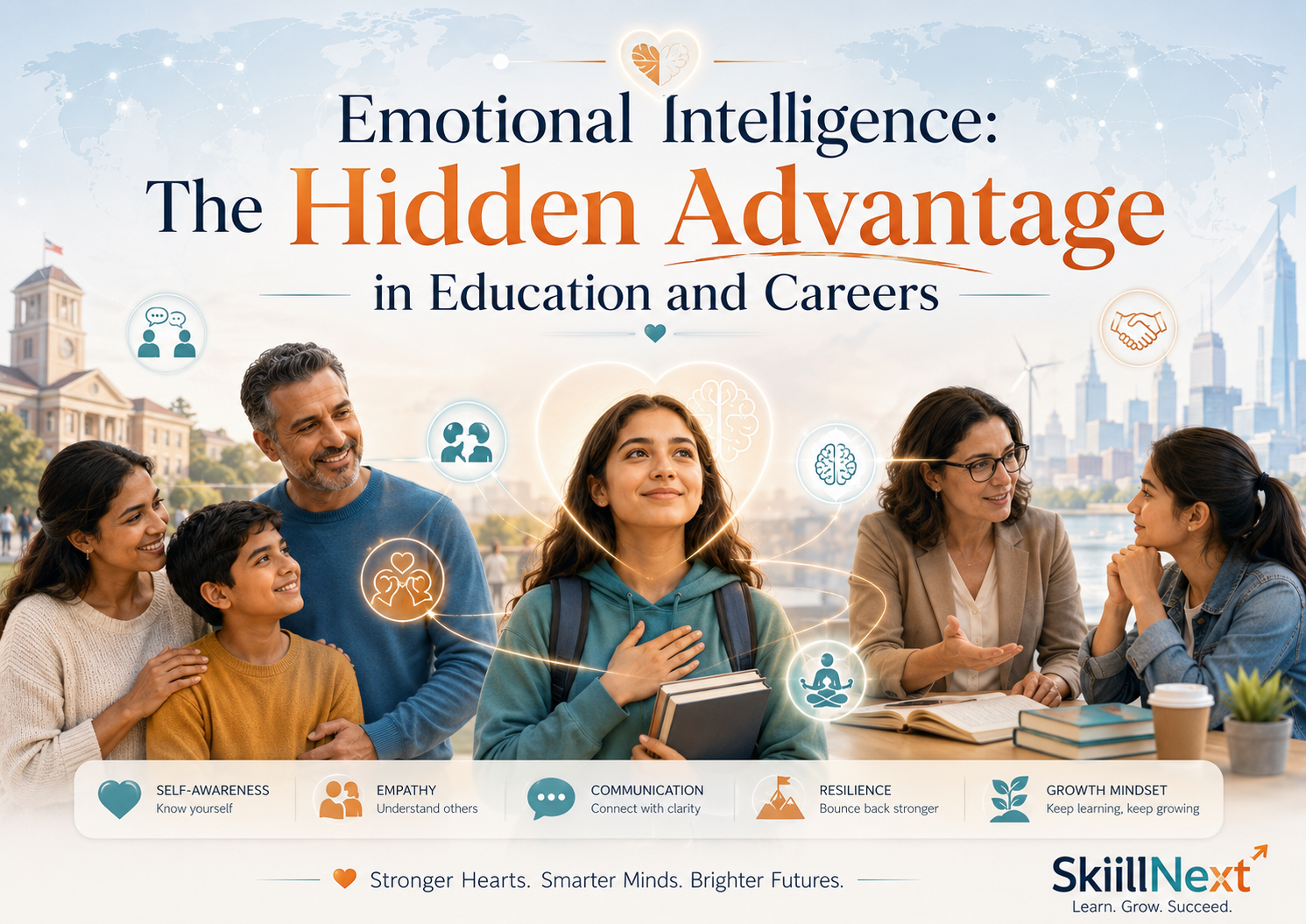
Emotional intelligence quietly shapes how students learn, families support, teachers guide, and future careers grow. Read this full blog to understand how small emotional skills can create lasting confidence, clarity, resilience, and success in education and life.
A student may score well, speak politely, and complete homework on time. Yet, during a small disagreement with a friend, a difficult exam result, or a comparison made by a relative, the same student may suddenly feel lost, angry, anxious, or withdrawn.
This is where emotional intelligence quietly enters the story.
Imagine a student named Aarav. He is bright, curious, and sincere. His parents care deeply about his future. His teachers see potential in him. His relatives often ask, “What stream will you choose?” or “What career are you planning?” Family friends give advice with good intentions. Everyone wants him to succeed.
But Aarav’s real struggle is not only academic. He worries about disappointing others. He feels uncomfortable asking questions in class. He compares himself with cousins and classmates. When he makes a mistake, he says, “Maybe I am not good enough.”
Now imagine another student, Meera. She also faces pressure. She also makes mistakes. But she has slowly learned to pause, name her emotions, ask for help, listen to feedback, and recover after setbacks. She does not always feel confident, but she knows how to return to balance.
That difference is emotional intelligence.
In education and careers, intelligence helps us learn. Skills help us perform. Emotional intelligence helps us stay human, balanced, adaptable, and connected while learning and performing.
Research on social and emotional learning shows positive links with academic performance, well-being, healthy behaviour, school climate, and long-term outcomes. CASEL notes that SEL research includes hundreds of studies and that SEL programmes can support academic achievement, well-being, and future readiness. A major meta-analysis reported by Oxford’s Centre for Educational Assessment reviewed 158 papers involving 42,529 students and found that emotional intelligence can predict academic outcomes such as GPA and assignment marks.
Emotional intelligence is not a replacement for hard work, subject knowledge, discipline, or career planning. It is the human foundation that helps all these efforts work better.
Emotional intelligence means the ability to understand and manage emotions—one’s own and others’—in a thoughtful, constructive way.
It includes five practical abilities:
Self-awareness: “What am I feeling, and why?”
Self-regulation: “How can I respond instead of reacting?”
Motivation: “How can I continue even when it is difficult?”
Empathy: “What might the other person be feeling?”
Relationship skills: “How can I communicate, collaborate, and resolve conflict respectfully?”
For students, emotional intelligence may look like staying calm before an exam, accepting feedback without feeling attacked, or speaking to a parent honestly about confusion.
For parents, it may mean listening before advising, noticing a child’s stress behind their silence, or avoiding comparison during sensitive moments.
For teachers, it may mean building a classroom where students feel safe to ask, fail, try again, and participate.
For relatives and family friends, it may mean offering encouragement without pressure, guidance without judgment, and questions without comparison.
Emotional intelligence is not about being emotional all the time. It is also not about suppressing emotions. It is about understanding emotions and using that understanding wisely.
Education is not only a process of reading books, writing exams, and scoring marks. It is also a process of building attention, curiosity, confidence, patience, discipline, communication, identity, and purpose.
A student’s emotional world directly influences learning.
When students feel unsafe, ashamed, constantly compared, or afraid of failure, their ability to learn may reduce. When they feel supported, respected, and guided, they are more likely to participate, ask questions, and recover from mistakes.
The OECD describes social and emotional skills such as self-control, stress resistance, cooperation, sociability, and curiosity as competencies that support health, well-being, academic achievement, and job performance. It also notes that students with stronger social and emotional skills tend to have better educational outcomes and happier, healthier lives.
In practical school life, emotional intelligence helps students:
This matters globally because students everywhere face uncertainty, digital distraction, academic pressure, social comparison, and career confusion. It matters in India because many students grow up in deeply connected family and community ecosystems where academic decisions are often discussed by parents, relatives, teachers, and well-wishers together.
That support can be powerful, but only when it is emotionally intelligent.
A child does not develop emotional intelligence only in school. The family environment plays a major role.
Children observe how adults speak during disagreement, how parents handle stress, how relatives discuss marks, how family friends compare children, and how mistakes are treated at home.
A home can become an emotional training ground.
When a child hears, “Why did you get less marks than your cousin?” the child may learn comparison.
When a child hears, “Let us understand what happened and plan better,” the child may learn reflection.
When a child hears, “You failed, so you are careless,” the child may learn shame.
When a child hears, “This result is feedback, not your identity,” the child may learn resilience.
Relatives and family friends often influence children more than they realize. A casual comment at a family gathering can either build confidence or create silent pressure. Questions like “What will you become?” may sound normal, but for a confused student, they can feel heavy.
A more emotionally intelligent question could be:
“What subjects are you enjoying these days?”
“What kind of problems do you like solving?”
“What are you curious about?”
“What support do you need from us?”
“What are you learning about yourself?”
These questions create space. They help children think. They reduce fear. They make guidance feel safe.
Parents, teachers, relatives, and family friends do not need to become psychologists. They only need to become more aware, patient, and constructive in everyday conversations.
Although emotional intelligence is often discussed using modern psychology, many Indian practices have long valued emotional balance, self-awareness, reflection, respect, and holistic growth.
Indian learning traditions have often emphasized not just information, but formation of the person. The National Education Policy 2020 also highlights socio-emotional learning as a critical aspect of holistic student development and recognizes India’s long tradition of holistic and multidisciplinary learning.
This connection is important.
In Indian homes, several simple practices can support emotional intelligence when used consciously:
Daily conversation: A calm family discussion after school can help children express feelings before they become stress.
Storytelling: Stories from Indian literature, biographies, folk traditions, Panchatantra-style wisdom, and real-life role models can help children understand empathy, courage, consequences, patience, and ethical choices.
Reflection or manan: Asking “What did I learn from today?” helps children convert experience into insight.
Respectful disagreement: Allowing children to express a different view respectfully teaches communication and confidence.
Breathing and stillness: Simple age-appropriate breathing, mindfulness, or quiet reflection can help children pause before reacting.
Seva and gratitude: Helping others at home, school, or community level can build empathy, responsibility, and social awareness.
These practices are not limited to India. They have global relevance because every culture needs emotionally balanced learners, thoughtful families, supportive teachers, and responsible future professionals.
The key is not to romanticize tradition or reject modern science. The real value lies in integration. Emotional intelligence becomes stronger when evidence-informed psychology meets meaningful cultural practices.
In the future of work, technical skills will matter. Academic knowledge will matter. Digital fluency will matter. But emotional intelligence will become even more important because careers are increasingly collaborative, uncertain, and human-centered.
A doctor needs empathy.
An engineer needs teamwork.
A designer needs user understanding.
A teacher needs patience.
A manager needs conflict resolution.
An entrepreneur needs resilience.
A counsellor needs listening.
A software developer needs communication.
A leader needs emotional balance.
Even in technology-driven careers, people do not work only with machines. They work with teams, customers, clients, managers, communities, and changing expectations.
The OECD links social and emotional skills not only with academic achievement and well-being, but also with job performance. It also reports that better teacher-student relationships are associated with higher levels of social and emotional skills among students.
This means emotional intelligence is not a decorative skill. It is a career capability.
Students with emotional intelligence may handle interviews better because they can communicate clearly. They may adapt better in college because they can ask for help. They may perform better in teams because they can listen. They may recover from rejection because they do not see one failure as the end of their future.
In a world where artificial intelligence can process information quickly, human intelligence must become more integrated. The future will reward people who can combine knowledge, skills, ethics, empathy, creativity, judgment, and lifelong learning.
That is where emotional intelligence becomes a hidden advantage.
At SkiillNext, emotional intelligence is not viewed as a separate personality trait. It is part of a larger development journey that includes self-awareness, career awareness, future readiness, integrated intelligence, and lifelong learning.
The goal is not to label a child as “emotionally strong” or “emotionally weak.” The goal is to help each learner understand themselves better, respond to life more wisely, and grow with clarity.
SkiillNext’s approach can be understood through three connected dimensions:
Students need to understand what emotions are, how stress works, why comparison affects confidence, how motivation changes, and how relationships influence learning.
When children understand their inner world, they stop seeing emotions as enemies. They begin to see emotions as signals.
Real-life success requires more than IQ. It requires the integration of cognitive intelligence, emotional intelligence, social intelligence, ethical awareness, digital awareness, and practical decision-making.
A student choosing a subject stream, for example, should not look only at marks. They should also consider interests, strengths, values, motivation, personality, learning style, family context, future opportunities, and emotional readiness.
Emotional intelligence grows over time. A student can develop it. A parent can improve it. A teacher can model it. A professional can refine it.
No one becomes emotionally intelligent in one workshop. It grows through daily practice—conversation, reflection, feedback, correction, patience, and lived experience.
This is why emotional intelligence aligns strongly with the SkiillNext philosophy: succeed through Knowledge, Integrated Intelligence, and Lifelong Learning.
When a student is upset, do not rush immediately into advice. First help them name the feeling.
“I feel nervous.”
“I feel ignored.”
“I feel confused.”
“I feel embarrassed.”
“I feel angry.”
Naming emotions reduces confusion. It also helps children understand that emotions are manageable.
Comparison may produce short-term pressure, but it often damages confidence.
Instead of saying, “Look at your cousin,” ask, “What can we learn from your current performance?”
Instead of saying, “Why are you not like others?” ask, “What kind of support will help you improve?”
Conversation builds trust. Trust improves learning.
Teach children a simple pause before reacting.
Pause.
Breathe.
Notice.
Think.
Respond.
This can help during arguments, exam anxiety, online conflicts, peer pressure, or disappointment.
Emotionally intelligent families and classrooms treat feedback as guidance, not insult.
A useful feedback sentence is:
“This is not about blaming you. This is about helping you grow.”
When children stop fearing feedback, they become better learners.
Empathy grows when children learn to see beyond themselves.
Ask:
“How do you think your friend felt?”
“What could your teacher have been trying to explain?”
“How would you feel in that situation?”
“What would be a kind response?”
These simple questions develop perspective-taking.
Once a week, parents, children, and even siblings can discuss three questions:
What went well this week?
What was difficult?
What did we learn about ourselves?
This practice builds self-awareness, communication, family bonding, and resilience.
Emotional intelligence is not a luxury skill. It is a life skill.
It helps students learn better, parents guide better, teachers connect better, relatives support better, and future professionals work better. It turns pressure into reflection, mistakes into learning, comparison into self-awareness, and confusion into clarity.
In education, emotional intelligence helps students handle stress, feedback, relationships, competition, and growth. In careers, it helps individuals collaborate, communicate, lead, adapt, and remain human in a rapidly changing world.
The future will not belong only to those who know more. It will belong to those who can learn deeply, understand themselves, relate wisely, adapt responsibly, and keep growing.
That is the hidden advantage of emotional intelligence.
For students, parents, teachers, relatives, and family friends, the journey can begin with one simple shift: before asking, “What will this child become?” ask, “How can we help this child understand, grow, and thrive?”
That question changes everything.
A student may score well, speak politely, and complete homework on time. Yet, during a small disagreement with a friend, a difficult exam result, or a comparison made by a relative, the same student may suddenly feel lost, angry, anxious, or withdrawn.
This is where emotional intelligence quietly enters the story.
Imagine a student named Aarav. He is bright, curious, and sincere. His parents care deeply about his future. His teachers see potential in him. His relatives often ask, “What stream will you choose?” or “What career are you planning?” Family friends give advice with good intentions. Everyone wants him to succeed.
But Aarav’s real struggle is not only academic. He worries about disappointing others. He feels uncomfortable asking questions in class. He compares himself with cousins and classmates. When he makes a mistake, he says, “Maybe I am not good enough.”
Now imagine another student, Meera. She also faces pressure. She also makes mistakes. But she has slowly learned to pause, name her emotions, ask for help, listen to feedback, and recover after setbacks. She does not always feel confident, but she knows how to return to balance.
That difference is emotional intelligence.
In education and careers, intelligence helps us learn. Skills help us perform. Emotional intelligence helps us stay human, balanced, adaptable, and connected while learning and performing.
Research on social and emotional learning shows positive links with academic performance, well-being, healthy behaviour, school climate, and long-term outcomes. CASEL notes that SEL research includes hundreds of studies and that SEL programmes can support academic achievement, well-being, and future readiness. A major meta-analysis reported by Oxford’s Centre for Educational Assessment reviewed 158 papers involving 42,529 students and found that emotional intelligence can predict academic outcomes such as GPA and assignment marks.
Emotional intelligence is not a replacement for hard work, subject knowledge, discipline, or career planning. It is the human foundation that helps all these efforts work better.
Emotional intelligence means the ability to understand and manage emotions—one’s own and others’—in a thoughtful, constructive way.
It includes five practical abilities:
Self-awareness: “What am I feeling, and why?”
Self-regulation: “How can I respond instead of reacting?”
Motivation: “How can I continue even when it is difficult?”
Empathy: “What might the other person be feeling?”
Relationship skills: “How can I communicate, collaborate, and resolve conflict respectfully?”
For students, emotional intelligence may look like staying calm before an exam, accepting feedback without feeling attacked, or speaking to a parent honestly about confusion.
For parents, it may mean listening before advising, noticing a child’s stress behind their silence, or avoiding comparison during sensitive moments.
For teachers, it may mean building a classroom where students feel safe to ask, fail, try again, and participate.
For relatives and family friends, it may mean offering encouragement without pressure, guidance without judgment, and questions without comparison.
Emotional intelligence is not about being emotional all the time. It is also not about suppressing emotions. It is about understanding emotions and using that understanding wisely.
Education is not only a process of reading books, writing exams, and scoring marks. It is also a process of building attention, curiosity, confidence, patience, discipline, communication, identity, and purpose.
A student’s emotional world directly influences learning.
When students feel unsafe, ashamed, constantly compared, or afraid of failure, their ability to learn may reduce. When they feel supported, respected, and guided, they are more likely to participate, ask questions, and recover from mistakes.
The OECD describes social and emotional skills such as self-control, stress resistance, cooperation, sociability, and curiosity as competencies that support health, well-being, academic achievement, and job performance. It also notes that students with stronger social and emotional skills tend to have better educational outcomes and happier, healthier lives.
In practical school life, emotional intelligence helps students:
This matters globally because students everywhere face uncertainty, digital distraction, academic pressure, social comparison, and career confusion. It matters in India because many students grow up in deeply connected family and community ecosystems where academic decisions are often discussed by parents, relatives, teachers, and well-wishers together.
That support can be powerful, but only when it is emotionally intelligent.
A child does not develop emotional intelligence only in school. The family environment plays a major role.
Children observe how adults speak during disagreement, how parents handle stress, how relatives discuss marks, how family friends compare children, and how mistakes are treated at home.
A home can become an emotional training ground.
When a child hears, “Why did you get less marks than your cousin?” the child may learn comparison.
When a child hears, “Let us understand what happened and plan better,” the child may learn reflection.
When a child hears, “You failed, so you are careless,” the child may learn shame.
When a child hears, “This result is feedback, not your identity,” the child may learn resilience.
Relatives and family friends often influence children more than they realize. A casual comment at a family gathering can either build confidence or create silent pressure. Questions like “What will you become?” may sound normal, but for a confused student, they can feel heavy.
A more emotionally intelligent question could be:
“What subjects are you enjoying these days?”
“What kind of problems do you like solving?”
“What are you curious about?”
“What support do you need from us?”
“What are you learning about yourself?”
These questions create space. They help children think. They reduce fear. They make guidance feel safe.
Parents, teachers, relatives, and family friends do not need to become psychologists. They only need to become more aware, patient, and constructive in everyday conversations.
Although emotional intelligence is often discussed using modern psychology, many Indian practices have long valued emotional balance, self-awareness, reflection, respect, and holistic growth.
Indian learning traditions have often emphasized not just information, but formation of the person. The National Education Policy 2020 also highlights socio-emotional learning as a critical aspect of holistic student development and recognizes India’s long tradition of holistic and multidisciplinary learning.
This connection is important.
In Indian homes, several simple practices can support emotional intelligence when used consciously:
Daily conversation: A calm family discussion after school can help children express feelings before they become stress.
Storytelling: Stories from Indian literature, biographies, folk traditions, Panchatantra-style wisdom, and real-life role models can help children understand empathy, courage, consequences, patience, and ethical choices.
Reflection or manan: Asking “What did I learn from today?” helps children convert experience into insight.
Respectful disagreement: Allowing children to express a different view respectfully teaches communication and confidence.
Breathing and stillness: Simple age-appropriate breathing, mindfulness, or quiet reflection can help children pause before reacting.
Seva and gratitude: Helping others at home, school, or community level can build empathy, responsibility, and social awareness.
These practices are not limited to India. They have global relevance because every culture needs emotionally balanced learners, thoughtful families, supportive teachers, and responsible future professionals.
The key is not to romanticize tradition or reject modern science. The real value lies in integration. Emotional intelligence becomes stronger when evidence-informed psychology meets meaningful cultural practices.
In the future of work, technical skills will matter. Academic knowledge will matter. Digital fluency will matter. But emotional intelligence will become even more important because careers are increasingly collaborative, uncertain, and human-centered.
A doctor needs empathy.
An engineer needs teamwork.
A designer needs user understanding.
A teacher needs patience.
A manager needs conflict resolution.
An entrepreneur needs resilience.
A counsellor needs listening.
A software developer needs communication.
A leader needs emotional balance.
Even in technology-driven careers, people do not work only with machines. They work with teams, customers, clients, managers, communities, and changing expectations.
The OECD links social and emotional skills not only with academic achievement and well-being, but also with job performance. It also reports that better teacher-student relationships are associated with higher levels of social and emotional skills among students.
This means emotional intelligence is not a decorative skill. It is a career capability.
Students with emotional intelligence may handle interviews better because they can communicate clearly. They may adapt better in college because they can ask for help. They may perform better in teams because they can listen. They may recover from rejection because they do not see one failure as the end of their future.
In a world where artificial intelligence can process information quickly, human intelligence must become more integrated. The future will reward people who can combine knowledge, skills, ethics, empathy, creativity, judgment, and lifelong learning.
That is where emotional intelligence becomes a hidden advantage.
At SkiillNext, emotional intelligence is not viewed as a separate personality trait. It is part of a larger development journey that includes self-awareness, career awareness, future readiness, integrated intelligence, and lifelong learning.
The goal is not to label a child as “emotionally strong” or “emotionally weak.” The goal is to help each learner understand themselves better, respond to life more wisely, and grow with clarity.
SkiillNext’s approach can be understood through three connected dimensions:
Students need to understand what emotions are, how stress works, why comparison affects confidence, how motivation changes, and how relationships influence learning.
When children understand their inner world, they stop seeing emotions as enemies. They begin to see emotions as signals.
Real-life success requires more than IQ. It requires the integration of cognitive intelligence, emotional intelligence, social intelligence, ethical awareness, digital awareness, and practical decision-making.
A student choosing a subject stream, for example, should not look only at marks. They should also consider interests, strengths, values, motivation, personality, learning style, family context, future opportunities, and emotional readiness.
Emotional intelligence grows over time. A student can develop it. A parent can improve it. A teacher can model it. A professional can refine it.
No one becomes emotionally intelligent in one workshop. It grows through daily practice—conversation, reflection, feedback, correction, patience, and lived experience.
This is why emotional intelligence aligns strongly with the SkiillNext philosophy: succeed through Knowledge, Integrated Intelligence, and Lifelong Learning.
When a student is upset, do not rush immediately into advice. First help them name the feeling.
“I feel nervous.”
“I feel ignored.”
“I feel confused.”
“I feel embarrassed.”
“I feel angry.”
Naming emotions reduces confusion. It also helps children understand that emotions are manageable.
Comparison may produce short-term pressure, but it often damages confidence.
Instead of saying, “Look at your cousin,” ask, “What can we learn from your current performance?”
Instead of saying, “Why are you not like others?” ask, “What kind of support will help you improve?”
Conversation builds trust. Trust improves learning.
Teach children a simple pause before reacting.
Pause.
Breathe.
Notice.
Think.
Respond.
This can help during arguments, exam anxiety, online conflicts, peer pressure, or disappointment.
Emotionally intelligent families and classrooms treat feedback as guidance, not insult.
A useful feedback sentence is:
“This is not about blaming you. This is about helping you grow.”
When children stop fearing feedback, they become better learners.
Empathy grows when children learn to see beyond themselves.
Ask:
“How do you think your friend felt?”
“What could your teacher have been trying to explain?”
“How would you feel in that situation?”
“What would be a kind response?”
These simple questions develop perspective-taking.
Once a week, parents, children, and even siblings can discuss three questions:
What went well this week?
What was difficult?
What did we learn about ourselves?
This practice builds self-awareness, communication, family bonding, and resilience.
Emotional intelligence is not a luxury skill. It is a life skill.
It helps students learn better, parents guide better, teachers connect better, relatives support better, and future professionals work better. It turns pressure into reflection, mistakes into learning, comparison into self-awareness, and confusion into clarity.
In education, emotional intelligence helps students handle stress, feedback, relationships, competition, and growth. In careers, it helps individuals collaborate, communicate, lead, adapt, and remain human in a rapidly changing world.
The future will not belong only to those who know more. It will belong to those who can learn deeply, understand themselves, relate wisely, adapt responsibly, and keep growing.
That is the hidden advantage of emotional intelligence.
For students, parents, teachers, relatives, and family friends, the journey can begin with one simple shift: before asking, “What will this child become?” ask, “How can we help this child understand, grow, and thrive?”
That question changes everything.