
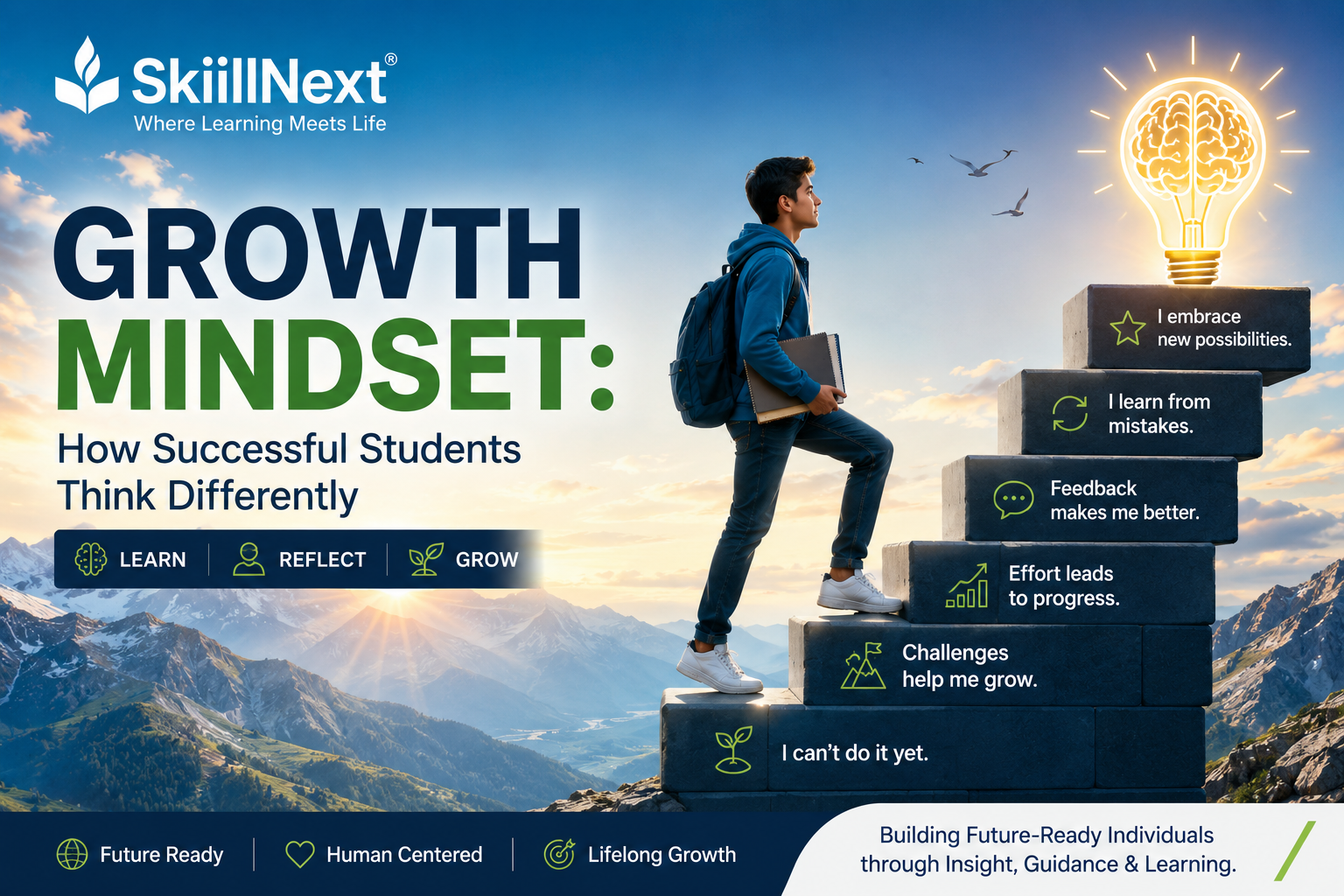
Every student has the ability to grow, improve, and think differently about learning. Read this full blog to discover how a growth mindset can help students handle challenges, learn from mistakes, build confidence, and move forward with purpose.
In every classroom, there are students who seem to handle challenges differently.
One student sees a difficult maths problem and thinks, “I am not good at this.” Another student looks at the same problem and thinks, “I have not understood this yet.” One student receives low marks and feels embarrassed. Another student feels disappointed too—but asks, “What exactly went wrong, and what can I improve next time?”
This difference is not simply about intelligence. It is about mindset.
A growth mindset is the belief that abilities, intelligence, skills, and performance can improve through effort, strategy, feedback, support, and consistent practice. It does not mean that everyone has the same natural ability. It does not mean marks do not matter. It does not mean success comes only by working harder.
It means students learn to see their current performance as a starting point, not a final label.
For students, this mindset is powerful because school years are not only about exams. They are also the years when young people form beliefs about themselves:
“Am I smart?”
“Am I capable?”
“Can I improve?”
“What happens if I fail?”
“Should I try difficult things or stay safe?”
“Do my marks define me?”
For parents, growth mindset matters because the language, expectations, and emotional environment at home shape how children respond to difficulty. A child who feels judged may hide mistakes. A child who feels supported may learn from them.
In a rapidly changing world—where careers, technologies, skills, and learning pathways are evolving—students need more than academic knowledge. They need learning agility, resilience, curiosity, self-awareness, emotional strength, and future readiness. Growth mindset supports all of these.
Growth mindset means believing that one’s abilities can develop over time.
A student with a growth mindset may say:
“I can improve with practice.”
“This mistake is showing me what I need to learn.”
“I need a better strategy.”
“Feedback can help me grow.”
“I may not be good at this yet.”
“Difficult does not mean impossible.”
A fixed mindset, on the other hand, treats ability as permanent. A student with a fixed mindset may say:
“I am just not a maths person.”
“I failed, so I am not capable.”
“If I ask for help, people will think I am weak.”
“If I cannot do it quickly, I must not be good at it.”
“Others are naturally talented; I am not.”
Both mindsets can appear in the same student. A child may have a growth mindset in sports but a fixed mindset in science. A student may be confident in writing but fearful in mathematics. A parent may encourage improvement in academics but unintentionally create fixed labels through comparison.
Growth mindset is not a personality type. It is a way of interpreting learning experiences.
Today’s students are growing up in a world of constant comparison. Marks, ranks, entrance exams, social media achievements, school competitions, coding classes, Olympiads, sports, hobbies, and future career pressure often create a silent question in the student’s mind:
“Am I enough?”
This pressure is especially visible in India, where academic milestones such as Class 10 subject choices, Class 12 board exams, entrance tests, competitive exams, stream selection, and career decisions often carry emotional weight for both students and parents.
At the same time, the global education and career landscape is changing. Students are no longer preparing for one fixed career path. They are preparing for a future that may require continuous learning, reskilling, interdisciplinary thinking, technological adaptability, and emotional resilience.
In this context, growth mindset becomes more than a motivational idea. It becomes a future-readiness capability.
A growth mindset helps students:
Successful students do not avoid struggle. They learn how to work with struggle.
Let us understand growth mindset through a realistic story.
Aarav is a Class 9 student in Pune. He is good at social science, enjoys cricket, and likes watching videos about space. But he has one problem: mathematics.
Every maths test feels like a threat.
Before every exam, he tells himself, “I am weak in maths.” His parents say, “You are intelligent, but you are careless.” His tuition teacher says, “You need more practice.” His friends say, “Algebra is easy.” None of this helps.
In the first unit test, Aarav scores 41 out of 80.
He feels embarrassed. He folds the paper and keeps it inside his bag. At home, his mother asks, “How was the result?” Aarav says, “Fine.” Later, she finds the paper while checking his bag.
The usual conversation begins.
“Why did you not tell us?”
“I knew you would scold me.”
“We are not scolding you. But why are you not serious?”
“I studied.”
“Then why so many mistakes?”
“I told you, I am not good at maths.”
That sentence becomes the turning point.
His father, instead of continuing the argument, pauses and asks, “What exactly do you mean by ‘not good at maths’?”
Aarav says, “I just do not understand it. Others get it quickly. I take too much time.”
His father says, “Taking time is not the same as being incapable. Let us not call this a maths problem. Let us call it a learning strategy problem.”
That evening, they do something different. They do not start with more worksheets. They open the test paper and divide the mistakes into four columns:
Aarav is surprised. Not all mistakes are the same.
Out of 39 lost marks, almost 18 marks were lost because he misunderstood questions. Another 9 marks were calculation errors. Only 12 marks were due to concept gaps.
For the first time, Aarav realizes, “Maybe I am not bad at maths. Maybe I do not know how to study maths properly.”
His parents and teacher help him create a simple four-week plan.
Week 1: Revise only the concepts he got wrong.
Week 2: Solve five questions daily, slowly and correctly.
Week 3: Practice reading questions carefully and underlining key data.
Week 4: Attempt one timed practice test and review mistakes.
They also agree on one rule: no one will say “You are weak in maths.” Instead, they will say, “This part needs practice,” or “This strategy needs improvement.”
Aarav also starts using one sentence after every difficult question:
“What is this question trying to teach me?”
At first, nothing dramatic happens. He still feels frustrated. He still makes mistakes. He still avoids some problems. But now he has a process.
In the next test, he scores 56 out of 80.
It is not a miracle. It is progress.
His mother is about to say, “Very good, now you must score 70.” But she stops and says, “Your calculation errors reduced. That means your practice method is working.”
Aarav smiles. For the first time, he feels seen not only for marks, but for improvement.
By the final exam, Aarav scores 68 out of 80 in maths. But the bigger change is not the score. The bigger change is how he thinks.
Earlier: “I am not good at maths.”
Now: “I need to understand the mistake type.”
Earlier: “Low marks mean I failed.”
Now: “Low marks show me where to improve.”
Earlier: “Asking doubts is embarrassing.”
Now: “Asking doubts saves time.”
Earlier: “Others are naturally better.”
Now: “Others may have better strategies. I can learn strategies too.”
Aarav did not become successful because someone gave him a motivational speech. He improved because he learned how to think about learning.
That is growth mindset in action.
A fixed mindset says, “I failed, so I am a failure.”
A growth mindset says, “My result was poor, but I can understand what happened and improve.”
Successful students do not make every mark sheet a judgment of identity. They treat performance as feedback. This helps them stay emotionally stable and practically focused.
This is especially important in exam-focused environments. Marks are important, but marks are not the full measure of a student’s ability, character, creativity, future potential, or life direction.
The word “yet” is small but powerful.
“I do not understand this yet.”
“I cannot solve these problems yet.”
“I am not confident in public speaking yet.”
“I have not built discipline yet.”
“Yet” keeps the door open. It tells the mind that improvement is possible. It reduces shame and encourages action.
Students should not use “yet” as an excuse to delay effort. They should use it as a bridge between current ability and future growth.
One common misunderstanding is that growth mindset means “just work harder.”
That is incomplete.
If a student keeps repeating the same ineffective method, more effort may only create more frustration. Growth mindset requires better strategies.
For example:
If reading a chapter again and again does not help, try active recall.
If solving problems randomly does not help, classify mistakes.
If memorization fails, create concept maps.
If exam anxiety affects performance, practice timed papers.
If self-study is not working, ask for guidance.
Successful students ask, “What strategy should I change?”
Mistakes are uncomfortable. But they are also useful.
A mistake shows one of three things:
Successful students review mistakes carefully. They do not simply check the correct answer and move on. They ask:
“Why did I choose this answer?”
“What was my thinking process?”
“What pattern do I notice in my mistakes?”
“What will I do differently next time?”
Mistake analysis is one of the most practical ways to develop a growth mindset.
Many students avoid feedback because they fear judgment. But feedback is not an insult. It is information.
A teacher’s correction, a parent’s observation, a mentor’s suggestion, or a peer’s explanation can help a student improve faster.
The key is to ask specific questions:
“Where exactly did I go wrong?”
“What is one thing I should improve first?”
“Which part of my answer was weak?”
“How can I make this explanation better?”
“What should I practice before the next test?”
Successful students do not wait for perfect confidence before asking. They build confidence by asking, learning, and improving.
Comparison is natural, but constant comparison is harmful.
When students compare themselves with others, they often see only the result, not the process. They see someone’s marks, not their practice. They see someone’s confidence, not their preparation. They see someone’s success, not their struggle.
Growth mindset shifts the question from:
“Why am I not like them?”
to
“What can I learn from their approach?”
Healthy comparison can inspire. Unhealthy comparison can damage confidence.
Successful students compete with their previous version more than with others.
Real confidence does not come only from positive thinking. It comes from evidence.
A student becomes confident when they can say:
“I practiced consistently.”
“I improved my weak areas.”
“I solved previous mistakes.”
“I asked doubts.”
“I revised properly.”
“I handled difficulty better than before.”
This kind of confidence is stable because it is built on action.
Growth mindset does not say, “I will succeed because I believe.”
It says, “I can improve because I am learning how to improve.”
Parents play a major role in shaping a child’s mindset. Children often internalize the words they hear repeatedly at home.
Even positive labels can create pressure.
“You are the intelligent one.”
“You are naturally good at science.”
“You are not a maths person.”
“You are careless.”
“You are slow.”
“You are born creative.”
These labels may seem harmless, but they can make children feel trapped. A child called “intelligent” may avoid difficult tasks because struggle threatens that identity. A child called “careless” may begin to believe improvement is impossible.
Instead, parents can use process-based language:
“You improved because your revision was more focused.”
“This mistake shows we need to work on question reading.”
“You stayed with a difficult problem today.”
“Your strategy worked better this time.”
“Let us identify what can be improved.”
Do not praise effort blindly. Praise meaningful effort.
Instead of: “You worked hard, so everything is fine.”
Say: “You worked hard and changed your method. That helped.”
Instead of: “You are very smart.”
Say: “Your explanation became clearer because you practiced.”
Instead of: “Do not worry about marks.”
Say: “Let us understand what these marks are telling us.”
This helps children connect progress with specific actions.
Students should not feel that every mistake will lead to anger, comparison, or disappointment.
When a child brings a poor result, the first parental response matters. A calm response does not mean parents are careless. It means they are creating space for honest reflection.
A useful sequence is:
Pause.
Understand.
Classify mistakes.
Plan improvement.
Follow up gently.
Children learn better when they feel supported, not threatened.
In India, students often face high expectations from school, family, society, and competitive systems. Growth mindset is especially useful because it helps students navigate academic pressure without losing self-belief.
However, it must be applied realistically.
A student preparing for board exams, JEE, NEET, CUET, CLAT, design entrance, commerce pathways, humanities careers, vocational courses, or international education needs more than motivation. They need:
Growth mindset supports these, but it does not replace disciplined preparation or quality guidance.
For Indian parents, growth mindset can also help shift conversations from “Which stream is best?” to “Which stream aligns with the student’s strengths, interests, values, learning style, and future goals?”
This shift is essential. A student should not choose a pathway only because they are “good” or “not good” at one subject today. Abilities can develop, interests can mature, and career awareness can expand.
The future will reward students who can keep learning.
Artificial intelligence, automation, new career fields, interdisciplinary work, global opportunities, and changing skill demands mean that students cannot depend only on what they know today.
They must learn how to learn.
Growth mindset supports future readiness because it develops:
The ability to learn, unlearn, and relearn.
The ability to respond to change without giving up.
The ability to recover from setbacks.
The ability to understand strengths, gaps, emotions, and motivations.
The ability to explore evolving pathways without fear.
The ability to keep growing beyond school, college, and formal education.
In this sense, growth mindset is not only an academic skill. It is a life skill.
At SkiillNext, growth mindset is not seen as a slogan. It is part of a larger developmental journey that connects self-awareness, career awareness, future readiness, integrated intelligence, and lifelong learning.
Students cannot improve meaningfully unless they understand themselves.
Self-awareness helps students identify:
A growth mindset becomes stronger when students know their starting point clearly.
Many students limit themselves too early.
“I am not good at science, so I have no future in technology.”
“I am weak in English, so I cannot communicate well.”
“I am average, so I should not dream big.”
“I do not know coding, so future careers are not for me.”
Career awareness helps students understand that careers are broad, evolving, and skill-based. It also helps them see that abilities can be developed through exposure, practice, mentoring, and informed choices.
Growth mindset allows students to explore possibilities instead of closing doors too early.
Future-ready students are not those who know everything. They are those who are willing and able to keep learning.
SkiillNext encourages students to develop future skills such as:
These skills grow through practice. A growth mindset gives students the emotional and mental foundation to develop them.
Academic intelligence alone is not enough.
Students also need emotional intelligence, social intelligence, practical intelligence, digital intelligence, and reflective intelligence. This is where integrated intelligence becomes important.
A student with integrated intelligence does not only ask, “How can I score more?”
They also ask:
“How do I handle stress?”
“How do I make better decisions?”
“How do I communicate my doubts?”
“How do I understand myself?”
“How do I prepare for the future?”
“How do I grow as a person?”
Growth mindset becomes more powerful when it is connected to the whole student, not just exam performance.
The goal is not to develop a growth mindset only for the next exam.
The goal is to help students carry this mindset into higher education, careers, relationships, leadership, and life decisions.
A lifelong learner does not stop growing after success. They continue reflecting, adapting, and improving.
This is the deeper purpose of growth mindset: not only better marks, but a better relationship with learning.
Students can use this simple five-step framework after every test, project, competition, or difficult learning experience.
Ask: “What am I feeling right now—fear, disappointment, anger, shame, confusion, or motivation?”
Say: “This result is feedback. It is not my full identity.”
Ask: “What type of mistake or challenge is repeating?”
Ask: “What method should I try next?”
Ask: “What improved compared to last time?”
This turns mindset into action.
This question reveals fixed mindset language. Once students identify the area, they can replace the label with a learning statement.
Example: “I am not good at physics” becomes “I need to strengthen numerical problem-solving in physics.”
Every mistake carries information. Students should write down what the mistake reveals—concept gap, careless error, weak revision, anxiety, poor time management, or misunderstanding.
If one method is not working, students should not conclude they are incapable. They should try a different strategy: active recall, spaced revision, visual notes, peer discussion, teacher feedback, practice tests, or mistake logs.
Marks matter, but they are not the only indicator of growth. Students should also track improved accuracy, better focus, faster recall, clearer writing, reduced anxiety, and stronger consistency.
Successful learners seek support before small gaps become large problems. Asking for help is not weakness. It is a smart learning behaviour.
Students should learn to ask for specific feedback. Parents and teachers should avoid vague criticism and provide actionable guidance.
Parents can reflect on whether the home environment encourages honesty or fear. Growth mindset grows best where mistakes can be discussed calmly and constructively.
Growth mindset becomes real through small, consistent actions. One chapter revised, one doubt clarified, one mistake pattern corrected, or one better study habit can create momentum.
Reality: Growth mindset does not guarantee that every student will become the topper or expert in every field. It means every student can improve from their current level with the right effort, strategy, support, and time.
Reality: Marks are useful indicators, especially in academic systems. But they should be interpreted as feedback, not identity.
Reality: Hard work matters, but strategy matters too. Effective learning requires the right methods.
Reality: Disappointment is natural. Growth mindset helps students process disappointment and move toward constructive action.
Reality: High-performing students also need growth mindset. Without it, they may fear failure, avoid challenges, or depend too much on being seen as “naturally smart.”
Growth mindset is often written on classroom walls, school posters, and motivational quotes. But its real value appears in ordinary moments.
When a student receives low marks.
When a parent chooses calm reflection over comparison.
When a teacher gives specific feedback.
When a child asks a doubt without shame.
When a difficult chapter becomes slightly clearer.
When failure becomes information.
When confidence is built through progress.
Successful students do not think differently because they never struggle. They think differently because they learn how to respond to struggle.
They do not say, “I cannot.”
They learn to say, “I cannot yet.”
They do not ask, “Am I smart enough?”
They ask, “What can I learn next?”
They do not treat mistakes as the end of confidence.
They treat mistakes as the beginning of improvement.
For students, growth mindset can transform the way they study, choose careers, handle setbacks, and build confidence. For parents, it can transform the way they support, guide, and communicate with their children.
At SkiillNext, the purpose of growth mindset is not only academic performance. It is to help students become self-aware, future-ready, emotionally balanced, and lifelong learners.
Because the students who grow the most are not always the ones who start ahead.
They are the ones who keep learning how to move forward.
In every classroom, there are students who seem to handle challenges differently.
One student sees a difficult maths problem and thinks, “I am not good at this.” Another student looks at the same problem and thinks, “I have not understood this yet.” One student receives low marks and feels embarrassed. Another student feels disappointed too—but asks, “What exactly went wrong, and what can I improve next time?”
This difference is not simply about intelligence. It is about mindset.
A growth mindset is the belief that abilities, intelligence, skills, and performance can improve through effort, strategy, feedback, support, and consistent practice. It does not mean that everyone has the same natural ability. It does not mean marks do not matter. It does not mean success comes only by working harder.
It means students learn to see their current performance as a starting point, not a final label.
For students, this mindset is powerful because school years are not only about exams. They are also the years when young people form beliefs about themselves:
“Am I smart?”
“Am I capable?”
“Can I improve?”
“What happens if I fail?”
“Should I try difficult things or stay safe?”
“Do my marks define me?”
For parents, growth mindset matters because the language, expectations, and emotional environment at home shape how children respond to difficulty. A child who feels judged may hide mistakes. A child who feels supported may learn from them.
In a rapidly changing world—where careers, technologies, skills, and learning pathways are evolving—students need more than academic knowledge. They need learning agility, resilience, curiosity, self-awareness, emotional strength, and future readiness. Growth mindset supports all of these.
Growth mindset means believing that one’s abilities can develop over time.
A student with a growth mindset may say:
“I can improve with practice.”
“This mistake is showing me what I need to learn.”
“I need a better strategy.”
“Feedback can help me grow.”
“I may not be good at this yet.”
“Difficult does not mean impossible.”
A fixed mindset, on the other hand, treats ability as permanent. A student with a fixed mindset may say:
“I am just not a maths person.”
“I failed, so I am not capable.”
“If I ask for help, people will think I am weak.”
“If I cannot do it quickly, I must not be good at it.”
“Others are naturally talented; I am not.”
Both mindsets can appear in the same student. A child may have a growth mindset in sports but a fixed mindset in science. A student may be confident in writing but fearful in mathematics. A parent may encourage improvement in academics but unintentionally create fixed labels through comparison.
Growth mindset is not a personality type. It is a way of interpreting learning experiences.
Today’s students are growing up in a world of constant comparison. Marks, ranks, entrance exams, social media achievements, school competitions, coding classes, Olympiads, sports, hobbies, and future career pressure often create a silent question in the student’s mind:
“Am I enough?”
This pressure is especially visible in India, where academic milestones such as Class 10 subject choices, Class 12 board exams, entrance tests, competitive exams, stream selection, and career decisions often carry emotional weight for both students and parents.
At the same time, the global education and career landscape is changing. Students are no longer preparing for one fixed career path. They are preparing for a future that may require continuous learning, reskilling, interdisciplinary thinking, technological adaptability, and emotional resilience.
In this context, growth mindset becomes more than a motivational idea. It becomes a future-readiness capability.
A growth mindset helps students:
Successful students do not avoid struggle. They learn how to work with struggle.
Let us understand growth mindset through a realistic story.
Aarav is a Class 9 student in Pune. He is good at social science, enjoys cricket, and likes watching videos about space. But he has one problem: mathematics.
Every maths test feels like a threat.
Before every exam, he tells himself, “I am weak in maths.” His parents say, “You are intelligent, but you are careless.” His tuition teacher says, “You need more practice.” His friends say, “Algebra is easy.” None of this helps.
In the first unit test, Aarav scores 41 out of 80.
He feels embarrassed. He folds the paper and keeps it inside his bag. At home, his mother asks, “How was the result?” Aarav says, “Fine.” Later, she finds the paper while checking his bag.
The usual conversation begins.
“Why did you not tell us?”
“I knew you would scold me.”
“We are not scolding you. But why are you not serious?”
“I studied.”
“Then why so many mistakes?”
“I told you, I am not good at maths.”
That sentence becomes the turning point.
His father, instead of continuing the argument, pauses and asks, “What exactly do you mean by ‘not good at maths’?”
Aarav says, “I just do not understand it. Others get it quickly. I take too much time.”
His father says, “Taking time is not the same as being incapable. Let us not call this a maths problem. Let us call it a learning strategy problem.”
That evening, they do something different. They do not start with more worksheets. They open the test paper and divide the mistakes into four columns:
Aarav is surprised. Not all mistakes are the same.
Out of 39 lost marks, almost 18 marks were lost because he misunderstood questions. Another 9 marks were calculation errors. Only 12 marks were due to concept gaps.
For the first time, Aarav realizes, “Maybe I am not bad at maths. Maybe I do not know how to study maths properly.”
His parents and teacher help him create a simple four-week plan.
Week 1: Revise only the concepts he got wrong.
Week 2: Solve five questions daily, slowly and correctly.
Week 3: Practice reading questions carefully and underlining key data.
Week 4: Attempt one timed practice test and review mistakes.
They also agree on one rule: no one will say “You are weak in maths.” Instead, they will say, “This part needs practice,” or “This strategy needs improvement.”
Aarav also starts using one sentence after every difficult question:
“What is this question trying to teach me?”
At first, nothing dramatic happens. He still feels frustrated. He still makes mistakes. He still avoids some problems. But now he has a process.
In the next test, he scores 56 out of 80.
It is not a miracle. It is progress.
His mother is about to say, “Very good, now you must score 70.” But she stops and says, “Your calculation errors reduced. That means your practice method is working.”
Aarav smiles. For the first time, he feels seen not only for marks, but for improvement.
By the final exam, Aarav scores 68 out of 80 in maths. But the bigger change is not the score. The bigger change is how he thinks.
Earlier: “I am not good at maths.”
Now: “I need to understand the mistake type.”
Earlier: “Low marks mean I failed.”
Now: “Low marks show me where to improve.”
Earlier: “Asking doubts is embarrassing.”
Now: “Asking doubts saves time.”
Earlier: “Others are naturally better.”
Now: “Others may have better strategies. I can learn strategies too.”
Aarav did not become successful because someone gave him a motivational speech. He improved because he learned how to think about learning.
That is growth mindset in action.
A fixed mindset says, “I failed, so I am a failure.”
A growth mindset says, “My result was poor, but I can understand what happened and improve.”
Successful students do not make every mark sheet a judgment of identity. They treat performance as feedback. This helps them stay emotionally stable and practically focused.
This is especially important in exam-focused environments. Marks are important, but marks are not the full measure of a student’s ability, character, creativity, future potential, or life direction.
The word “yet” is small but powerful.
“I do not understand this yet.”
“I cannot solve these problems yet.”
“I am not confident in public speaking yet.”
“I have not built discipline yet.”
“Yet” keeps the door open. It tells the mind that improvement is possible. It reduces shame and encourages action.
Students should not use “yet” as an excuse to delay effort. They should use it as a bridge between current ability and future growth.
One common misunderstanding is that growth mindset means “just work harder.”
That is incomplete.
If a student keeps repeating the same ineffective method, more effort may only create more frustration. Growth mindset requires better strategies.
For example:
If reading a chapter again and again does not help, try active recall.
If solving problems randomly does not help, classify mistakes.
If memorization fails, create concept maps.
If exam anxiety affects performance, practice timed papers.
If self-study is not working, ask for guidance.
Successful students ask, “What strategy should I change?”
Mistakes are uncomfortable. But they are also useful.
A mistake shows one of three things:
Successful students review mistakes carefully. They do not simply check the correct answer and move on. They ask:
“Why did I choose this answer?”
“What was my thinking process?”
“What pattern do I notice in my mistakes?”
“What will I do differently next time?”
Mistake analysis is one of the most practical ways to develop a growth mindset.
Many students avoid feedback because they fear judgment. But feedback is not an insult. It is information.
A teacher’s correction, a parent’s observation, a mentor’s suggestion, or a peer’s explanation can help a student improve faster.
The key is to ask specific questions:
“Where exactly did I go wrong?”
“What is one thing I should improve first?”
“Which part of my answer was weak?”
“How can I make this explanation better?”
“What should I practice before the next test?”
Successful students do not wait for perfect confidence before asking. They build confidence by asking, learning, and improving.
Comparison is natural, but constant comparison is harmful.
When students compare themselves with others, they often see only the result, not the process. They see someone’s marks, not their practice. They see someone’s confidence, not their preparation. They see someone’s success, not their struggle.
Growth mindset shifts the question from:
“Why am I not like them?”
to
“What can I learn from their approach?”
Healthy comparison can inspire. Unhealthy comparison can damage confidence.
Successful students compete with their previous version more than with others.
Real confidence does not come only from positive thinking. It comes from evidence.
A student becomes confident when they can say:
“I practiced consistently.”
“I improved my weak areas.”
“I solved previous mistakes.”
“I asked doubts.”
“I revised properly.”
“I handled difficulty better than before.”
This kind of confidence is stable because it is built on action.
Growth mindset does not say, “I will succeed because I believe.”
It says, “I can improve because I am learning how to improve.”
Parents play a major role in shaping a child’s mindset. Children often internalize the words they hear repeatedly at home.
Even positive labels can create pressure.
“You are the intelligent one.”
“You are naturally good at science.”
“You are not a maths person.”
“You are careless.”
“You are slow.”
“You are born creative.”
These labels may seem harmless, but they can make children feel trapped. A child called “intelligent” may avoid difficult tasks because struggle threatens that identity. A child called “careless” may begin to believe improvement is impossible.
Instead, parents can use process-based language:
“You improved because your revision was more focused.”
“This mistake shows we need to work on question reading.”
“You stayed with a difficult problem today.”
“Your strategy worked better this time.”
“Let us identify what can be improved.”
Do not praise effort blindly. Praise meaningful effort.
Instead of: “You worked hard, so everything is fine.”
Say: “You worked hard and changed your method. That helped.”
Instead of: “You are very smart.”
Say: “Your explanation became clearer because you practiced.”
Instead of: “Do not worry about marks.”
Say: “Let us understand what these marks are telling us.”
This helps children connect progress with specific actions.
Students should not feel that every mistake will lead to anger, comparison, or disappointment.
When a child brings a poor result, the first parental response matters. A calm response does not mean parents are careless. It means they are creating space for honest reflection.
A useful sequence is:
Pause.
Understand.
Classify mistakes.
Plan improvement.
Follow up gently.
Children learn better when they feel supported, not threatened.
In India, students often face high expectations from school, family, society, and competitive systems. Growth mindset is especially useful because it helps students navigate academic pressure without losing self-belief.
However, it must be applied realistically.
A student preparing for board exams, JEE, NEET, CUET, CLAT, design entrance, commerce pathways, humanities careers, vocational courses, or international education needs more than motivation. They need:
Growth mindset supports these, but it does not replace disciplined preparation or quality guidance.
For Indian parents, growth mindset can also help shift conversations from “Which stream is best?” to “Which stream aligns with the student’s strengths, interests, values, learning style, and future goals?”
This shift is essential. A student should not choose a pathway only because they are “good” or “not good” at one subject today. Abilities can develop, interests can mature, and career awareness can expand.
The future will reward students who can keep learning.
Artificial intelligence, automation, new career fields, interdisciplinary work, global opportunities, and changing skill demands mean that students cannot depend only on what they know today.
They must learn how to learn.
Growth mindset supports future readiness because it develops:
The ability to learn, unlearn, and relearn.
The ability to respond to change without giving up.
The ability to recover from setbacks.
The ability to understand strengths, gaps, emotions, and motivations.
The ability to explore evolving pathways without fear.
The ability to keep growing beyond school, college, and formal education.
In this sense, growth mindset is not only an academic skill. It is a life skill.
At SkiillNext, growth mindset is not seen as a slogan. It is part of a larger developmental journey that connects self-awareness, career awareness, future readiness, integrated intelligence, and lifelong learning.
Students cannot improve meaningfully unless they understand themselves.
Self-awareness helps students identify:
A growth mindset becomes stronger when students know their starting point clearly.
Many students limit themselves too early.
“I am not good at science, so I have no future in technology.”
“I am weak in English, so I cannot communicate well.”
“I am average, so I should not dream big.”
“I do not know coding, so future careers are not for me.”
Career awareness helps students understand that careers are broad, evolving, and skill-based. It also helps them see that abilities can be developed through exposure, practice, mentoring, and informed choices.
Growth mindset allows students to explore possibilities instead of closing doors too early.
Future-ready students are not those who know everything. They are those who are willing and able to keep learning.
SkiillNext encourages students to develop future skills such as:
These skills grow through practice. A growth mindset gives students the emotional and mental foundation to develop them.
Academic intelligence alone is not enough.
Students also need emotional intelligence, social intelligence, practical intelligence, digital intelligence, and reflective intelligence. This is where integrated intelligence becomes important.
A student with integrated intelligence does not only ask, “How can I score more?”
They also ask:
“How do I handle stress?”
“How do I make better decisions?”
“How do I communicate my doubts?”
“How do I understand myself?”
“How do I prepare for the future?”
“How do I grow as a person?”
Growth mindset becomes more powerful when it is connected to the whole student, not just exam performance.
The goal is not to develop a growth mindset only for the next exam.
The goal is to help students carry this mindset into higher education, careers, relationships, leadership, and life decisions.
A lifelong learner does not stop growing after success. They continue reflecting, adapting, and improving.
This is the deeper purpose of growth mindset: not only better marks, but a better relationship with learning.
Students can use this simple five-step framework after every test, project, competition, or difficult learning experience.
Ask: “What am I feeling right now—fear, disappointment, anger, shame, confusion, or motivation?”
Say: “This result is feedback. It is not my full identity.”
Ask: “What type of mistake or challenge is repeating?”
Ask: “What method should I try next?”
Ask: “What improved compared to last time?”
This turns mindset into action.
This question reveals fixed mindset language. Once students identify the area, they can replace the label with a learning statement.
Example: “I am not good at physics” becomes “I need to strengthen numerical problem-solving in physics.”
Every mistake carries information. Students should write down what the mistake reveals—concept gap, careless error, weak revision, anxiety, poor time management, or misunderstanding.
If one method is not working, students should not conclude they are incapable. They should try a different strategy: active recall, spaced revision, visual notes, peer discussion, teacher feedback, practice tests, or mistake logs.
Marks matter, but they are not the only indicator of growth. Students should also track improved accuracy, better focus, faster recall, clearer writing, reduced anxiety, and stronger consistency.
Successful learners seek support before small gaps become large problems. Asking for help is not weakness. It is a smart learning behaviour.
Students should learn to ask for specific feedback. Parents and teachers should avoid vague criticism and provide actionable guidance.
Parents can reflect on whether the home environment encourages honesty or fear. Growth mindset grows best where mistakes can be discussed calmly and constructively.
Growth mindset becomes real through small, consistent actions. One chapter revised, one doubt clarified, one mistake pattern corrected, or one better study habit can create momentum.
Reality: Growth mindset does not guarantee that every student will become the topper or expert in every field. It means every student can improve from their current level with the right effort, strategy, support, and time.
Reality: Marks are useful indicators, especially in academic systems. But they should be interpreted as feedback, not identity.
Reality: Hard work matters, but strategy matters too. Effective learning requires the right methods.
Reality: Disappointment is natural. Growth mindset helps students process disappointment and move toward constructive action.
Reality: High-performing students also need growth mindset. Without it, they may fear failure, avoid challenges, or depend too much on being seen as “naturally smart.”
Growth mindset is often written on classroom walls, school posters, and motivational quotes. But its real value appears in ordinary moments.
When a student receives low marks.
When a parent chooses calm reflection over comparison.
When a teacher gives specific feedback.
When a child asks a doubt without shame.
When a difficult chapter becomes slightly clearer.
When failure becomes information.
When confidence is built through progress.
Successful students do not think differently because they never struggle. They think differently because they learn how to respond to struggle.
They do not say, “I cannot.”
They learn to say, “I cannot yet.”
They do not ask, “Am I smart enough?”
They ask, “What can I learn next?”
They do not treat mistakes as the end of confidence.
They treat mistakes as the beginning of improvement.
For students, growth mindset can transform the way they study, choose careers, handle setbacks, and build confidence. For parents, it can transform the way they support, guide, and communicate with their children.
At SkiillNext, the purpose of growth mindset is not only academic performance. It is to help students become self-aware, future-ready, emotionally balanced, and lifelong learners.
Because the students who grow the most are not always the ones who start ahead.
They are the ones who keep learning how to move forward.