
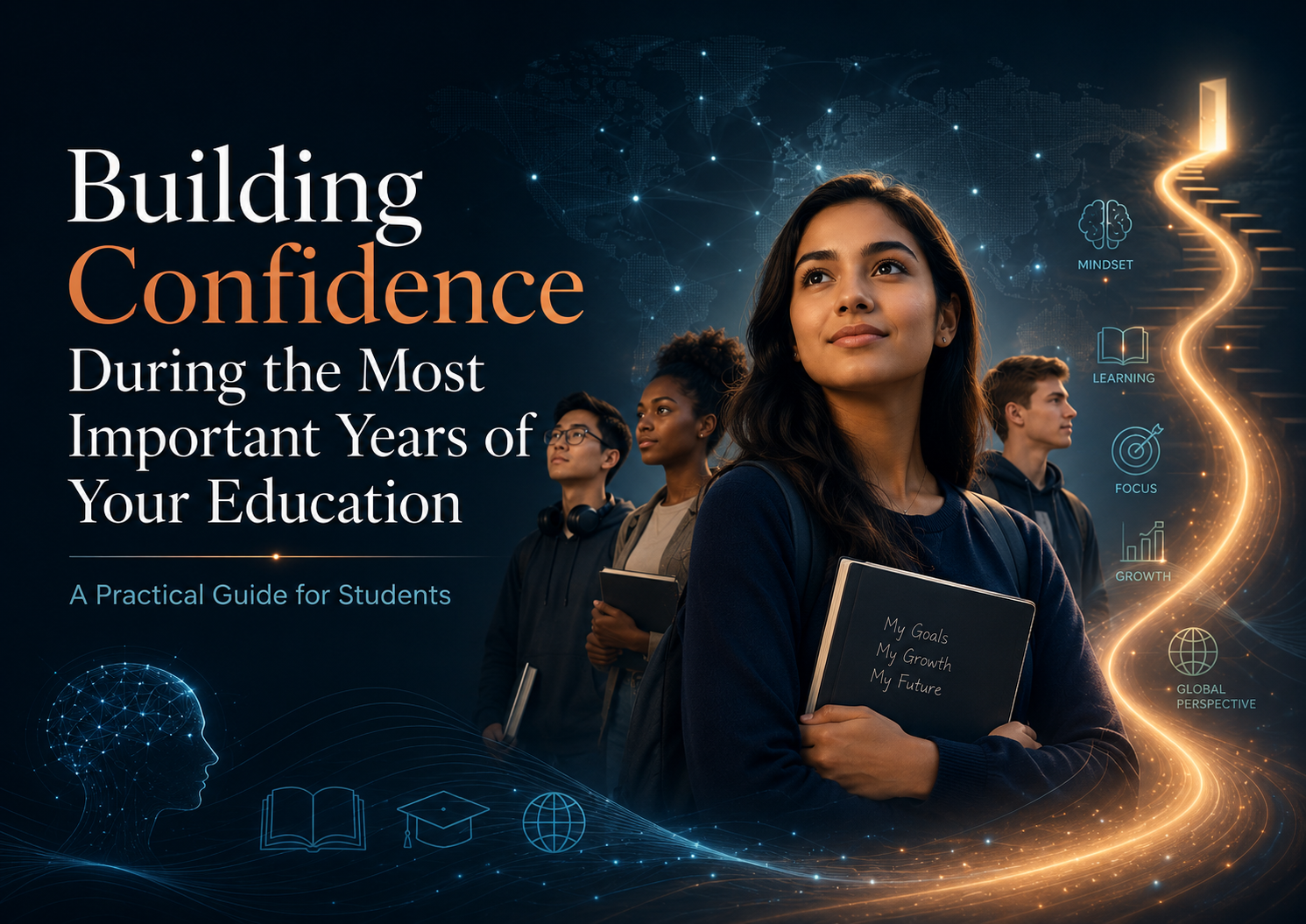
Confidence is built step by step through self-awareness, learning, effort, and reflection. Read this full blog to understand how students can develop real confidence during their most important education years and prepare themselves for a stronger, clearer, and future-ready journey.
The most important years of education are not only about marks, exams, certificates, or admissions. They are also the years when students begin to understand who they are, what they can do, what they enjoy learning, how they respond to pressure, and how they prepare for the future.
For many students, these years can feel intense. There are academic expectations, peer comparisons, subject choices, career questions, entrance exams, family hopes, digital distractions, and the constant pressure to “do well.” In India, this pressure may become especially visible during Classes 9 to 12, stream selection after Class 10, board examinations, competitive exams, and decisions about college or professional pathways. Globally too, students are navigating rapid changes in technology, artificial intelligence, careers, and the skills needed for tomorrow.
In the middle of all this, confidence becomes extremely important.
But confidence does not mean always feeling certain. It does not mean being the best in the class. It does not mean speaking loudly, never failing, or never feeling nervous. Real confidence is quieter and stronger than that.
Confidence is the belief that you can learn, improve, ask for help, face difficulty, and keep moving forward with awareness and responsibility.
This kind of confidence can be built.
Confidence affects how students participate in class, prepare for exams, communicate with teachers, explore career options, recover from mistakes, and handle uncertainty. A student with healthy confidence is more likely to attempt difficult questions, ask doubts, try new activities, accept feedback, and stay engaged even when progress is slow.
A lack of confidence, on the other hand, can make even capable students hesitate. They may avoid opportunities, compare themselves constantly, fear judgment, or assume that one poor result defines their ability.
The important point is this: confidence is not separate from learning. It is deeply connected with learning.
When students feel capable of improving, they are more likely to take action. When they take action, they gain experience. When they gain experience, they build evidence of their own growth. This creates a positive cycle:
Awareness → Effort → Practice → Improvement → Confidence → Growth
This is why confidence must be developed intentionally during school and college years.
The first foundation of confidence is self-awareness.
Many students lose confidence because they judge themselves without understanding themselves. They may say:
“I am not good at studies.”
“I am not a confident person.”
“I am weak in everything.”
“I cannot speak well.”
“I am not like others.”
These statements often come from frustration, not from accurate self-understanding.
Self-awareness helps students look deeper. Instead of saying, “I am bad at studies,” a self-aware student may ask:
Which subject is difficult for me?
Is the problem understanding, memory, practice, time management, or exam anxiety?
Do I learn better by reading, writing, discussing, watching, solving, or teaching others?
What kind of feedback helps me improve?
Which strengths do I already have?
This shift is powerful.
Confidence grows when students stop labelling themselves and start understanding themselves.
For example, a student who struggles in mathematics may actually have strong visual thinking but weak procedural practice. Another student who fears public speaking may have good ideas but needs structured speaking practice. A student who feels “average” may have excellent consistency, empathy, observation, creativity, or problem-solving ability that has not yet been recognized.
Self-awareness turns confusion into clarity.
A common myth is that confident students do not feel fear. In reality, confident students also feel nervous before exams, presentations, interviews, competitions, or new experiences.
The difference is not the absence of fear. The difference is how they respond to fear.
A student with low confidence may think, “I am nervous, so I cannot do this.”
A student building confidence learns to think, “I am nervous because this matters, but I can prepare and try.”
This distinction matters because education is full of first experiences: first board exam, first debate, first project, first career decision, first interview, first failure, first major success. Students do not become confident by avoiding all discomfort. They become confident by learning how to move through discomfort with preparation and support.
Confidence is not fearlessness. Confidence is guided courage.
Confidence without competence can become overconfidence. Competence without confidence can remain hidden. Students need both.
Competence means developing actual ability through learning, practice, feedback, and improvement. Confidence means trusting that ability enough to use it.
For example, if a student wants to become confident in science, the answer is not only positive thinking. The student must understand concepts, practise questions, revise regularly, ask doubts, connect theory to real examples, and review mistakes. As competence improves, confidence becomes more stable.
Similarly, if a student wants to become confident in communication, the student must practise speaking, listen actively, read widely, organize thoughts, participate in discussions, and receive feedback.
This is one of the most practical truths of student life:
Confidence grows when preparation becomes visible to the student.
When you can see your effort, track your progress, and understand your improvement, confidence becomes evidence-based.
During school and college years, students are not only learning subjects. They are forming identity.
They begin to ask:
Who am I?
What am I good at?
What do I care about?
What kind of future do I want?
What kind of person am I becoming?
Where do I fit in the world?
These questions are not distractions from education. They are part of education.
In a global world where careers are changing rapidly, students cannot depend only on marks or degrees. They need self-understanding, adaptability, communication, critical thinking, emotional intelligence, digital awareness, and the ability to keep learning.
For Indian students, this is especially relevant because educational choices often appear early. Students may feel pressure to choose Science, Commerce, Humanities, professional courses, entrance exam pathways, or career tracks before they fully understand themselves. Confidence helps students participate in these decisions with greater maturity.
A confident student does not need to have the entire future planned. But they should gradually learn how to explore options, ask better questions, and make informed decisions.
Many students feel underconfident because they do not know where their education is leading.
They study subjects, prepare for exams, and complete assignments, but may not understand how learning connects with careers, skills, life, or society. This can make education feel mechanical.
Career awareness changes that.
When students understand how different subjects connect to different fields, their motivation improves. Mathematics may connect to data science, economics, design, architecture, finance, engineering, research, and problem-solving. Biology may connect to medicine, biotechnology, psychology, nutrition, environmental science, public health, and neuroscience. Humanities may connect to law, policy, communication, education, design, media, civil services, research, and social impact.
Career awareness does not mean choosing a career too early. It means becoming aware of possibilities.
When students see possibilities, they stop feeling trapped by comparison. They begin to understand that there are many meaningful ways to grow.
The future will reward students who can adapt, learn continuously, work with technology, communicate well, think critically, and collaborate across cultures and disciplines.
Artificial intelligence and automation are changing the world of work. But this does not reduce the value of human potential. It increases the importance of human capabilities such as judgment, creativity, empathy, ethical thinking, problem-solving, and lifelong learning.
Students need confidence not only to score marks but to keep evolving.
Future-ready confidence includes:
The confidence to learn new tools.
The confidence to ask questions.
The confidence to work with others.
The confidence to admit what you do not know.
The confidence to improve after feedback.
The confidence to explore unfamiliar careers.
The confidence to remain human in a technology-rich world.
This is where SkiillNext’s philosophy of Integrated Intelligence becomes important. Students need more than academic intelligence. They need a balanced combination of self-awareness, emotional intelligence, career awareness, learning ability, digital awareness, and practical decision-making.
At SkiillNext, confidence is not viewed as a motivational slogan. It is seen as a developmental outcome that can be built through awareness, learning, reflection, and action.
Knowledge reduces unnecessary fear. When students understand a subject, an exam pattern, a career pathway, or a skill requirement, uncertainty reduces.
Action step: Before saying “I cannot do this,” first ask, “Do I understand what this requires?”
Students should learn to identify their strengths, interests, learning style, values, habits, and areas of improvement.
Action step: Maintain a simple “confidence journal” with three columns: What I tried, what I learned, what I will improve next.
Confidence grows through repeated evidence. Small wins matter because they show the brain that improvement is possible.
Action step: Break large goals into weekly targets. Instead of “I will become good at English,” write, “This week, I will learn 20 new words and write one paragraph daily.”
Students often move from one test to another without reflecting. Reflection converts experience into learning.
Action step: After every test, presentation, project, or competition, ask: What worked? What did not work? What should I change next time?
Marks matter, but they are not the whole picture. Students must develop academic ability, emotional balance, communication, digital literacy, career awareness, and social responsibility together.
Action step: Every month, choose one academic skill, one personal skill, and one future skill to improve.
The most confident students are not those who know everything. They are those who know how to keep learning.
Action step: Develop a learning routine beyond textbooks: read articles, watch educational videos, explore careers, build projects, attend workshops, and speak with mentors.
Confidence grows faster when goals are specific. Choose one small area instead of trying to fix everything at once.
Comparison often hides strengths. Look for qualities such as discipline, curiosity, creativity, kindness, patience, observation, or problem-solving.
Mistakes are not final judgments. They are feedback points. Review them calmly and convert them into next steps.
Confident students ask for help. Speak with a teacher, mentor, counsellor, parent, senior, or trusted friend when you feel stuck.
Track progress. Keep old notes, test scores, drafts, recordings, or project versions. Visible progress strengthens belief.
Worry feels active but often changes nothing. Preparation creates confidence. Convert worry into a plan.
Do not reject options only because they are unfamiliar. Explore first. Decide later.
Think beyond exams. Do you want to become curious, disciplined, adaptable, creative, thoughtful, responsible, or future-ready? Your identity shapes your habits.
Here is a simple weekly routine students can follow:
Monday: Set one academic goal and one personal growth goal.
Tuesday: Ask one doubt or clarify one concept.
Wednesday: Practise one difficult topic for 30–45 minutes.
Thursday: Work on one communication or future skill.
Friday: Review mistakes from the week.
Saturday: Explore one career, skill, book, video, or real-world topic.
Sunday: Reflect: What did I learn about myself this week?
This routine is simple, scalable, and adaptable. It can work for school students, college students, competitive exam aspirants, and lifelong learners.
While building confidence, students should also avoid certain traps.
Healthy confidence is balanced. It respects effort, but it also respects wellbeing. It values achievement, but it does not reduce the student to performance alone.
The most important years of education are not only about preparing for exams. They are about preparing for life.
These are the years when students build habits, identity, learning attitudes, emotional strength, career awareness, and future readiness. Confidence plays a central role in this journey.
But confidence does not appear suddenly. It grows through self-awareness, consistent effort, supportive guidance, meaningful feedback, practical exploration, and the courage to keep learning.
Students do not need to have everything figured out today. They need to keep understanding themselves better, learning with intention, exploring opportunities, and taking responsible action.
That is real confidence.
Not the confidence of knowing all the answers.
But the confidence of knowing that you can learn, grow, adapt, and move forward.
At SkiillNext, this is the deeper purpose of education: to help students succeed through Knowledge, Integrated Intelligence, and Lifelong Learning.
The most important years of education are not only about marks, exams, certificates, or admissions. They are also the years when students begin to understand who they are, what they can do, what they enjoy learning, how they respond to pressure, and how they prepare for the future.
For many students, these years can feel intense. There are academic expectations, peer comparisons, subject choices, career questions, entrance exams, family hopes, digital distractions, and the constant pressure to “do well.” In India, this pressure may become especially visible during Classes 9 to 12, stream selection after Class 10, board examinations, competitive exams, and decisions about college or professional pathways. Globally too, students are navigating rapid changes in technology, artificial intelligence, careers, and the skills needed for tomorrow.
In the middle of all this, confidence becomes extremely important.
But confidence does not mean always feeling certain. It does not mean being the best in the class. It does not mean speaking loudly, never failing, or never feeling nervous. Real confidence is quieter and stronger than that.
Confidence is the belief that you can learn, improve, ask for help, face difficulty, and keep moving forward with awareness and responsibility.
This kind of confidence can be built.
Confidence affects how students participate in class, prepare for exams, communicate with teachers, explore career options, recover from mistakes, and handle uncertainty. A student with healthy confidence is more likely to attempt difficult questions, ask doubts, try new activities, accept feedback, and stay engaged even when progress is slow.
A lack of confidence, on the other hand, can make even capable students hesitate. They may avoid opportunities, compare themselves constantly, fear judgment, or assume that one poor result defines their ability.
The important point is this: confidence is not separate from learning. It is deeply connected with learning.
When students feel capable of improving, they are more likely to take action. When they take action, they gain experience. When they gain experience, they build evidence of their own growth. This creates a positive cycle:
Awareness → Effort → Practice → Improvement → Confidence → Growth
This is why confidence must be developed intentionally during school and college years.
The first foundation of confidence is self-awareness.
Many students lose confidence because they judge themselves without understanding themselves. They may say:
“I am not good at studies.”
“I am not a confident person.”
“I am weak in everything.”
“I cannot speak well.”
“I am not like others.”
These statements often come from frustration, not from accurate self-understanding.
Self-awareness helps students look deeper. Instead of saying, “I am bad at studies,” a self-aware student may ask:
Which subject is difficult for me?
Is the problem understanding, memory, practice, time management, or exam anxiety?
Do I learn better by reading, writing, discussing, watching, solving, or teaching others?
What kind of feedback helps me improve?
Which strengths do I already have?
This shift is powerful.
Confidence grows when students stop labelling themselves and start understanding themselves.
For example, a student who struggles in mathematics may actually have strong visual thinking but weak procedural practice. Another student who fears public speaking may have good ideas but needs structured speaking practice. A student who feels “average” may have excellent consistency, empathy, observation, creativity, or problem-solving ability that has not yet been recognized.
Self-awareness turns confusion into clarity.
A common myth is that confident students do not feel fear. In reality, confident students also feel nervous before exams, presentations, interviews, competitions, or new experiences.
The difference is not the absence of fear. The difference is how they respond to fear.
A student with low confidence may think, “I am nervous, so I cannot do this.”
A student building confidence learns to think, “I am nervous because this matters, but I can prepare and try.”
This distinction matters because education is full of first experiences: first board exam, first debate, first project, first career decision, first interview, first failure, first major success. Students do not become confident by avoiding all discomfort. They become confident by learning how to move through discomfort with preparation and support.
Confidence is not fearlessness. Confidence is guided courage.
Confidence without competence can become overconfidence. Competence without confidence can remain hidden. Students need both.
Competence means developing actual ability through learning, practice, feedback, and improvement. Confidence means trusting that ability enough to use it.
For example, if a student wants to become confident in science, the answer is not only positive thinking. The student must understand concepts, practise questions, revise regularly, ask doubts, connect theory to real examples, and review mistakes. As competence improves, confidence becomes more stable.
Similarly, if a student wants to become confident in communication, the student must practise speaking, listen actively, read widely, organize thoughts, participate in discussions, and receive feedback.
This is one of the most practical truths of student life:
Confidence grows when preparation becomes visible to the student.
When you can see your effort, track your progress, and understand your improvement, confidence becomes evidence-based.
During school and college years, students are not only learning subjects. They are forming identity.
They begin to ask:
Who am I?
What am I good at?
What do I care about?
What kind of future do I want?
What kind of person am I becoming?
Where do I fit in the world?
These questions are not distractions from education. They are part of education.
In a global world where careers are changing rapidly, students cannot depend only on marks or degrees. They need self-understanding, adaptability, communication, critical thinking, emotional intelligence, digital awareness, and the ability to keep learning.
For Indian students, this is especially relevant because educational choices often appear early. Students may feel pressure to choose Science, Commerce, Humanities, professional courses, entrance exam pathways, or career tracks before they fully understand themselves. Confidence helps students participate in these decisions with greater maturity.
A confident student does not need to have the entire future planned. But they should gradually learn how to explore options, ask better questions, and make informed decisions.
Many students feel underconfident because they do not know where their education is leading.
They study subjects, prepare for exams, and complete assignments, but may not understand how learning connects with careers, skills, life, or society. This can make education feel mechanical.
Career awareness changes that.
When students understand how different subjects connect to different fields, their motivation improves. Mathematics may connect to data science, economics, design, architecture, finance, engineering, research, and problem-solving. Biology may connect to medicine, biotechnology, psychology, nutrition, environmental science, public health, and neuroscience. Humanities may connect to law, policy, communication, education, design, media, civil services, research, and social impact.
Career awareness does not mean choosing a career too early. It means becoming aware of possibilities.
When students see possibilities, they stop feeling trapped by comparison. They begin to understand that there are many meaningful ways to grow.
The future will reward students who can adapt, learn continuously, work with technology, communicate well, think critically, and collaborate across cultures and disciplines.
Artificial intelligence and automation are changing the world of work. But this does not reduce the value of human potential. It increases the importance of human capabilities such as judgment, creativity, empathy, ethical thinking, problem-solving, and lifelong learning.
Students need confidence not only to score marks but to keep evolving.
Future-ready confidence includes:
The confidence to learn new tools.
The confidence to ask questions.
The confidence to work with others.
The confidence to admit what you do not know.
The confidence to improve after feedback.
The confidence to explore unfamiliar careers.
The confidence to remain human in a technology-rich world.
This is where SkiillNext’s philosophy of Integrated Intelligence becomes important. Students need more than academic intelligence. They need a balanced combination of self-awareness, emotional intelligence, career awareness, learning ability, digital awareness, and practical decision-making.
At SkiillNext, confidence is not viewed as a motivational slogan. It is seen as a developmental outcome that can be built through awareness, learning, reflection, and action.
Knowledge reduces unnecessary fear. When students understand a subject, an exam pattern, a career pathway, or a skill requirement, uncertainty reduces.
Action step: Before saying “I cannot do this,” first ask, “Do I understand what this requires?”
Students should learn to identify their strengths, interests, learning style, values, habits, and areas of improvement.
Action step: Maintain a simple “confidence journal” with three columns: What I tried, what I learned, what I will improve next.
Confidence grows through repeated evidence. Small wins matter because they show the brain that improvement is possible.
Action step: Break large goals into weekly targets. Instead of “I will become good at English,” write, “This week, I will learn 20 new words and write one paragraph daily.”
Students often move from one test to another without reflecting. Reflection converts experience into learning.
Action step: After every test, presentation, project, or competition, ask: What worked? What did not work? What should I change next time?
Marks matter, but they are not the whole picture. Students must develop academic ability, emotional balance, communication, digital literacy, career awareness, and social responsibility together.
Action step: Every month, choose one academic skill, one personal skill, and one future skill to improve.
The most confident students are not those who know everything. They are those who know how to keep learning.
Action step: Develop a learning routine beyond textbooks: read articles, watch educational videos, explore careers, build projects, attend workshops, and speak with mentors.
Confidence grows faster when goals are specific. Choose one small area instead of trying to fix everything at once.
Comparison often hides strengths. Look for qualities such as discipline, curiosity, creativity, kindness, patience, observation, or problem-solving.
Mistakes are not final judgments. They are feedback points. Review them calmly and convert them into next steps.
Confident students ask for help. Speak with a teacher, mentor, counsellor, parent, senior, or trusted friend when you feel stuck.
Track progress. Keep old notes, test scores, drafts, recordings, or project versions. Visible progress strengthens belief.
Worry feels active but often changes nothing. Preparation creates confidence. Convert worry into a plan.
Do not reject options only because they are unfamiliar. Explore first. Decide later.
Think beyond exams. Do you want to become curious, disciplined, adaptable, creative, thoughtful, responsible, or future-ready? Your identity shapes your habits.
Here is a simple weekly routine students can follow:
Monday: Set one academic goal and one personal growth goal.
Tuesday: Ask one doubt or clarify one concept.
Wednesday: Practise one difficult topic for 30–45 minutes.
Thursday: Work on one communication or future skill.
Friday: Review mistakes from the week.
Saturday: Explore one career, skill, book, video, or real-world topic.
Sunday: Reflect: What did I learn about myself this week?
This routine is simple, scalable, and adaptable. It can work for school students, college students, competitive exam aspirants, and lifelong learners.
While building confidence, students should also avoid certain traps.
Healthy confidence is balanced. It respects effort, but it also respects wellbeing. It values achievement, but it does not reduce the student to performance alone.
The most important years of education are not only about preparing for exams. They are about preparing for life.
These are the years when students build habits, identity, learning attitudes, emotional strength, career awareness, and future readiness. Confidence plays a central role in this journey.
But confidence does not appear suddenly. It grows through self-awareness, consistent effort, supportive guidance, meaningful feedback, practical exploration, and the courage to keep learning.
Students do not need to have everything figured out today. They need to keep understanding themselves better, learning with intention, exploring opportunities, and taking responsible action.
That is real confidence.
Not the confidence of knowing all the answers.
But the confidence of knowing that you can learn, grow, adapt, and move forward.
At SkiillNext, this is the deeper purpose of education: to help students succeed through Knowledge, Integrated Intelligence, and Lifelong Learning.