
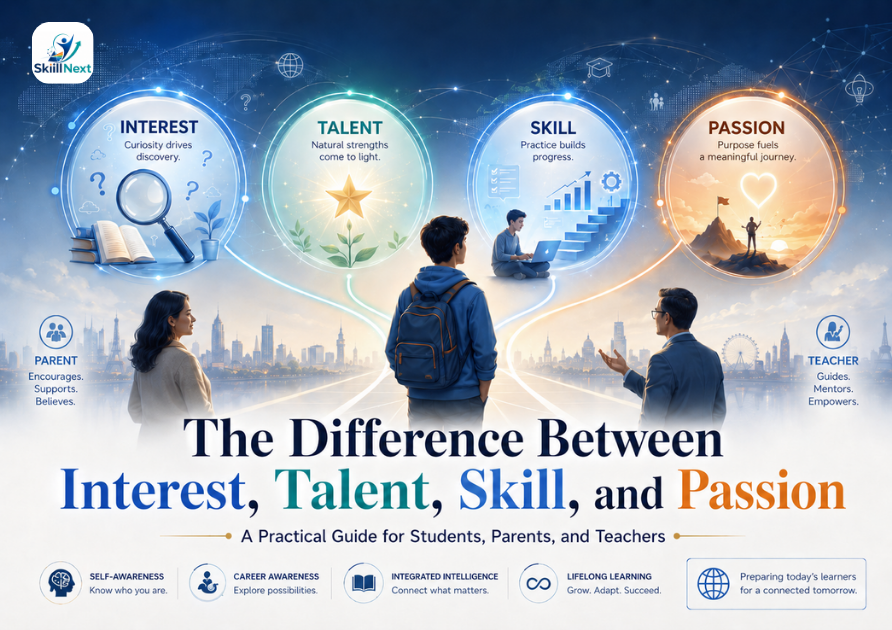
Many students like something, are naturally good at something, learn something well, or feel deeply connected to something — but these are not always the same. Read this full blog to understand the difference between interest, talent, skill, and passion, and discover how this clarity can support better learning, career choices, and lifelong growth.
A student says, “I love music.”
A parent says, “You are good at maths.”
A teacher says, “You write very well.”
A counsellor asks, “What kind of future do you want to build?”
At first, all these statements may appear connected. But they may be pointing to different things: interest, talent, skill, or passion.
This difference matters deeply.
Many students feel confused because they are expected to make career-related choices before they fully understand themselves. Parents often want to support their children but may not know whether a child’s liking for an activity is a passing interest, a genuine strength, a future skill pathway, or a meaningful life direction. Teachers observe students in classrooms, competitions, projects, and conversations, but even they need a clear framework to interpret what they see.
In career guidance, one of the biggest mistakes is using these four words interchangeably.
Interest is not always talent.
Talent is not always skill.
Skill is not always passion.
Passion is not always a career.
A student may be interested in cricket but may not have strong athletic talent. Another may have talent in public speaking but may not enjoy it. A student may build a skill in coding without being passionate about technology. Another may feel passionate about helping animals, but still need to build the skills required for veterinary science, animal welfare, research, or conservation.
The purpose of this article is to bring clarity.
When students, parents, and teachers understand the difference between interest, talent, skill, and passion, they can make better decisions. They can avoid pressure, comparison, and premature conclusions. They can create space for exploration, practice, reflection, and lifelong growth.
Let us begin with a clear explanation.
Interest is what you are curious about. It is what pulls your attention, makes you ask questions, or gives you the desire to explore.
A student may be interested in astronomy because they enjoy watching documentaries about space. Another may be interested in psychology because they like understanding people’s behaviour. A third may be interested in design because they notice colours, patterns, layouts, and aesthetics.
Interest is a starting point. It opens the door.
But interest alone does not prove ability. It also does not guarantee long-term commitment. Interests can be temporary, situational, or deeply developing. A child may be fascinated by robotics after watching a video, but the real test is whether that curiosity continues when learning becomes structured, complex, and effortful.
Example of interest:
A Grade 8 student enjoys watching videos about artificial intelligence and asks how machines learn. This shows interest in AI or technology. It does not yet prove skill or career suitability, but it is a valuable signal for exploration.
Talent refers to a natural inclination or early ability in a particular area. It is often visible when a student learns something faster than peers, performs with less effort, or shows unusual ease in an activity.
A student may have a talent for rhythm, spatial reasoning, storytelling, mathematics, empathy, leadership, sports coordination, or visual imagination.
Talent is potential. It is not a finished achievement.
This is important because talent can remain underdeveloped if it is not nurtured. A talented singer still needs voice training. A mathematically talented student still needs problem-solving practice. A child with leadership talent still needs emotional intelligence, communication, responsibility, and ethical decision-making.
Talent gives a student a head start, not a complete journey.
Example of talent:
A student quickly understands geometric patterns and can mentally visualise shapes. This may indicate spatial talent, which could later support architecture, design, engineering, animation, data visualisation, or product development.
Skill is developed ability. It is what a person can perform with some level of competence because they have learned, practised, received feedback, and improved.
Skills may be academic, technical, creative, social, emotional, physical, or professional.
Writing an essay is a skill. Solving equations is a skill. Playing the piano is a skill. Coding a website is a skill. Managing time is a skill. Listening carefully is also a skill.
Unlike talent, skill is not only about natural ability. It is built through effort, instruction, repetition, correction, and reflection. A student who is not naturally talented in public speaking can still become a strong speaker through practice. A student who initially struggles with mathematics can build mathematical skill through the right support and learning method.
Skill is measurable and improvable.
Example of skill:
A Grade 10 student learns Python, completes small projects, debugs errors, and builds a basic app. Coding has moved beyond interest. It has become a skill.
Passion is a deeper, more enduring connection with an activity, cause, subject, or purpose. It is not just excitement. It usually includes emotional energy, personal meaning, identity, and long-term commitment.
A student may feel passionate about environmental protection, storytelling, teaching, sports, research, entrepreneurship, social justice, medicine, technology, or music.
But passion should be understood carefully.
Healthy passion does not mean obsession. It should not destroy balance, wellbeing, relationships, or academic stability. A mature passion gives direction, but it also allows learning, patience, discipline, and adaptability.
Passion is not always discovered suddenly. Often, it develops slowly through exposure, practice, success, struggle, mentors, and meaningful experiences.
Example of passion:
A student who cares deeply about climate change, studies environmental science, joins school projects, reads about sustainability, and wants to solve real-world environmental problems may be developing passion for sustainability and climate action.
Shaan was a Grade 9 student in Mumbai. He was bright, curious, and often confused.
He loved watching cricket. He knew player statistics, match strategies, and tournament histories. His friends said, “You are passionate about cricket. You should become a cricketer.”
But when Shaan played on the field, he struggled with stamina and consistency. He enjoyed cricket deeply as a viewer and analyst, but he did not enjoy daily physical training. His cricket coach gently told him, “You understand the game well, but playing professionally requires a different level of physical discipline.”
Shaan felt disappointed.
In school, his mathematics teacher noticed something else. Shaan was quick at identifying patterns in data. During a class project, he created a simple spreadsheet to compare cricket players’ performance across seasons. He enjoyed discovering why some players performed better in specific conditions.
His teacher said, “Shaan, your interest may be cricket, but your talent may be pattern recognition.”
This sentence changed his thinking.
Later, during a computer class, Shaan learned basic coding. At first, he found it difficult. But he practised. He made mistakes. He asked questions. Slowly, he learned how to write small programs. Coding became a skill.
Then came the school annual project. Shaan created a simple cricket analytics dashboard showing runs, strike rates, averages, and performance trends. He presented it to his classmates. For the first time, he saw how his interest in cricket, talent in pattern recognition, and skill in coding could come together.
His passion was not necessarily playing cricket.
His emerging passion was using data to understand performance.
By Grade 11, Shaan began exploring data science, sports analytics, statistics, computer science, and decision sciences. His parents stopped asking, “Do you want to become a cricketer or an engineer?” Instead, they began asking, “What combination of interests, talents, skills, and meaningful problems should we help you explore?”
Shaan’s clarity did not come from one test, one mark sheet, or one hobby.
It came from understanding himself.
A simple way to understand the difference is through four questions.
Interest begins with curiosity. It is about attention, enjoyment, and exploration.
Ask:
What do I like learning about?
What topics naturally catch my attention?
What do I keep returning to even when no one forces me?
Talent is about potential. It may appear as quick learning, natural ease, unusual sensitivity, or early strength.
Ask:
What do I learn faster than many others?
Where do people notice my natural ability?
What feels easier for me than it does for others?
Skill is about competence. It is developed through learning and practice.
Ask:
What have I practised enough to do reliably?
What can I demonstrate through projects, performance, or results?
Where have I improved through effort?
Passion is about sustained meaning. It connects effort with identity and purpose.
Ask:
What work feels important to me?
What problems do I care about solving?
What activity or field gives me energy even when it becomes difficult?
Students often confuse interest, talent, skill, and passion because school life gives limited exposure to the real world of work. A student may know subjects, exams, marks, and popular careers, but may not fully understand the wide range of roles that exist globally.
For example, a student who likes biology may assume the only meaningful path is medicine. But biology connects to biotechnology, genetics, neuroscience, public health, environmental science, agriculture, sports science, bioinformatics, nutrition, psychology, and research.
Similarly, a student who enjoys drawing may assume the only career option is fine arts. But visual ability may connect to design, architecture, animation, user experience, product design, advertising, filmmaking, game design, education technology, or visual communication.
In India, this confusion is often intensified by early subject decisions, board exam pressure, entrance exam culture, and social comparison. Many students are asked to choose streams or career directions before they have had enough structured exposure to careers, skills, and self-awareness.
A global future requires a broader approach.
Students need to understand not only “What am I good at?” but also:
What am I curious about?
What can I become good at?
What problems matter to me?
What skills will the future demand?
What kind of life do I want to build?
Career clarity is rarely built from one factor. A strong career direction often emerges from the alignment of multiple factors.
A good career choice may involve:
Interest, because curiosity supports engagement.
Talent, because natural strengths can create confidence and momentum.
Skill, because employability depends on demonstrated competence.
Passion, because meaning supports resilience and long-term growth.
Opportunity, because careers exist within changing social, technological, and economic realities.
Wellbeing, because success should not come at the cost of balance.
A student does not need all four factors to be fully clear from the beginning. In fact, most students do not begin with passion. They begin with curiosity. Then they explore, practise, receive feedback, reflect, and gradually discover stronger patterns.
This is why career guidance should not simply ask, “What is your passion?”
A better question is:
“What are your interests, talents, skills, values, learning patterns, personality traits, opportunities, and future possibilities telling us together?”
This is Integrated Intelligence in action.
Interest: Enjoys sketching characters and watching animation videos.
Talent: Has strong visual imagination and proportion sense.
Skill: Learns digital illustration tools and creates portfolio pieces.
Passion: Wants to tell meaningful stories through visual media.
Possible pathways: Animation, graphic design, visual communication, game design, illustration, UX design, film design, educational content design.
Interest: Enjoys experiments and science documentaries.
Talent: Understands scientific concepts quickly.
Skill: Can design experiments, analyse results, and explain findings.
Passion: Wants to solve health, environment, or technology-related problems.
Possible pathways: Research, medicine, biotechnology, engineering, environmental science, data science, neuroscience, science communication.
Interest: Enjoys listening to people and understanding emotions.
Talent: Naturally empathetic and observant.
Skill: Builds communication, active listening, psychology knowledge, and conflict-resolution ability.
Passion: Wants to support human wellbeing.
Possible pathways: Psychology, counselling, education, social work, human resources, coaching, healthcare, community development.
Interest: Enjoys playing games and understanding game mechanics.
Talent: Strong strategy, reaction time, or systems thinking.
Skill: Learns coding, design, storytelling, 3D tools, or game testing.
Passion: Wants to create interactive experiences.
Possible pathways: Game design, game development, esports management, animation, storytelling, software testing, UX research, product design.
The key is not to dismiss an interest, but also not to overinterpret it. Every interest should be explored, tested, and connected with skill-building and real-world understanding.
Parents play a powerful role in helping students interpret themselves.
A parent’s responsibility is not to convert every interest into a career or every mark into a destiny. It is to create a safe environment for exploration, discipline, reflection, and wise decision-making.
Parents can help by observing patterns over time. Does the child return to an activity repeatedly? Does the child enjoy only the outcome, or also the process? Does the child continue when the activity becomes difficult? Does the child show improvement with feedback? Does the child connect the activity to a larger purpose?
Parents should also be careful with labels.
Saying “You are a born artist” may sound encouraging, but it can create pressure. Saying “You are not a maths person” can close doors too early. A better approach is to say, “You seem interested in this. Let us explore it more. Let us see what skills it requires and whether you enjoy the learning journey.”
The goal is not to push.
The goal is to guide.
Teachers often see dimensions of students that parents may not see. They observe how students respond to challenge, collaboration, deadlines, creativity, feedback, leadership, and responsibility.
A teacher may notice that a student who is quiet in class writes beautifully. Another student may not score the highest marks but may ask original questions. A third may struggle with theory but excel in hands-on projects.
Teachers can support self-awareness by giving specific feedback.
Instead of saying, “Good job,” a teacher can say:
“You explained the concept clearly.”
“You noticed a pattern others missed.”
“You worked patiently through difficulty.”
“You asked a thoughtful question.”
“You improved because you practised.”
Such feedback helps students understand the difference between interest, talent, and skill.
Teachers can also design classroom activities that allow multiple strengths to become visible: debates, projects, experiments, presentations, creative assignments, peer teaching, reflective journals, group problem-solving, and interdisciplinary learning.
The future of work is changing rapidly. Technology, automation, AI, sustainability, digital transformation, and global collaboration are reshaping careers. In such a world, students cannot rely only on a fixed career label.
They need self-awareness and adaptability.
A student may begin with an interest in biology, build skills in data analysis, discover talent in research thinking, and develop passion for public health. Another may begin with interest in storytelling, build digital media skills, discover talent in teaching, and develop passion for educational technology.
Future readiness is not about predicting one perfect job. It is about building the capacity to keep learning, adapting, connecting ideas, and making informed choices.
This is why students need a portfolio of awareness:
Awareness of self.
Awareness of careers.
Awareness of skills.
Awareness of change.
Awareness of wellbeing.
Awareness of lifelong learning.
The future will favour students who can combine knowledge, human strengths, digital skills, emotional intelligence, and purpose-driven learning.
At SkiillNext, career guidance is not viewed as a one-time answer. It is a guided process of discovery, interpretation, decision-making, and growth.
Students should first understand their interests, talents, learning styles, personality patterns, values, emotional strengths, and decision-making tendencies. Without self-awareness, career choices may become borrowed from friends, parents, social media, or social pressure.
An interest should be explored through reading, projects, conversations, internships, workshops, competitions, volunteering, and real-world exposure. Exploration helps students test whether curiosity can become commitment.
Talent should be noticed, but not worshipped. A student’s natural strengths are valuable signals, but they require development. Talent becomes meaningful only when supported by learning, discipline, feedback, and opportunity.
Skills are the bridge between potential and performance. Students should build academic, technical, communication, creative, digital, analytical, emotional, and life skills gradually. Skills convert dreams into capability.
Passion is not always found in childhood. It often develops through meaningful effort. Students should not panic if they do not yet know their passion. They should keep exploring, practising, reflecting, and noticing what feels meaningful over time.
Integrated Intelligence means combining different forms of understanding: self-awareness, career awareness, future skills, emotional intelligence, practical reality, and lifelong learning. A wise decision is rarely based on one factor alone.
Instead of asking only, “Which career should I choose?” students should also ask, “What kind of person am I becoming? What capabilities am I building? What problems do I want to understand? What future am I preparing for?”
That is the deeper purpose of career guidance.
Here is a practical four-week exploration exercise.
Write down what attracts your attention during the week. Include subjects, videos, conversations, problems, activities, books, hobbies, and questions.
At the end of the week, ask:
What did I return to repeatedly?
What made me curious?
What did I enjoy learning without pressure?
Ask parents, teachers, and friends:
Where do you think I learn quickly?
What do you think comes naturally to me?
What strengths have you noticed in me?
Compare their observations with your own experience.
Choose one interest and practise a related skill.
If you like writing, write one article.
If you like coding, build one small program.
If you like psychology, read one beginner-friendly book and summarise it.
If you like design, create one poster or prototype.
If you like science, complete one small experiment or project.
The goal is not perfection. The goal is evidence.
Ask:
Did I enjoy only the idea, or also the process?
Did I continue when it became difficult?
Did I feel proud of improving?
Does this connect to a problem or purpose I care about?
Do I want to explore this further?
This simple process helps students move from confusion to clarity.
For parents, the most useful support is patient observation. Watch patterns, not isolated moments. A child’s one-week fascination may not be a career direction, but repeated curiosity over months may be meaningful.
For teachers, the most useful support is precise feedback. Help students understand what they are actually demonstrating: curiosity, creativity, discipline, empathy, reasoning, communication, leadership, or technical skill.
For both parents and teachers, avoid forcing early certainty. Students need guidance, but they also need space to mature. Career clarity is built through exposure, reflection, and experience.
Encourage students to create a simple “Discovery Portfolio” containing:
Projects completed
Books or videos explored
Skills practised
Feedback received
Competitions or activities attempted
Reflection notes
Career questions
Strength observations
Over time, this portfolio becomes a powerful self-awareness document.
Not always. Some interests remain hobbies. Some become supporting strengths. Some grow into careers. The right approach is to explore before deciding.
Talent helps, but skill-building, discipline, mentorship, resilience, opportunity, and wellbeing also matter. Undeveloped talent may remain only potential.
Many skills can be developed through practice and feedback. Natural talent helps, but growth is not limited to talent.
Not necessarily. Passion often develops slowly through exposure, effort, struggle, success, and meaning.
The strongest pathways often combine all four, but students may begin with one or two. The goal is to develop alignment over time.
Interest, talent, skill, and passion are connected, but they are not the same.
Interest opens the door.
Talent shows potential.
Skill builds capability.
Passion gives meaning.
A wise career journey does not begin with pressure to find one perfect answer. It begins with self-awareness, exploration, practice, reflection, and guidance.
For students, this means being patient with yourself. You do not need to know everything today. You need to start observing, exploring, learning, and growing.
For parents, this means supporting without rushing. Your child’s future will not be built by comparison, fear, or force. It will be built through clarity, confidence, exposure, and meaningful development.
For teachers, this means helping students see themselves more accurately. Sometimes one thoughtful observation from a teacher can help a student understand a strength they never noticed.
In a changing world, the most future-ready students will not simply be those who choose the most popular career. They will be those who understand themselves, build relevant skills, remain open to change, and continue learning throughout life.
That is the true difference between choosing a career and designing a life.
And that is the heart of the SkiillNext philosophy: succeeding through Knowledge, Integrated Intelligence, and Lifelong Learning.
Interest is curiosity or attraction toward something. Passion is deeper, more sustained, and personally meaningful. Interest may be temporary, while passion usually involves long-term commitment and identity.
Yes. Interest can grow into passion when a student explores it deeply, builds related skills, experiences meaning, and continues despite difficulty.
Talent may begin as a natural inclination or early strength, but it must be developed. Without practice, feedback, and opportunity, talent may not become achievement.
Yes. Many skills can be developed through structured learning, deliberate practice, guidance, and persistence. Talent may speed up learning, but it is not the only factor.
Passion is important, but career decisions should not be based on passion alone. Students should also consider skills, strengths, values, opportunities, future trends, lifestyle preferences, and wellbeing.
This is common and often positive. Help the child explore systematically. Track which interests remain over time, which ones lead to action, and which ones connect with strengths and skills.
Teachers should observe curiosity, learning speed, effort, improvement, creativity, collaboration, communication, resilience, and problem-solving. These signals can help students understand themselves better.
That is completely normal. Instead of searching desperately for passion, the student should begin with exploration, skill-building, exposure, and reflection. Passion often develops through the journey.
A student says, “I love music.”
A parent says, “You are good at maths.”
A teacher says, “You write very well.”
A counsellor asks, “What kind of future do you want to build?”
At first, all these statements may appear connected. But they may be pointing to different things: interest, talent, skill, or passion.
This difference matters deeply.
Many students feel confused because they are expected to make career-related choices before they fully understand themselves. Parents often want to support their children but may not know whether a child’s liking for an activity is a passing interest, a genuine strength, a future skill pathway, or a meaningful life direction. Teachers observe students in classrooms, competitions, projects, and conversations, but even they need a clear framework to interpret what they see.
In career guidance, one of the biggest mistakes is using these four words interchangeably.
Interest is not always talent.
Talent is not always skill.
Skill is not always passion.
Passion is not always a career.
A student may be interested in cricket but may not have strong athletic talent. Another may have talent in public speaking but may not enjoy it. A student may build a skill in coding without being passionate about technology. Another may feel passionate about helping animals, but still need to build the skills required for veterinary science, animal welfare, research, or conservation.
The purpose of this article is to bring clarity.
When students, parents, and teachers understand the difference between interest, talent, skill, and passion, they can make better decisions. They can avoid pressure, comparison, and premature conclusions. They can create space for exploration, practice, reflection, and lifelong growth.
Let us begin with a clear explanation.
Interest is what you are curious about. It is what pulls your attention, makes you ask questions, or gives you the desire to explore.
A student may be interested in astronomy because they enjoy watching documentaries about space. Another may be interested in psychology because they like understanding people’s behaviour. A third may be interested in design because they notice colours, patterns, layouts, and aesthetics.
Interest is a starting point. It opens the door.
But interest alone does not prove ability. It also does not guarantee long-term commitment. Interests can be temporary, situational, or deeply developing. A child may be fascinated by robotics after watching a video, but the real test is whether that curiosity continues when learning becomes structured, complex, and effortful.
Example of interest:
A Grade 8 student enjoys watching videos about artificial intelligence and asks how machines learn. This shows interest in AI or technology. It does not yet prove skill or career suitability, but it is a valuable signal for exploration.
Talent refers to a natural inclination or early ability in a particular area. It is often visible when a student learns something faster than peers, performs with less effort, or shows unusual ease in an activity.
A student may have a talent for rhythm, spatial reasoning, storytelling, mathematics, empathy, leadership, sports coordination, or visual imagination.
Talent is potential. It is not a finished achievement.
This is important because talent can remain underdeveloped if it is not nurtured. A talented singer still needs voice training. A mathematically talented student still needs problem-solving practice. A child with leadership talent still needs emotional intelligence, communication, responsibility, and ethical decision-making.
Talent gives a student a head start, not a complete journey.
Example of talent:
A student quickly understands geometric patterns and can mentally visualise shapes. This may indicate spatial talent, which could later support architecture, design, engineering, animation, data visualisation, or product development.
Skill is developed ability. It is what a person can perform with some level of competence because they have learned, practised, received feedback, and improved.
Skills may be academic, technical, creative, social, emotional, physical, or professional.
Writing an essay is a skill. Solving equations is a skill. Playing the piano is a skill. Coding a website is a skill. Managing time is a skill. Listening carefully is also a skill.
Unlike talent, skill is not only about natural ability. It is built through effort, instruction, repetition, correction, and reflection. A student who is not naturally talented in public speaking can still become a strong speaker through practice. A student who initially struggles with mathematics can build mathematical skill through the right support and learning method.
Skill is measurable and improvable.
Example of skill:
A Grade 10 student learns Python, completes small projects, debugs errors, and builds a basic app. Coding has moved beyond interest. It has become a skill.
Passion is a deeper, more enduring connection with an activity, cause, subject, or purpose. It is not just excitement. It usually includes emotional energy, personal meaning, identity, and long-term commitment.
A student may feel passionate about environmental protection, storytelling, teaching, sports, research, entrepreneurship, social justice, medicine, technology, or music.
But passion should be understood carefully.
Healthy passion does not mean obsession. It should not destroy balance, wellbeing, relationships, or academic stability. A mature passion gives direction, but it also allows learning, patience, discipline, and adaptability.
Passion is not always discovered suddenly. Often, it develops slowly through exposure, practice, success, struggle, mentors, and meaningful experiences.
Example of passion:
A student who cares deeply about climate change, studies environmental science, joins school projects, reads about sustainability, and wants to solve real-world environmental problems may be developing passion for sustainability and climate action.
Shaan was a Grade 9 student in Mumbai. He was bright, curious, and often confused.
He loved watching cricket. He knew player statistics, match strategies, and tournament histories. His friends said, “You are passionate about cricket. You should become a cricketer.”
But when Shaan played on the field, he struggled with stamina and consistency. He enjoyed cricket deeply as a viewer and analyst, but he did not enjoy daily physical training. His cricket coach gently told him, “You understand the game well, but playing professionally requires a different level of physical discipline.”
Shaan felt disappointed.
In school, his mathematics teacher noticed something else. Shaan was quick at identifying patterns in data. During a class project, he created a simple spreadsheet to compare cricket players’ performance across seasons. He enjoyed discovering why some players performed better in specific conditions.
His teacher said, “Shaan, your interest may be cricket, but your talent may be pattern recognition.”
This sentence changed his thinking.
Later, during a computer class, Shaan learned basic coding. At first, he found it difficult. But he practised. He made mistakes. He asked questions. Slowly, he learned how to write small programs. Coding became a skill.
Then came the school annual project. Shaan created a simple cricket analytics dashboard showing runs, strike rates, averages, and performance trends. He presented it to his classmates. For the first time, he saw how his interest in cricket, talent in pattern recognition, and skill in coding could come together.
His passion was not necessarily playing cricket.
His emerging passion was using data to understand performance.
By Grade 11, Shaan began exploring data science, sports analytics, statistics, computer science, and decision sciences. His parents stopped asking, “Do you want to become a cricketer or an engineer?” Instead, they began asking, “What combination of interests, talents, skills, and meaningful problems should we help you explore?”
Shaan’s clarity did not come from one test, one mark sheet, or one hobby.
It came from understanding himself.
A simple way to understand the difference is through four questions.
Interest begins with curiosity. It is about attention, enjoyment, and exploration.
Ask:
What do I like learning about?
What topics naturally catch my attention?
What do I keep returning to even when no one forces me?
Talent is about potential. It may appear as quick learning, natural ease, unusual sensitivity, or early strength.
Ask:
What do I learn faster than many others?
Where do people notice my natural ability?
What feels easier for me than it does for others?
Skill is about competence. It is developed through learning and practice.
Ask:
What have I practised enough to do reliably?
What can I demonstrate through projects, performance, or results?
Where have I improved through effort?
Passion is about sustained meaning. It connects effort with identity and purpose.
Ask:
What work feels important to me?
What problems do I care about solving?
What activity or field gives me energy even when it becomes difficult?
Students often confuse interest, talent, skill, and passion because school life gives limited exposure to the real world of work. A student may know subjects, exams, marks, and popular careers, but may not fully understand the wide range of roles that exist globally.
For example, a student who likes biology may assume the only meaningful path is medicine. But biology connects to biotechnology, genetics, neuroscience, public health, environmental science, agriculture, sports science, bioinformatics, nutrition, psychology, and research.
Similarly, a student who enjoys drawing may assume the only career option is fine arts. But visual ability may connect to design, architecture, animation, user experience, product design, advertising, filmmaking, game design, education technology, or visual communication.
In India, this confusion is often intensified by early subject decisions, board exam pressure, entrance exam culture, and social comparison. Many students are asked to choose streams or career directions before they have had enough structured exposure to careers, skills, and self-awareness.
A global future requires a broader approach.
Students need to understand not only “What am I good at?” but also:
What am I curious about?
What can I become good at?
What problems matter to me?
What skills will the future demand?
What kind of life do I want to build?
Career clarity is rarely built from one factor. A strong career direction often emerges from the alignment of multiple factors.
A good career choice may involve:
Interest, because curiosity supports engagement.
Talent, because natural strengths can create confidence and momentum.
Skill, because employability depends on demonstrated competence.
Passion, because meaning supports resilience and long-term growth.
Opportunity, because careers exist within changing social, technological, and economic realities.
Wellbeing, because success should not come at the cost of balance.
A student does not need all four factors to be fully clear from the beginning. In fact, most students do not begin with passion. They begin with curiosity. Then they explore, practise, receive feedback, reflect, and gradually discover stronger patterns.
This is why career guidance should not simply ask, “What is your passion?”
A better question is:
“What are your interests, talents, skills, values, learning patterns, personality traits, opportunities, and future possibilities telling us together?”
This is Integrated Intelligence in action.
Interest: Enjoys sketching characters and watching animation videos.
Talent: Has strong visual imagination and proportion sense.
Skill: Learns digital illustration tools and creates portfolio pieces.
Passion: Wants to tell meaningful stories through visual media.
Possible pathways: Animation, graphic design, visual communication, game design, illustration, UX design, film design, educational content design.
Interest: Enjoys experiments and science documentaries.
Talent: Understands scientific concepts quickly.
Skill: Can design experiments, analyse results, and explain findings.
Passion: Wants to solve health, environment, or technology-related problems.
Possible pathways: Research, medicine, biotechnology, engineering, environmental science, data science, neuroscience, science communication.
Interest: Enjoys listening to people and understanding emotions.
Talent: Naturally empathetic and observant.
Skill: Builds communication, active listening, psychology knowledge, and conflict-resolution ability.
Passion: Wants to support human wellbeing.
Possible pathways: Psychology, counselling, education, social work, human resources, coaching, healthcare, community development.
Interest: Enjoys playing games and understanding game mechanics.
Talent: Strong strategy, reaction time, or systems thinking.
Skill: Learns coding, design, storytelling, 3D tools, or game testing.
Passion: Wants to create interactive experiences.
Possible pathways: Game design, game development, esports management, animation, storytelling, software testing, UX research, product design.
The key is not to dismiss an interest, but also not to overinterpret it. Every interest should be explored, tested, and connected with skill-building and real-world understanding.
Parents play a powerful role in helping students interpret themselves.
A parent’s responsibility is not to convert every interest into a career or every mark into a destiny. It is to create a safe environment for exploration, discipline, reflection, and wise decision-making.
Parents can help by observing patterns over time. Does the child return to an activity repeatedly? Does the child enjoy only the outcome, or also the process? Does the child continue when the activity becomes difficult? Does the child show improvement with feedback? Does the child connect the activity to a larger purpose?
Parents should also be careful with labels.
Saying “You are a born artist” may sound encouraging, but it can create pressure. Saying “You are not a maths person” can close doors too early. A better approach is to say, “You seem interested in this. Let us explore it more. Let us see what skills it requires and whether you enjoy the learning journey.”
The goal is not to push.
The goal is to guide.
Teachers often see dimensions of students that parents may not see. They observe how students respond to challenge, collaboration, deadlines, creativity, feedback, leadership, and responsibility.
A teacher may notice that a student who is quiet in class writes beautifully. Another student may not score the highest marks but may ask original questions. A third may struggle with theory but excel in hands-on projects.
Teachers can support self-awareness by giving specific feedback.
Instead of saying, “Good job,” a teacher can say:
“You explained the concept clearly.”
“You noticed a pattern others missed.”
“You worked patiently through difficulty.”
“You asked a thoughtful question.”
“You improved because you practised.”
Such feedback helps students understand the difference between interest, talent, and skill.
Teachers can also design classroom activities that allow multiple strengths to become visible: debates, projects, experiments, presentations, creative assignments, peer teaching, reflective journals, group problem-solving, and interdisciplinary learning.
The future of work is changing rapidly. Technology, automation, AI, sustainability, digital transformation, and global collaboration are reshaping careers. In such a world, students cannot rely only on a fixed career label.
They need self-awareness and adaptability.
A student may begin with an interest in biology, build skills in data analysis, discover talent in research thinking, and develop passion for public health. Another may begin with interest in storytelling, build digital media skills, discover talent in teaching, and develop passion for educational technology.
Future readiness is not about predicting one perfect job. It is about building the capacity to keep learning, adapting, connecting ideas, and making informed choices.
This is why students need a portfolio of awareness:
Awareness of self.
Awareness of careers.
Awareness of skills.
Awareness of change.
Awareness of wellbeing.
Awareness of lifelong learning.
The future will favour students who can combine knowledge, human strengths, digital skills, emotional intelligence, and purpose-driven learning.
At SkiillNext, career guidance is not viewed as a one-time answer. It is a guided process of discovery, interpretation, decision-making, and growth.
Students should first understand their interests, talents, learning styles, personality patterns, values, emotional strengths, and decision-making tendencies. Without self-awareness, career choices may become borrowed from friends, parents, social media, or social pressure.
An interest should be explored through reading, projects, conversations, internships, workshops, competitions, volunteering, and real-world exposure. Exploration helps students test whether curiosity can become commitment.
Talent should be noticed, but not worshipped. A student’s natural strengths are valuable signals, but they require development. Talent becomes meaningful only when supported by learning, discipline, feedback, and opportunity.
Skills are the bridge between potential and performance. Students should build academic, technical, communication, creative, digital, analytical, emotional, and life skills gradually. Skills convert dreams into capability.
Passion is not always found in childhood. It often develops through meaningful effort. Students should not panic if they do not yet know their passion. They should keep exploring, practising, reflecting, and noticing what feels meaningful over time.
Integrated Intelligence means combining different forms of understanding: self-awareness, career awareness, future skills, emotional intelligence, practical reality, and lifelong learning. A wise decision is rarely based on one factor alone.
Instead of asking only, “Which career should I choose?” students should also ask, “What kind of person am I becoming? What capabilities am I building? What problems do I want to understand? What future am I preparing for?”
That is the deeper purpose of career guidance.
Here is a practical four-week exploration exercise.
Write down what attracts your attention during the week. Include subjects, videos, conversations, problems, activities, books, hobbies, and questions.
At the end of the week, ask:
What did I return to repeatedly?
What made me curious?
What did I enjoy learning without pressure?
Ask parents, teachers, and friends:
Where do you think I learn quickly?
What do you think comes naturally to me?
What strengths have you noticed in me?
Compare their observations with your own experience.
Choose one interest and practise a related skill.
If you like writing, write one article.
If you like coding, build one small program.
If you like psychology, read one beginner-friendly book and summarise it.
If you like design, create one poster or prototype.
If you like science, complete one small experiment or project.
The goal is not perfection. The goal is evidence.
Ask:
Did I enjoy only the idea, or also the process?
Did I continue when it became difficult?
Did I feel proud of improving?
Does this connect to a problem or purpose I care about?
Do I want to explore this further?
This simple process helps students move from confusion to clarity.
For parents, the most useful support is patient observation. Watch patterns, not isolated moments. A child’s one-week fascination may not be a career direction, but repeated curiosity over months may be meaningful.
For teachers, the most useful support is precise feedback. Help students understand what they are actually demonstrating: curiosity, creativity, discipline, empathy, reasoning, communication, leadership, or technical skill.
For both parents and teachers, avoid forcing early certainty. Students need guidance, but they also need space to mature. Career clarity is built through exposure, reflection, and experience.
Encourage students to create a simple “Discovery Portfolio” containing:
Projects completed
Books or videos explored
Skills practised
Feedback received
Competitions or activities attempted
Reflection notes
Career questions
Strength observations
Over time, this portfolio becomes a powerful self-awareness document.
Not always. Some interests remain hobbies. Some become supporting strengths. Some grow into careers. The right approach is to explore before deciding.
Talent helps, but skill-building, discipline, mentorship, resilience, opportunity, and wellbeing also matter. Undeveloped talent may remain only potential.
Many skills can be developed through practice and feedback. Natural talent helps, but growth is not limited to talent.
Not necessarily. Passion often develops slowly through exposure, effort, struggle, success, and meaning.
The strongest pathways often combine all four, but students may begin with one or two. The goal is to develop alignment over time.
Interest, talent, skill, and passion are connected, but they are not the same.
Interest opens the door.
Talent shows potential.
Skill builds capability.
Passion gives meaning.
A wise career journey does not begin with pressure to find one perfect answer. It begins with self-awareness, exploration, practice, reflection, and guidance.
For students, this means being patient with yourself. You do not need to know everything today. You need to start observing, exploring, learning, and growing.
For parents, this means supporting without rushing. Your child’s future will not be built by comparison, fear, or force. It will be built through clarity, confidence, exposure, and meaningful development.
For teachers, this means helping students see themselves more accurately. Sometimes one thoughtful observation from a teacher can help a student understand a strength they never noticed.
In a changing world, the most future-ready students will not simply be those who choose the most popular career. They will be those who understand themselves, build relevant skills, remain open to change, and continue learning throughout life.
That is the true difference between choosing a career and designing a life.
And that is the heart of the SkiillNext philosophy: succeeding through Knowledge, Integrated Intelligence, and Lifelong Learning.
Interest is curiosity or attraction toward something. Passion is deeper, more sustained, and personally meaningful. Interest may be temporary, while passion usually involves long-term commitment and identity.
Yes. Interest can grow into passion when a student explores it deeply, builds related skills, experiences meaning, and continues despite difficulty.
Talent may begin as a natural inclination or early strength, but it must be developed. Without practice, feedback, and opportunity, talent may not become achievement.
Yes. Many skills can be developed through structured learning, deliberate practice, guidance, and persistence. Talent may speed up learning, but it is not the only factor.
Passion is important, but career decisions should not be based on passion alone. Students should also consider skills, strengths, values, opportunities, future trends, lifestyle preferences, and wellbeing.
This is common and often positive. Help the child explore systematically. Track which interests remain over time, which ones lead to action, and which ones connect with strengths and skills.
Teachers should observe curiosity, learning speed, effort, improvement, creativity, collaboration, communication, resilience, and problem-solving. These signals can help students understand themselves better.
That is completely normal. Instead of searching desperately for passion, the student should begin with exploration, skill-building, exposure, and reflection. Passion often develops through the journey.