
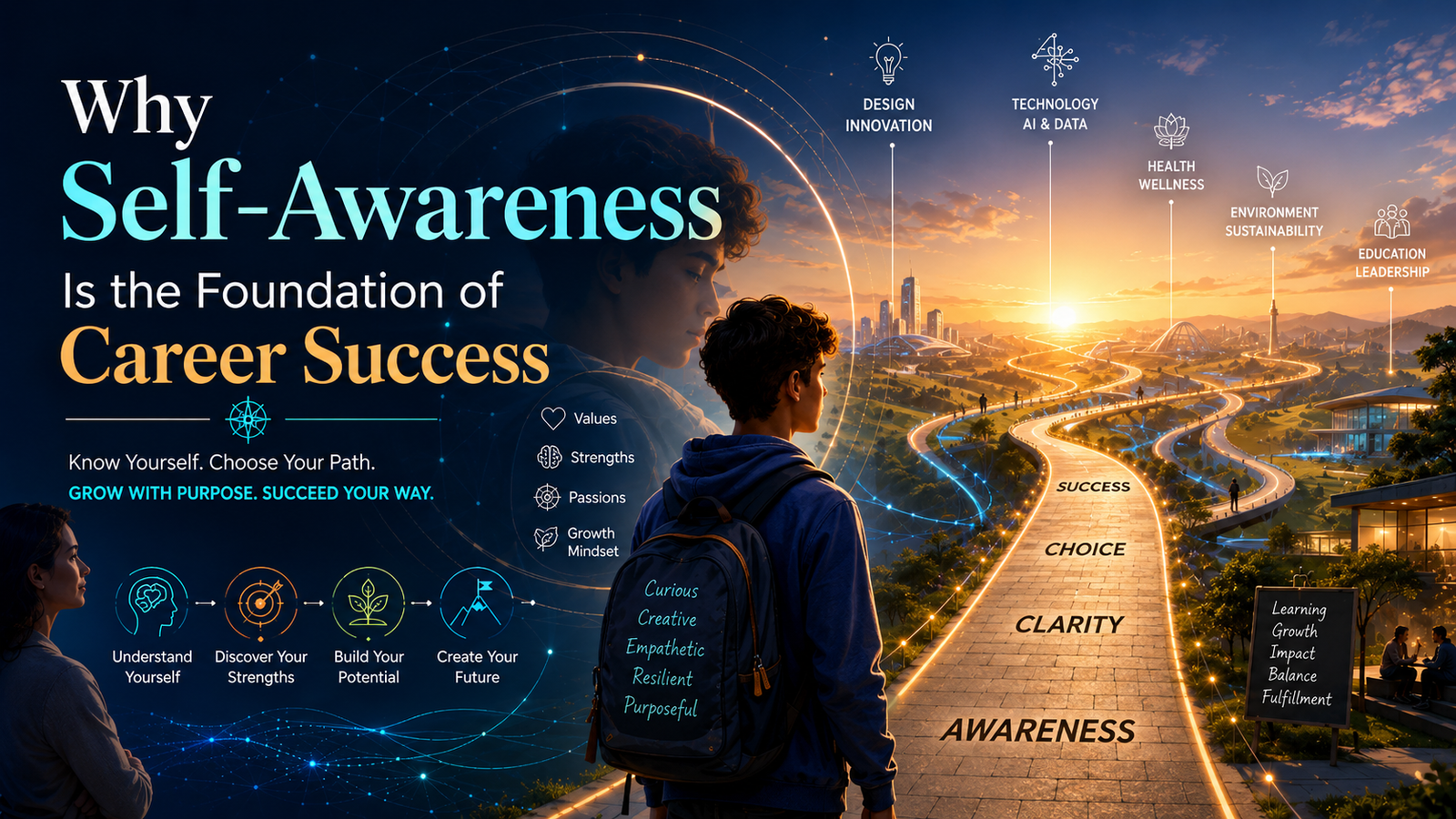
Self-awareness helps students understand their strengths, interests, values, emotions, and aspirations before making important academic and career choices. It is the inner compass that supports clarity, confidence, wellbeing, and meaningful success. Read the full blog to explore how students and parents can build this foundation together.
When students think about career success, they often imagine marks, subjects, degrees, entrance exams, colleges, jobs, salaries, and professional achievements. These are important. But they are not the starting point.
The real starting point is self-awareness.
Before a student can answer, “Which career should I choose?”, they first need to understand, “Who am I becoming?” Before parents ask, “Which stream is best?”, they need to help the child explore, “What kind of learner, thinker, problem-solver, creator, communicator, and person is my child?”
Self-awareness is the ability to understand one’s strengths, interests, values, emotions, motivations, learning style, personality, aspirations, and areas of improvement. It helps students recognize what energizes them, what challenges them, what they care about, and how they respond to situations.
For students in Grades 6–12, self-awareness is not a luxury. It is a developmental necessity. These years shape identity, confidence, academic choices, social relationships, habits, emotional regulation, and future direction. A student who understands themselves better is more likely to make thoughtful choices, handle pressure, learn from feedback, communicate needs, and build a meaningful path.
For parents, self-awareness provides a more balanced way to support children. Instead of pushing a child toward a popular stream, a high-status career, or a socially approved path, parents can guide the child toward a direction that fits their abilities, interests, values, and long-term wellbeing.
At SkiillNext, self-awareness is viewed as the first foundation of career readiness because career success is not only about getting ahead. It is about growing with clarity, confidence, adaptability, purpose, and balance.
Self-awareness means seeing oneself with honesty and clarity. It is not about labelling a child as “good at science,” “weak in maths,” “creative,” “introvert,” or “not career-focused.” It is about understanding the deeper patterns behind behaviour, interest, learning, choices, and emotions.
For a student, self-awareness includes questions such as:
What subjects do I naturally enjoy?
What kind of problems do I like solving?
What activities make me feel engaged?
What do I find difficult, and why?
How do I respond to pressure?
Do I prefer working alone, in teams, or in structured guidance?
What values matter to me?
What kind of future life do I imagine?
What motivates me — recognition, curiosity, helping others, creativity, stability, challenge, independence, or impact?
For parents, self-awareness means observing the child beyond marks. It means noticing patterns: curiosity, persistence, emotional triggers, communication style, decision-making ability, strengths, fears, interests, and emerging identity.
Self-awareness is not a one-time discovery. It develops gradually through reflection, experience, feedback, exposure, conversation, and guidance.
Today’s students are growing up in a world of rapid change. Careers are no longer linear. New industries are emerging, traditional roles are transforming, and technology, artificial intelligence, automation, globalization, and interdisciplinary work are reshaping opportunities.
In such a world, students cannot depend only on fixed career formulas.
Earlier, many career decisions were made through a limited set of options: doctor, engineer, teacher, government service, business, law, management, or chartered accountancy. These remain valuable paths, but the career landscape has expanded significantly. Students now encounter fields such as data science, design, psychology, sustainability, digital media, biotechnology, entrepreneurship, cybersecurity, public policy, sports science, animation, behavioural science, product management, robotics, AI ethics, and many more.
This expansion creates opportunity, but also confusion.
When options increase, self-awareness becomes more important. A student who does not understand themselves may simply follow trends. A student who understands themselves can explore opportunities more intelligently.
Self-awareness helps students move from imitation to informed choice.
Instead of asking, “What is everyone choosing?”, the student begins to ask, “What fits my strengths, interests, values, and future goals?”
That shift is the beginning of career maturity.
Career success is often misunderstood as only financial achievement, a prestigious job title, or admission to a reputed institution. These may be meaningful outcomes, but they do not fully define success.
A more complete view of career success includes:
Clarity of direction
Confidence in decision-making
Ability to learn and adapt
Emotional resilience
Meaningful contribution
Sustainable performance
Healthy relationships
Personal wellbeing
Balanced life design
Continuous growth
Self-awareness supports all these dimensions.
A student who understands their strengths can use them more effectively. A student who understands their weaknesses can work on them without shame. A student who understands their interests can explore relevant career areas. A student who understands their values can avoid choices that may look attractive but feel deeply misaligned later.
For example, a student may be academically strong in science but deeply interested in design, human behaviour, or environmental problem-solving. Another student may enjoy mathematics but not necessarily want a conventional engineering path. A third student may be socially confident and empathetic, with potential in counselling, teaching, law, management, public service, or communication-based careers.
Marks tell part of the story. Self-awareness helps understand the full story.
Self-awareness should not begin only after Class 10 or Class 12. By then, many students are already under pressure to choose subjects, prepare for entrance exams, or make decisions based on limited exposure.
Grades 6–8 are ideal for early discovery. At this stage, students can begin noticing their interests, learning preferences, strengths, habits, curiosity areas, social behaviour, and emotional patterns. The goal is not career selection. The goal is self-understanding.
Grades 9–10 are important for structured reflection. Students begin facing subject-related choices, performance pressure, peer comparison, and expectations from family and school. Self-awareness helps them evaluate options more thoughtfully rather than choosing streams only because of marks, peer influence, or family pressure.
Grades 11–12 require deeper career alignment. Students need to connect academic direction with future possibilities. They must understand their motivation, aptitude, interests, values, readiness, and long-term goals. Self-awareness helps reduce confusion and supports better planning.
This developmental approach prevents rushed decisions. It allows career planning to become a process, not a panic-driven event.
Many career mistakes begin with low self-awareness.
A student may choose a stream because friends are choosing it.
A parent may push a career because it worked for someone else.
A student may select a subject based only on marks, not interest.
A family may prefer a “safe” career without considering the child’s temperament.
A student may avoid a suitable path because of lack of confidence.
A child may appear “unmotivated” when the real issue is lack of connection with the chosen direction.
Without self-awareness, students may experience confusion, stress, disengagement, low confidence, or frequent changes in direction.
This does not mean every student must know their final career early. That is unrealistic. But students should gradually develop awareness of themselves so that each decision becomes better informed.
A career decision without self-awareness is like using a map without knowing your starting point.
Self-awareness is multidimensional. For career guidance, students and parents should explore at least five key dimensions.
Strength awareness means understanding what a student does relatively well. This may include academic strengths, communication skills, creativity, logical thinking, empathy, leadership, observation, discipline, problem-solving, memory, imagination, practical ability, or persistence.
Strengths are not limited to school subjects. A child who organizes group activities, repairs things, writes stories, asks deep questions, notices people’s feelings, explains concepts to friends, or creates digital content may be showing important career-related strengths.
Parents should observe repeated patterns of natural ability and effort. Teachers and counsellors can also help identify strengths more objectively.
Interest awareness means understanding what naturally attracts a student’s attention. Interests may appear through reading choices, questions, hobbies, online searches, conversations, projects, games, experiments, or activities.
A student may be interested in animals, machines, human behaviour, business, nature, technology, art, sports, storytelling, finance, medicine, social issues, space, design, or teaching.
Interests do not automatically become careers, but they provide important clues. When interests are explored seriously, they can open pathways toward subjects, projects, internships, skill-building, and career possibilities.
Values are what a person considers important. Some students value security. Some value creativity. Some value independence. Some value helping others. Some value recognition, stability, innovation, justice, income, leadership, freedom, or social impact.
Values matter because a career may be successful externally but unsatisfying internally if it conflicts with personal values.
For example, a student who values human connection may feel unhappy in a highly isolated work environment. A student who values creativity may feel restricted in overly repetitive work. A student who values stability may find highly uncertain career paths stressful unless properly prepared.
Understanding values helps students make better long-term choices.
Emotional awareness means recognizing feelings, triggers, reactions, stress patterns, confidence levels, and coping style. It helps students understand how emotions affect learning, relationships, decision-making, and performance.
A student may feel anxious before exams, discouraged by comparison, overwhelmed by expectations, or afraid of failure. Without emotional awareness, these feelings may appear as laziness, anger, avoidance, or lack of interest.
When students learn to name and understand emotions, they can manage them better. This supports academic performance, relationships, wellbeing, and career readiness.
Aspiration awareness means understanding the kind of life and future a student wishes to build. It does not mean having a fixed dream job. It means reflecting on questions such as:
What kind of problems do I want to solve?
What kind of people do I want to work with?
What kind of lifestyle matters to me?
What kind of contribution feels meaningful?
What kind of learning journey excites me?
This helps students see careers not only as jobs, but as part of life design.
In India, academic choices after Class 10 and Class 12 often carry heavy emotional weight. Science, Commerce, Humanities, vocational options, integrated programmes, entrance exams, and college pathways are often discussed with anxiety.
Self-awareness can make this process healthier.
A student should not choose Science only because they scored well. A student should not avoid Humanities because others underestimate it. A student should not choose Commerce only because it appears practical. A student should not enter a competitive exam track without understanding the discipline, effort, interest, and long-term fit required.
Academic decisions should consider:
Aptitude
Interest
Learning style
Work habits
Subject enjoyment
Career exposure
Personality
Motivation
Family context
Future opportunities
Wellbeing
This balanced approach helps students choose with clarity instead of pressure.
Future readiness is not only about coding, AI, robotics, or digital skills. These are important, but future readiness also requires human capabilities.
Students will need adaptability, critical thinking, creativity, communication, collaboration, emotional intelligence, ethical judgment, resilience, and lifelong learning. Self-awareness supports all of these.
A self-aware student can recognize when they need to improve.
A self-aware student can ask for help earlier.
A self-aware student can learn from mistakes.
A self-aware student can adapt to changing environments.
A self-aware student can make better decisions under uncertainty.
A self-aware student can balance ambition with wellbeing.
In a world where knowledge changes quickly, the ability to understand oneself and keep learning becomes a long-term advantage.
Career success without wellbeing is incomplete.
Many students today face academic pressure, comparison, digital distraction, social expectations, performance anxiety, and uncertainty about the future. Parents also experience pressure because they want to secure the best possible future for their children.
Self-awareness supports wellbeing by helping students understand their limits, needs, emotions, strengths, and stress responses. It encourages healthier choices around study habits, sleep, friendships, screen time, hobbies, exercise, and rest.
A self-aware student is more likely to notice:
When they are tired
When they are stressed
When they need support
When comparison is affecting confidence
When a goal is meaningful
When a goal is being pursued only to please others
When they are losing balance
This does not remove challenges, but it helps students respond more wisely.
A balanced life does not mean avoiding ambition. It means building ambition on a healthy foundation.
Students should learn that success is not only about doing more. It is also about knowing what matters, choosing well, recovering well, and growing sustainably.
Parents play a powerful role in shaping a child’s self-understanding. Children often see themselves through the words adults use for them.
A child repeatedly called “careless” may stop seeing their potential.
A child constantly compared with others may lose confidence.
A child praised only for marks may believe performance is their only value.
A child allowed to reflect may develop confidence and self-understanding.
Parents can support self-awareness by asking better questions.
Instead of asking only, “How many marks did you get?”, ask:
“What did you understand well?”
“What was difficult?”
“What helped you learn?”
“What did you enjoy?”
“What would you do differently next time?”
“What kind of support do you need?”
Instead of saying, “You must become this,” parents can say:
“Let us understand your strengths and options carefully.”
“Let us explore before deciding.”
“Let us look at both interest and effort.”
“Let us choose a path that supports growth and wellbeing.”
The goal is not to leave children alone in decision-making. The goal is to guide them without overpowering their individuality.
Schools can help students develop self-awareness through reflective learning, project-based activities, career exposure, mentoring, counselling, life skills education, and social-emotional learning.
A school that focuses only on marks may produce performance but not always clarity. A school that encourages reflection helps students connect learning with identity, purpose, and future possibilities.
Educators can support students by:
Giving constructive feedback
Encouraging questions
Recognizing different kinds of strengths
Creating safe spaces for expression
Connecting subjects with real-world careers
Encouraging reflection after projects and assessments
Helping students understand effort, mindset, and growth
Career guidance should not be treated as a one-day seminar. It should be a developmental process that includes self-awareness, career awareness, future readiness, and lifelong learning.
Reality: Self-awareness does not force early career decisions. It helps students make better decisions gradually.
Reality: Marks matter, but they do not fully reveal interest, personality, values, motivation, emotional readiness, or long-term fit.
Reality: Every student benefits from self-awareness and guidance. Even high-performing students can make misaligned choices.
Reality: Parents have valuable experience, but the child’s strengths, interests, and future context must also be understood.
Reality: Self-awareness improves practical decisions about subjects, skills, careers, habits, relationships, and wellbeing.
Students can begin with simple practices.
Maintain a reflection journal. Write weekly about what you enjoyed learning, what challenged you, what you improved, and what you want to explore.
Notice energy patterns. Some activities drain you, while others make you curious and engaged. These patterns matter.
Ask for feedback. Speak to teachers, parents, mentors, and friends about what they notice as your strengths.
Explore different fields. Read about careers, watch educational videos, speak to professionals, attend workshops, and try small projects.
Understand emotions. Notice what makes you anxious, confident, motivated, or discouraged.
Try skill-based activities. Participate in debates, coding, art, science projects, writing, sports, volunteering, entrepreneurship activities, or problem-solving challenges.
Reflect after experiences. Ask: What did I learn about myself?
Self-awareness grows through action and reflection together.
Parents can support their children through patient observation and meaningful dialogue.
Observe patterns instead of making quick judgments.
Encourage exploration before specialization.
Avoid constant comparison with siblings, cousins, classmates, or neighbours.
Respect different forms of intelligence and talent.
Discuss careers as evolving possibilities, not fixed labels.
Help children connect effort with growth.
Create a home environment where mistakes can become learning.
Balance ambition with emotional wellbeing.
Seek professional career counselling when decisions feel complex or confusing.
Parents should remember that career guidance is not about controlling the child’s future. It is about helping the child build the awareness and capability to shape it.
At SkiillNext, career success is understood through a broader lens: Self-Awareness, Career Awareness, Future Readiness, Integrated Intelligence, and Lifelong Learning.
Self-awareness is the foundation because it helps students understand their inner world before navigating the outer world of opportunities.
Knowledge is not only external information. It is also self-knowledge.
Students need to understand their strengths, interests, values, emotions, learning preferences, and aspirations. This self-knowledge helps them interpret academic choices and career options more clearly.
Without self-knowledge, career information can become overwhelming. With self-knowledge, information becomes meaningful.
Integrated Intelligence means combining academic understanding, emotional awareness, career awareness, social awareness, future skills, and life perspective.
A student is not only a mark sheet. A career is not only a job title. Life is not only professional achievement.
Integrated Intelligence helps students and parents connect multiple dimensions: ability, interest, personality, values, opportunity, wellbeing, family context, future trends, and lifelong growth.
This creates wiser decision-making.
No career decision is final in today’s changing world. Students will keep learning, adapting, reskilling, and redefining success.
Self-awareness supports lifelong learning because it helps students ask:
What do I need to learn next?
Where am I growing?
What must I improve?
What opportunities fit my evolving strengths?
How can I stay relevant without losing balance?
This mindset prepares students not just for one exam or one career, but for a lifetime of growth.
Start observing yourself from today. Do not wait for Class 10 or Class 12.
Create a “Self-Awareness Notebook” with sections for strengths, interests, values, emotions, skills, career ideas, and questions.
Try at least one new learning activity every month.
Do not judge yourself only by marks. Use marks as feedback, not as identity.
Speak openly with parents or mentors about what you enjoy, fear, and want to explore.
Build both academic skills and life skills.
Learn to ask, “What does this experience teach me about myself?”
Have career conversations early, but keep them exploratory.
Do not convert every discussion into advice.
Listen carefully to your child’s interests, even if they seem unfamiliar.
Help your child explore both traditional and emerging careers.
Use assessments and counselling as guidance tools, not final verdicts.
Support emotional wellbeing along with academic performance.
Focus on long-term growth, not only immediate achievement.
Self-awareness is not a soft idea. It is a strong foundation for academic growth, career clarity, emotional balance, decision-making, and lifelong success.
For students, self-awareness helps transform confusion into clarity.
For parents, it creates a healthier way to guide without pressure.
For educators, it supports deeper learning and development.
For career planning, it connects the child’s inner potential with the world’s outer opportunities.
In a changing world, students do not need to have every answer immediately. But they do need to begin asking better questions.
Who am I?
What are my strengths?
What matters to me?
How do I learn?
What kind of future do I want to build?
What skills must I develop?
How can I succeed without losing balance?
These questions build the foundation for meaningful career success.
At SkiillNext, self-awareness is the beginning of a larger journey — a journey of Knowledge, Integrated Intelligence, and Lifelong Learning. When students understand themselves, they are better prepared to understand opportunities, navigate change, make wise choices, and build a future that is not only successful, but also balanced, purposeful, and growth-oriented.
No. Career counselling is useful for anyone making educational, professional, or life-direction decisions. It supports students, parents, graduates, professionals, and lifelong learners.
A psychometric test can provide important insights, but it should not be treated as the final answer. The result needs to be interpreted along with the person’s context, exposure, interests, and goals.
Career awareness can begin early in age-appropriate ways. Younger students can explore strengths and interests, while older students can examine subjects, careers, skills, and future pathways in greater depth.
Parents should support exploration, encourage reflection, avoid comparison, and remain open to changing career realities. Their role is not to control the decision, but to help create a supportive decision-making environment.
Teachers can observe student strengths, encourage curiosity, connect subjects with real-world applications, and guide students toward counselling or career resources when needed.
Yes. Professionals may need counselling during career transitions, growth stagnation, burnout, reskilling decisions, leadership development, or life-work balance challenges.
Human-centred counselling respects the individual’s story, context, emotions, aspirations, constraints, and potential. It does not reduce a person to marks, test scores, or market trends.
When students think about career success, they often imagine marks, subjects, degrees, entrance exams, colleges, jobs, salaries, and professional achievements. These are important. But they are not the starting point.
The real starting point is self-awareness.
Before a student can answer, “Which career should I choose?”, they first need to understand, “Who am I becoming?” Before parents ask, “Which stream is best?”, they need to help the child explore, “What kind of learner, thinker, problem-solver, creator, communicator, and person is my child?”
Self-awareness is the ability to understand one’s strengths, interests, values, emotions, motivations, learning style, personality, aspirations, and areas of improvement. It helps students recognize what energizes them, what challenges them, what they care about, and how they respond to situations.
For students in Grades 6–12, self-awareness is not a luxury. It is a developmental necessity. These years shape identity, confidence, academic choices, social relationships, habits, emotional regulation, and future direction. A student who understands themselves better is more likely to make thoughtful choices, handle pressure, learn from feedback, communicate needs, and build a meaningful path.
For parents, self-awareness provides a more balanced way to support children. Instead of pushing a child toward a popular stream, a high-status career, or a socially approved path, parents can guide the child toward a direction that fits their abilities, interests, values, and long-term wellbeing.
At SkiillNext, self-awareness is viewed as the first foundation of career readiness because career success is not only about getting ahead. It is about growing with clarity, confidence, adaptability, purpose, and balance.
Self-awareness means seeing oneself with honesty and clarity. It is not about labelling a child as “good at science,” “weak in maths,” “creative,” “introvert,” or “not career-focused.” It is about understanding the deeper patterns behind behaviour, interest, learning, choices, and emotions.
For a student, self-awareness includes questions such as:
What subjects do I naturally enjoy?
What kind of problems do I like solving?
What activities make me feel engaged?
What do I find difficult, and why?
How do I respond to pressure?
Do I prefer working alone, in teams, or in structured guidance?
What values matter to me?
What kind of future life do I imagine?
What motivates me — recognition, curiosity, helping others, creativity, stability, challenge, independence, or impact?
For parents, self-awareness means observing the child beyond marks. It means noticing patterns: curiosity, persistence, emotional triggers, communication style, decision-making ability, strengths, fears, interests, and emerging identity.
Self-awareness is not a one-time discovery. It develops gradually through reflection, experience, feedback, exposure, conversation, and guidance.
Today’s students are growing up in a world of rapid change. Careers are no longer linear. New industries are emerging, traditional roles are transforming, and technology, artificial intelligence, automation, globalization, and interdisciplinary work are reshaping opportunities.
In such a world, students cannot depend only on fixed career formulas.
Earlier, many career decisions were made through a limited set of options: doctor, engineer, teacher, government service, business, law, management, or chartered accountancy. These remain valuable paths, but the career landscape has expanded significantly. Students now encounter fields such as data science, design, psychology, sustainability, digital media, biotechnology, entrepreneurship, cybersecurity, public policy, sports science, animation, behavioural science, product management, robotics, AI ethics, and many more.
This expansion creates opportunity, but also confusion.
When options increase, self-awareness becomes more important. A student who does not understand themselves may simply follow trends. A student who understands themselves can explore opportunities more intelligently.
Self-awareness helps students move from imitation to informed choice.
Instead of asking, “What is everyone choosing?”, the student begins to ask, “What fits my strengths, interests, values, and future goals?”
That shift is the beginning of career maturity.
Career success is often misunderstood as only financial achievement, a prestigious job title, or admission to a reputed institution. These may be meaningful outcomes, but they do not fully define success.
A more complete view of career success includes:
Clarity of direction
Confidence in decision-making
Ability to learn and adapt
Emotional resilience
Meaningful contribution
Sustainable performance
Healthy relationships
Personal wellbeing
Balanced life design
Continuous growth
Self-awareness supports all these dimensions.
A student who understands their strengths can use them more effectively. A student who understands their weaknesses can work on them without shame. A student who understands their interests can explore relevant career areas. A student who understands their values can avoid choices that may look attractive but feel deeply misaligned later.
For example, a student may be academically strong in science but deeply interested in design, human behaviour, or environmental problem-solving. Another student may enjoy mathematics but not necessarily want a conventional engineering path. A third student may be socially confident and empathetic, with potential in counselling, teaching, law, management, public service, or communication-based careers.
Marks tell part of the story. Self-awareness helps understand the full story.
Self-awareness should not begin only after Class 10 or Class 12. By then, many students are already under pressure to choose subjects, prepare for entrance exams, or make decisions based on limited exposure.
Grades 6–8 are ideal for early discovery. At this stage, students can begin noticing their interests, learning preferences, strengths, habits, curiosity areas, social behaviour, and emotional patterns. The goal is not career selection. The goal is self-understanding.
Grades 9–10 are important for structured reflection. Students begin facing subject-related choices, performance pressure, peer comparison, and expectations from family and school. Self-awareness helps them evaluate options more thoughtfully rather than choosing streams only because of marks, peer influence, or family pressure.
Grades 11–12 require deeper career alignment. Students need to connect academic direction with future possibilities. They must understand their motivation, aptitude, interests, values, readiness, and long-term goals. Self-awareness helps reduce confusion and supports better planning.
This developmental approach prevents rushed decisions. It allows career planning to become a process, not a panic-driven event.
Many career mistakes begin with low self-awareness.
A student may choose a stream because friends are choosing it.
A parent may push a career because it worked for someone else.
A student may select a subject based only on marks, not interest.
A family may prefer a “safe” career without considering the child’s temperament.
A student may avoid a suitable path because of lack of confidence.
A child may appear “unmotivated” when the real issue is lack of connection with the chosen direction.
Without self-awareness, students may experience confusion, stress, disengagement, low confidence, or frequent changes in direction.
This does not mean every student must know their final career early. That is unrealistic. But students should gradually develop awareness of themselves so that each decision becomes better informed.
A career decision without self-awareness is like using a map without knowing your starting point.
Self-awareness is multidimensional. For career guidance, students and parents should explore at least five key dimensions.
Strength awareness means understanding what a student does relatively well. This may include academic strengths, communication skills, creativity, logical thinking, empathy, leadership, observation, discipline, problem-solving, memory, imagination, practical ability, or persistence.
Strengths are not limited to school subjects. A child who organizes group activities, repairs things, writes stories, asks deep questions, notices people’s feelings, explains concepts to friends, or creates digital content may be showing important career-related strengths.
Parents should observe repeated patterns of natural ability and effort. Teachers and counsellors can also help identify strengths more objectively.
Interest awareness means understanding what naturally attracts a student’s attention. Interests may appear through reading choices, questions, hobbies, online searches, conversations, projects, games, experiments, or activities.
A student may be interested in animals, machines, human behaviour, business, nature, technology, art, sports, storytelling, finance, medicine, social issues, space, design, or teaching.
Interests do not automatically become careers, but they provide important clues. When interests are explored seriously, they can open pathways toward subjects, projects, internships, skill-building, and career possibilities.
Values are what a person considers important. Some students value security. Some value creativity. Some value independence. Some value helping others. Some value recognition, stability, innovation, justice, income, leadership, freedom, or social impact.
Values matter because a career may be successful externally but unsatisfying internally if it conflicts with personal values.
For example, a student who values human connection may feel unhappy in a highly isolated work environment. A student who values creativity may feel restricted in overly repetitive work. A student who values stability may find highly uncertain career paths stressful unless properly prepared.
Understanding values helps students make better long-term choices.
Emotional awareness means recognizing feelings, triggers, reactions, stress patterns, confidence levels, and coping style. It helps students understand how emotions affect learning, relationships, decision-making, and performance.
A student may feel anxious before exams, discouraged by comparison, overwhelmed by expectations, or afraid of failure. Without emotional awareness, these feelings may appear as laziness, anger, avoidance, or lack of interest.
When students learn to name and understand emotions, they can manage them better. This supports academic performance, relationships, wellbeing, and career readiness.
Aspiration awareness means understanding the kind of life and future a student wishes to build. It does not mean having a fixed dream job. It means reflecting on questions such as:
What kind of problems do I want to solve?
What kind of people do I want to work with?
What kind of lifestyle matters to me?
What kind of contribution feels meaningful?
What kind of learning journey excites me?
This helps students see careers not only as jobs, but as part of life design.
In India, academic choices after Class 10 and Class 12 often carry heavy emotional weight. Science, Commerce, Humanities, vocational options, integrated programmes, entrance exams, and college pathways are often discussed with anxiety.
Self-awareness can make this process healthier.
A student should not choose Science only because they scored well. A student should not avoid Humanities because others underestimate it. A student should not choose Commerce only because it appears practical. A student should not enter a competitive exam track without understanding the discipline, effort, interest, and long-term fit required.
Academic decisions should consider:
Aptitude
Interest
Learning style
Work habits
Subject enjoyment
Career exposure
Personality
Motivation
Family context
Future opportunities
Wellbeing
This balanced approach helps students choose with clarity instead of pressure.
Future readiness is not only about coding, AI, robotics, or digital skills. These are important, but future readiness also requires human capabilities.
Students will need adaptability, critical thinking, creativity, communication, collaboration, emotional intelligence, ethical judgment, resilience, and lifelong learning. Self-awareness supports all of these.
A self-aware student can recognize when they need to improve.
A self-aware student can ask for help earlier.
A self-aware student can learn from mistakes.
A self-aware student can adapt to changing environments.
A self-aware student can make better decisions under uncertainty.
A self-aware student can balance ambition with wellbeing.
In a world where knowledge changes quickly, the ability to understand oneself and keep learning becomes a long-term advantage.
Career success without wellbeing is incomplete.
Many students today face academic pressure, comparison, digital distraction, social expectations, performance anxiety, and uncertainty about the future. Parents also experience pressure because they want to secure the best possible future for their children.
Self-awareness supports wellbeing by helping students understand their limits, needs, emotions, strengths, and stress responses. It encourages healthier choices around study habits, sleep, friendships, screen time, hobbies, exercise, and rest.
A self-aware student is more likely to notice:
When they are tired
When they are stressed
When they need support
When comparison is affecting confidence
When a goal is meaningful
When a goal is being pursued only to please others
When they are losing balance
This does not remove challenges, but it helps students respond more wisely.
A balanced life does not mean avoiding ambition. It means building ambition on a healthy foundation.
Students should learn that success is not only about doing more. It is also about knowing what matters, choosing well, recovering well, and growing sustainably.
Parents play a powerful role in shaping a child’s self-understanding. Children often see themselves through the words adults use for them.
A child repeatedly called “careless” may stop seeing their potential.
A child constantly compared with others may lose confidence.
A child praised only for marks may believe performance is their only value.
A child allowed to reflect may develop confidence and self-understanding.
Parents can support self-awareness by asking better questions.
Instead of asking only, “How many marks did you get?”, ask:
“What did you understand well?”
“What was difficult?”
“What helped you learn?”
“What did you enjoy?”
“What would you do differently next time?”
“What kind of support do you need?”
Instead of saying, “You must become this,” parents can say:
“Let us understand your strengths and options carefully.”
“Let us explore before deciding.”
“Let us look at both interest and effort.”
“Let us choose a path that supports growth and wellbeing.”
The goal is not to leave children alone in decision-making. The goal is to guide them without overpowering their individuality.
Schools can help students develop self-awareness through reflective learning, project-based activities, career exposure, mentoring, counselling, life skills education, and social-emotional learning.
A school that focuses only on marks may produce performance but not always clarity. A school that encourages reflection helps students connect learning with identity, purpose, and future possibilities.
Educators can support students by:
Giving constructive feedback
Encouraging questions
Recognizing different kinds of strengths
Creating safe spaces for expression
Connecting subjects with real-world careers
Encouraging reflection after projects and assessments
Helping students understand effort, mindset, and growth
Career guidance should not be treated as a one-day seminar. It should be a developmental process that includes self-awareness, career awareness, future readiness, and lifelong learning.
Reality: Self-awareness does not force early career decisions. It helps students make better decisions gradually.
Reality: Marks matter, but they do not fully reveal interest, personality, values, motivation, emotional readiness, or long-term fit.
Reality: Every student benefits from self-awareness and guidance. Even high-performing students can make misaligned choices.
Reality: Parents have valuable experience, but the child’s strengths, interests, and future context must also be understood.
Reality: Self-awareness improves practical decisions about subjects, skills, careers, habits, relationships, and wellbeing.
Students can begin with simple practices.
Maintain a reflection journal. Write weekly about what you enjoyed learning, what challenged you, what you improved, and what you want to explore.
Notice energy patterns. Some activities drain you, while others make you curious and engaged. These patterns matter.
Ask for feedback. Speak to teachers, parents, mentors, and friends about what they notice as your strengths.
Explore different fields. Read about careers, watch educational videos, speak to professionals, attend workshops, and try small projects.
Understand emotions. Notice what makes you anxious, confident, motivated, or discouraged.
Try skill-based activities. Participate in debates, coding, art, science projects, writing, sports, volunteering, entrepreneurship activities, or problem-solving challenges.
Reflect after experiences. Ask: What did I learn about myself?
Self-awareness grows through action and reflection together.
Parents can support their children through patient observation and meaningful dialogue.
Observe patterns instead of making quick judgments.
Encourage exploration before specialization.
Avoid constant comparison with siblings, cousins, classmates, or neighbours.
Respect different forms of intelligence and talent.
Discuss careers as evolving possibilities, not fixed labels.
Help children connect effort with growth.
Create a home environment where mistakes can become learning.
Balance ambition with emotional wellbeing.
Seek professional career counselling when decisions feel complex or confusing.
Parents should remember that career guidance is not about controlling the child’s future. It is about helping the child build the awareness and capability to shape it.
At SkiillNext, career success is understood through a broader lens: Self-Awareness, Career Awareness, Future Readiness, Integrated Intelligence, and Lifelong Learning.
Self-awareness is the foundation because it helps students understand their inner world before navigating the outer world of opportunities.
Knowledge is not only external information. It is also self-knowledge.
Students need to understand their strengths, interests, values, emotions, learning preferences, and aspirations. This self-knowledge helps them interpret academic choices and career options more clearly.
Without self-knowledge, career information can become overwhelming. With self-knowledge, information becomes meaningful.
Integrated Intelligence means combining academic understanding, emotional awareness, career awareness, social awareness, future skills, and life perspective.
A student is not only a mark sheet. A career is not only a job title. Life is not only professional achievement.
Integrated Intelligence helps students and parents connect multiple dimensions: ability, interest, personality, values, opportunity, wellbeing, family context, future trends, and lifelong growth.
This creates wiser decision-making.
No career decision is final in today’s changing world. Students will keep learning, adapting, reskilling, and redefining success.
Self-awareness supports lifelong learning because it helps students ask:
What do I need to learn next?
Where am I growing?
What must I improve?
What opportunities fit my evolving strengths?
How can I stay relevant without losing balance?
This mindset prepares students not just for one exam or one career, but for a lifetime of growth.
Start observing yourself from today. Do not wait for Class 10 or Class 12.
Create a “Self-Awareness Notebook” with sections for strengths, interests, values, emotions, skills, career ideas, and questions.
Try at least one new learning activity every month.
Do not judge yourself only by marks. Use marks as feedback, not as identity.
Speak openly with parents or mentors about what you enjoy, fear, and want to explore.
Build both academic skills and life skills.
Learn to ask, “What does this experience teach me about myself?”
Have career conversations early, but keep them exploratory.
Do not convert every discussion into advice.
Listen carefully to your child’s interests, even if they seem unfamiliar.
Help your child explore both traditional and emerging careers.
Use assessments and counselling as guidance tools, not final verdicts.
Support emotional wellbeing along with academic performance.
Focus on long-term growth, not only immediate achievement.
Self-awareness is not a soft idea. It is a strong foundation for academic growth, career clarity, emotional balance, decision-making, and lifelong success.
For students, self-awareness helps transform confusion into clarity.
For parents, it creates a healthier way to guide without pressure.
For educators, it supports deeper learning and development.
For career planning, it connects the child’s inner potential with the world’s outer opportunities.
In a changing world, students do not need to have every answer immediately. But they do need to begin asking better questions.
Who am I?
What are my strengths?
What matters to me?
How do I learn?
What kind of future do I want to build?
What skills must I develop?
How can I succeed without losing balance?
These questions build the foundation for meaningful career success.
At SkiillNext, self-awareness is the beginning of a larger journey — a journey of Knowledge, Integrated Intelligence, and Lifelong Learning. When students understand themselves, they are better prepared to understand opportunities, navigate change, make wise choices, and build a future that is not only successful, but also balanced, purposeful, and growth-oriented.
No. Career counselling is useful for anyone making educational, professional, or life-direction decisions. It supports students, parents, graduates, professionals, and lifelong learners.
A psychometric test can provide important insights, but it should not be treated as the final answer. The result needs to be interpreted along with the person’s context, exposure, interests, and goals.
Career awareness can begin early in age-appropriate ways. Younger students can explore strengths and interests, while older students can examine subjects, careers, skills, and future pathways in greater depth.
Parents should support exploration, encourage reflection, avoid comparison, and remain open to changing career realities. Their role is not to control the decision, but to help create a supportive decision-making environment.
Teachers can observe student strengths, encourage curiosity, connect subjects with real-world applications, and guide students toward counselling or career resources when needed.
Yes. Professionals may need counselling during career transitions, growth stagnation, burnout, reskilling decisions, leadership development, or life-work balance challenges.
Human-centred counselling respects the individual’s story, context, emotions, aspirations, constraints, and potential. It does not reduce a person to marks, test scores, or market trends.