
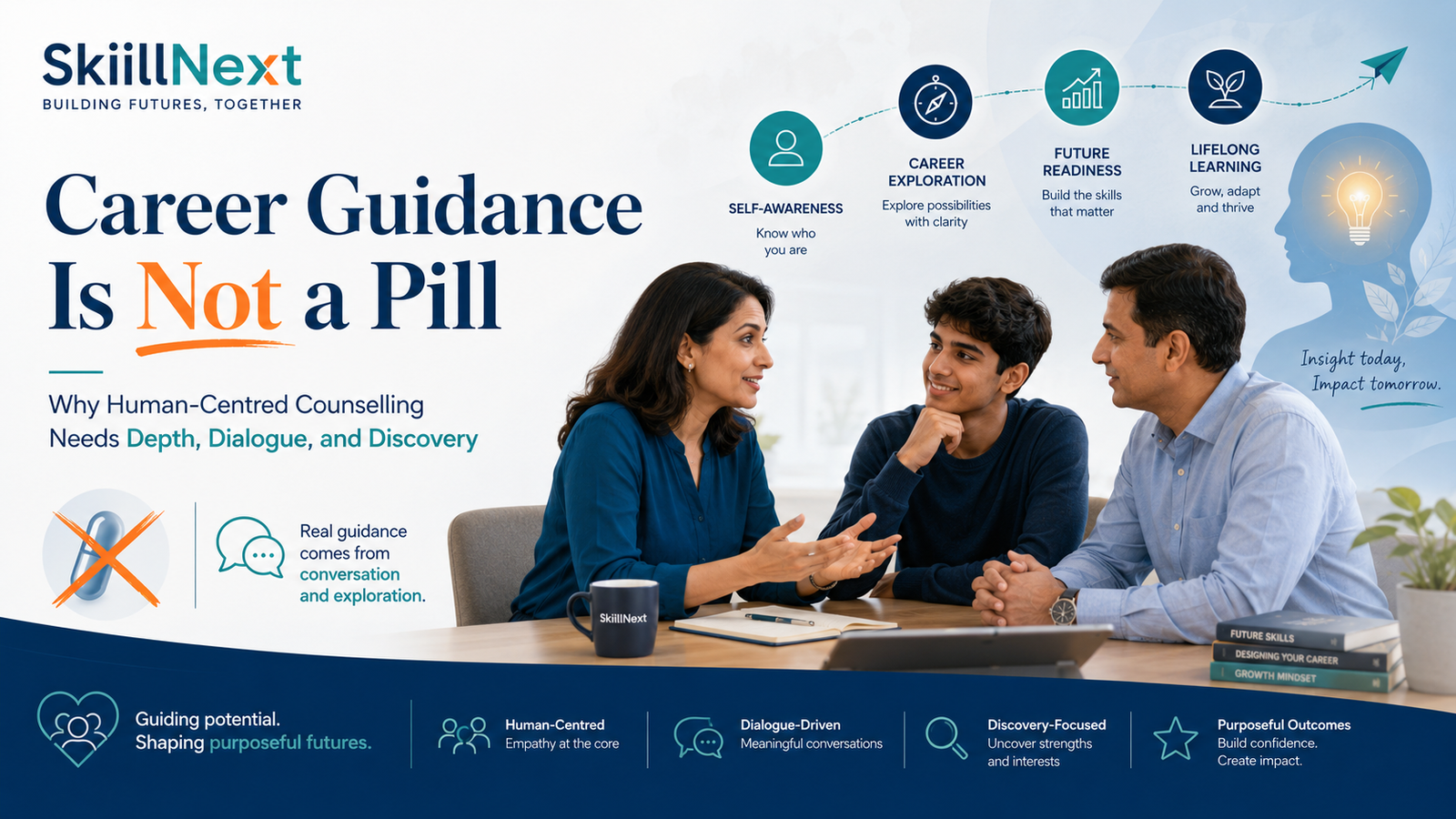
Career guidance is not a quick prescription. It is a human-centred process of self-awareness, dialogue, discovery, and future readiness. Meaningful counselling helps individuals understand strengths, explore possibilities, interpret assessments wisely, and make informed career decisions with clarity, confidence, and lifelong growth.
Many people approach career guidance as if it is a pill: take one test, get one answer, feel better immediately, and move on. A student wants to know which stream to choose. A parent wants certainty. A teacher wants direction for a confused learner. A graduate wants clarity. A working professional wants the “right next step.”
But career guidance does not work like instant medicine.
A career decision is not only about marks, aptitude, salary, or job trends. It is connected to a person’s interests, strengths, values, personality, learning style, emotional readiness, family context, exposure, opportunities, and future adaptability. This is why human-centred counselling cannot be reduced to a report, a chart, or a quick recommendation.
Meaningful career guidance needs depth, dialogue, and discovery. It is not about telling someone what to become. It is about helping them understand who they are, what the world is becoming, and how they can make informed, flexible, and future-ready choices.
In many homes and schools, career guidance is often expected to give immediate answers:
“What should my child take after Class 10?”
“Which career has the best scope?”
“Which course guarantees success?”
“Which job will be safe in the future?”
These are understandable questions, but they can be dangerous when answered too quickly. A quick answer may reduce anxiety for a moment, but it may not build long-term clarity.
Career decisions made only on the basis of trends, peer pressure, marks, family expectations, or one assessment result can lead to confusion later. A student may choose a stream without understanding their own abilities. A graduate may enter a course without knowing the real nature of the profession. A professional may change careers without examining whether the transition fits their strengths, responsibilities, and long-term goals.
Career guidance should reduce confusion, not replace thinking.
A prescription usually assumes that a problem has a fixed solution. Career development is different. People grow. Interests evolve. New industries emerge. Skills become outdated. Personal priorities change.
Good career counselling therefore works as a process. It helps individuals explore questions such as:
Who am I becoming?
What am I naturally good at?
What energizes me?
What kind of work environment suits me?
Which opportunities are realistic and meaningful?
What skills do I need to develop?
How can I make a decision without closing future possibilities?
This process is especially important today because careers are no longer linear. Many people will shift roles, learn new skills, work with technology, change industries, or design hybrid career paths. Therefore, the goal of counselling is not simply to choose one career. The goal is to build career decision-making capacity.
Psychometric assessments, aptitude tests, interest inventories, personality tools, and career reports can be extremely useful. They can provide structure, insight, and evidence. They can reveal patterns that individuals may not notice on their own.
But a test is not the full truth of a person.
A report can show preferences, but it cannot fully understand a student’s fears. It can indicate aptitude, but it cannot know family expectations. It can suggest career clusters, but it cannot explain whether the person has exposure to those fields. It can offer direction, but it cannot replace a reflective conversation.
The real value of an assessment emerges when it is interpreted properly. A good counsellor does not simply read a report. The counsellor connects the report with the individual’s story, context, aspirations, doubts, readiness, and possibilities.
That is where human-centred counselling becomes essential.
Depth means looking beyond the surface question.
When a student says, “I am confused,” the issue may not only be lack of career information. It may involve low self-confidence, comparison with peers, parental pressure, fear of failure, limited exposure, or unclear strengths.
When a parent says, “My child is not serious,” the issue may not only be discipline. It may involve motivation, learning style, emotional stress, lack of direction, or absence of meaningful career conversations.
When a professional says, “I want to change my field,” the issue may not only be dissatisfaction. It may involve burnout, skill mismatch, workplace culture, growth stagnation, financial responsibility, or changing life priorities.
Depth helps counselling move from symptoms to understanding.
Career counselling is not a lecture. It is a guided conversation.
Dialogue allows the individual to express doubts, assumptions, fears, hopes, and contradictions. It also allows the counsellor to ask deeper questions:
Why does this career appeal to you?
What do you know about the daily work involved?
Is this your interest or someone else’s expectation?
What kind of problems do you enjoy solving?
What have you tried so far?
What would you like to explore before deciding?
In many cases, people do not discover clarity because someone gives them an answer. They discover clarity because someone helps them think better.
This is especially important for parents and teachers. Children and young adults often need safe spaces where they can speak without being judged. A meaningful career conversation listens first, interprets carefully, and guides responsibly.
Many career confusions exist because individuals have limited exposure.
A student may know only a few careers: doctor, engineer, lawyer, teacher, business, government job, or software professional. A parent may know careers through the lens of their own generation. A teacher may observe academic performance but may not always have time to explore each student’s career identity.
Discovery expands the world of possibilities.
It includes reading about careers, speaking to professionals, exploring industries, observing workplaces, attending workshops, doing projects, taking internships, building skills, and reflecting on real experiences. Once individuals experience the world of work more closely, their decisions become more informed.
Career discovery is not about overwhelming people with hundreds of options. It is about helping them understand suitable possibilities with context.
Across the world, education systems are recognizing that career guidance must begin earlier, become more personalized, and connect learning with the world of work.
The future of work is being shaped by automation, artificial intelligence, sustainability, global mobility, entrepreneurship, new skill demands, and changing workplace models. In this environment, career guidance cannot remain a one-time event near a board exam or graduation.
Students need career awareness before critical decision points. Parents need updated understanding of modern careers. Teachers need support systems that connect classroom learning with life readiness. Graduates and professionals need guidance that helps them adapt throughout life.
The global message is clear: career guidance is not only about employment. It is about human development, lifelong learning, and future readiness.
In India, career decisions are often deeply influenced by marks, entrance exams, social reputation, family expectations, and perceived job security. These factors matter, but they should not be the only basis of choice.
India’s education landscape is changing. Multidisciplinary education, vocational exposure, skill development, entrepreneurship, digital careers, and emerging industries are becoming increasingly important. At the same time, many students still make major decisions without enough self-awareness or career exposure.
This creates a strong need for structured, human-centred counselling.
A Class 10 student should not choose Science, Commerce, Arts, or vocational pathways only because of marks or pressure. A Class 12 student should not choose a degree only because it is popular. A graduate should not choose postgraduate education only to delay confusion. A professional should not make a transition only because a trend looks attractive.
Each decision needs understanding, context, and readiness.
At SkiillNext, career guidance begins with the person, not the profession. Self-awareness helps individuals understand their strengths, interests, values, personality, motivations, learning patterns, and emotional readiness.
Without self-awareness, career choice becomes external. With self-awareness, career choice becomes more intentional.
Career awareness helps individuals understand courses, industries, roles, work environments, future trends, and skill requirements. It prevents narrow thinking and helps people move beyond stereotypes.
A good career decision is not only “What do I like?” It is also “What does this career actually involve?”
Future readiness means preparing for change. It includes adaptability, critical thinking, communication, creativity, digital awareness, emotional intelligence, and learning agility.
A future-ready person does not depend only on one fixed career prediction. They develop the ability to keep learning, adjusting, and growing.
Integrated Intelligence means combining self-understanding, career information, emotional awareness, practical realities, family context, labour-market awareness, and long-term growth thinking.
This is where counselling becomes deeper than advice. It integrates multiple dimensions before supporting a decision.
Career guidance should not end after one choice. Every stage of life brings new questions. Students choose subjects. Graduates choose pathways. Professionals choose growth, transition, leadership, or reinvention.
Lifelong learning ensures that career development continues with clarity and confidence.
Do not ask only, “Which career should I choose?” Also ask, “What am I learning about myself?” Keep a reflection journal of your interests, strengths, activities you enjoy, subjects you find meaningful, and problems you like solving.
Avoid turning counselling into a demand for certainty. Instead of asking for the “best career,” support your child in discovering suitable pathways. Listen to their interests, observe their strengths, and remain open to new-age careers.
Notice patterns beyond marks. Some students show leadership, creativity, empathy, analytical thinking, practical skills, or communication ability in non-exam settings. These observations can become valuable inputs in career conversations.
Career guidance should not be limited to one seminar before subject selection. Schools can build structured exposure through career talks, skill workshops, project-based learning, alumni interactions, industry visits, and counselling support.
Do not treat career confusion as failure. It may be a signal that your aspirations, skills, environment, or priorities are changing. Use counselling to understand whether you need upskilling, role change, industry shift, or deeper personal reflection.
Career guidance is not a pill because human beings are not problems to be fixed instantly. They are evolving individuals who need understanding, exposure, reflection, and support.
A quick answer may create temporary comfort. A deep counselling process creates lasting clarity.
In a changing world, the real purpose of career guidance is not to predict one perfect career. It is to help individuals understand themselves, understand opportunities, make informed choices, and keep growing through every stage of life.
That is why human-centred counselling needs depth, dialogue, and discovery. And that is why meaningful guidance remains one of the most important foundations for future-ready living.
No. Career counselling is useful for anyone making educational, professional, or life-direction decisions. It supports students, parents, graduates, professionals, and lifelong learners.
A psychometric test can provide important insights, but it should not be treated as the final answer. The result needs to be interpreted along with the person’s context, exposure, interests, and goals.
Career awareness can begin early in age-appropriate ways. Younger students can explore strengths and interests, while older students can examine subjects, careers, skills, and future pathways in greater depth.
Parents should support exploration, encourage reflection, avoid comparison, and remain open to changing career realities. Their role is not to control the decision, but to help create a supportive decision-making environment.
Teachers can observe student strengths, encourage curiosity, connect subjects with real-world applications, and guide students toward counselling or career resources when needed.
Yes. Professionals may need counselling during career transitions, growth stagnation, burnout, reskilling decisions, leadership development, or life-work balance challenges.
Human-centred counselling respects the individual’s story, context, emotions, aspirations, constraints, and potential. It does not reduce a person to marks, test scores, or market trends.
Many people approach career guidance as if it is a pill: take one test, get one answer, feel better immediately, and move on. A student wants to know which stream to choose. A parent wants certainty. A teacher wants direction for a confused learner. A graduate wants clarity. A working professional wants the “right next step.”
But career guidance does not work like instant medicine.
A career decision is not only about marks, aptitude, salary, or job trends. It is connected to a person’s interests, strengths, values, personality, learning style, emotional readiness, family context, exposure, opportunities, and future adaptability. This is why human-centred counselling cannot be reduced to a report, a chart, or a quick recommendation.
Meaningful career guidance needs depth, dialogue, and discovery. It is not about telling someone what to become. It is about helping them understand who they are, what the world is becoming, and how they can make informed, flexible, and future-ready choices.
In many homes and schools, career guidance is often expected to give immediate answers:
“What should my child take after Class 10?”
“Which career has the best scope?”
“Which course guarantees success?”
“Which job will be safe in the future?”
These are understandable questions, but they can be dangerous when answered too quickly. A quick answer may reduce anxiety for a moment, but it may not build long-term clarity.
Career decisions made only on the basis of trends, peer pressure, marks, family expectations, or one assessment result can lead to confusion later. A student may choose a stream without understanding their own abilities. A graduate may enter a course without knowing the real nature of the profession. A professional may change careers without examining whether the transition fits their strengths, responsibilities, and long-term goals.
Career guidance should reduce confusion, not replace thinking.
A prescription usually assumes that a problem has a fixed solution. Career development is different. People grow. Interests evolve. New industries emerge. Skills become outdated. Personal priorities change.
Good career counselling therefore works as a process. It helps individuals explore questions such as:
Who am I becoming?
What am I naturally good at?
What energizes me?
What kind of work environment suits me?
Which opportunities are realistic and meaningful?
What skills do I need to develop?
How can I make a decision without closing future possibilities?
This process is especially important today because careers are no longer linear. Many people will shift roles, learn new skills, work with technology, change industries, or design hybrid career paths. Therefore, the goal of counselling is not simply to choose one career. The goal is to build career decision-making capacity.
Psychometric assessments, aptitude tests, interest inventories, personality tools, and career reports can be extremely useful. They can provide structure, insight, and evidence. They can reveal patterns that individuals may not notice on their own.
But a test is not the full truth of a person.
A report can show preferences, but it cannot fully understand a student’s fears. It can indicate aptitude, but it cannot know family expectations. It can suggest career clusters, but it cannot explain whether the person has exposure to those fields. It can offer direction, but it cannot replace a reflective conversation.
The real value of an assessment emerges when it is interpreted properly. A good counsellor does not simply read a report. The counsellor connects the report with the individual’s story, context, aspirations, doubts, readiness, and possibilities.
That is where human-centred counselling becomes essential.
Depth means looking beyond the surface question.
When a student says, “I am confused,” the issue may not only be lack of career information. It may involve low self-confidence, comparison with peers, parental pressure, fear of failure, limited exposure, or unclear strengths.
When a parent says, “My child is not serious,” the issue may not only be discipline. It may involve motivation, learning style, emotional stress, lack of direction, or absence of meaningful career conversations.
When a professional says, “I want to change my field,” the issue may not only be dissatisfaction. It may involve burnout, skill mismatch, workplace culture, growth stagnation, financial responsibility, or changing life priorities.
Depth helps counselling move from symptoms to understanding.
Career counselling is not a lecture. It is a guided conversation.
Dialogue allows the individual to express doubts, assumptions, fears, hopes, and contradictions. It also allows the counsellor to ask deeper questions:
Why does this career appeal to you?
What do you know about the daily work involved?
Is this your interest or someone else’s expectation?
What kind of problems do you enjoy solving?
What have you tried so far?
What would you like to explore before deciding?
In many cases, people do not discover clarity because someone gives them an answer. They discover clarity because someone helps them think better.
This is especially important for parents and teachers. Children and young adults often need safe spaces where they can speak without being judged. A meaningful career conversation listens first, interprets carefully, and guides responsibly.
Many career confusions exist because individuals have limited exposure.
A student may know only a few careers: doctor, engineer, lawyer, teacher, business, government job, or software professional. A parent may know careers through the lens of their own generation. A teacher may observe academic performance but may not always have time to explore each student’s career identity.
Discovery expands the world of possibilities.
It includes reading about careers, speaking to professionals, exploring industries, observing workplaces, attending workshops, doing projects, taking internships, building skills, and reflecting on real experiences. Once individuals experience the world of work more closely, their decisions become more informed.
Career discovery is not about overwhelming people with hundreds of options. It is about helping them understand suitable possibilities with context.
Across the world, education systems are recognizing that career guidance must begin earlier, become more personalized, and connect learning with the world of work.
The future of work is being shaped by automation, artificial intelligence, sustainability, global mobility, entrepreneurship, new skill demands, and changing workplace models. In this environment, career guidance cannot remain a one-time event near a board exam or graduation.
Students need career awareness before critical decision points. Parents need updated understanding of modern careers. Teachers need support systems that connect classroom learning with life readiness. Graduates and professionals need guidance that helps them adapt throughout life.
The global message is clear: career guidance is not only about employment. It is about human development, lifelong learning, and future readiness.
In India, career decisions are often deeply influenced by marks, entrance exams, social reputation, family expectations, and perceived job security. These factors matter, but they should not be the only basis of choice.
India’s education landscape is changing. Multidisciplinary education, vocational exposure, skill development, entrepreneurship, digital careers, and emerging industries are becoming increasingly important. At the same time, many students still make major decisions without enough self-awareness or career exposure.
This creates a strong need for structured, human-centred counselling.
A Class 10 student should not choose Science, Commerce, Arts, or vocational pathways only because of marks or pressure. A Class 12 student should not choose a degree only because it is popular. A graduate should not choose postgraduate education only to delay confusion. A professional should not make a transition only because a trend looks attractive.
Each decision needs understanding, context, and readiness.
At SkiillNext, career guidance begins with the person, not the profession. Self-awareness helps individuals understand their strengths, interests, values, personality, motivations, learning patterns, and emotional readiness.
Without self-awareness, career choice becomes external. With self-awareness, career choice becomes more intentional.
Career awareness helps individuals understand courses, industries, roles, work environments, future trends, and skill requirements. It prevents narrow thinking and helps people move beyond stereotypes.
A good career decision is not only “What do I like?” It is also “What does this career actually involve?”
Future readiness means preparing for change. It includes adaptability, critical thinking, communication, creativity, digital awareness, emotional intelligence, and learning agility.
A future-ready person does not depend only on one fixed career prediction. They develop the ability to keep learning, adjusting, and growing.
Integrated Intelligence means combining self-understanding, career information, emotional awareness, practical realities, family context, labour-market awareness, and long-term growth thinking.
This is where counselling becomes deeper than advice. It integrates multiple dimensions before supporting a decision.
Career guidance should not end after one choice. Every stage of life brings new questions. Students choose subjects. Graduates choose pathways. Professionals choose growth, transition, leadership, or reinvention.
Lifelong learning ensures that career development continues with clarity and confidence.
Do not ask only, “Which career should I choose?” Also ask, “What am I learning about myself?” Keep a reflection journal of your interests, strengths, activities you enjoy, subjects you find meaningful, and problems you like solving.
Avoid turning counselling into a demand for certainty. Instead of asking for the “best career,” support your child in discovering suitable pathways. Listen to their interests, observe their strengths, and remain open to new-age careers.
Notice patterns beyond marks. Some students show leadership, creativity, empathy, analytical thinking, practical skills, or communication ability in non-exam settings. These observations can become valuable inputs in career conversations.
Career guidance should not be limited to one seminar before subject selection. Schools can build structured exposure through career talks, skill workshops, project-based learning, alumni interactions, industry visits, and counselling support.
Do not treat career confusion as failure. It may be a signal that your aspirations, skills, environment, or priorities are changing. Use counselling to understand whether you need upskilling, role change, industry shift, or deeper personal reflection.
Career guidance is not a pill because human beings are not problems to be fixed instantly. They are evolving individuals who need understanding, exposure, reflection, and support.
A quick answer may create temporary comfort. A deep counselling process creates lasting clarity.
In a changing world, the real purpose of career guidance is not to predict one perfect career. It is to help individuals understand themselves, understand opportunities, make informed choices, and keep growing through every stage of life.
That is why human-centred counselling needs depth, dialogue, and discovery. And that is why meaningful guidance remains one of the most important foundations for future-ready living.
No. Career counselling is useful for anyone making educational, professional, or life-direction decisions. It supports students, parents, graduates, professionals, and lifelong learners.
A psychometric test can provide important insights, but it should not be treated as the final answer. The result needs to be interpreted along with the person’s context, exposure, interests, and goals.
Career awareness can begin early in age-appropriate ways. Younger students can explore strengths and interests, while older students can examine subjects, careers, skills, and future pathways in greater depth.
Parents should support exploration, encourage reflection, avoid comparison, and remain open to changing career realities. Their role is not to control the decision, but to help create a supportive decision-making environment.
Teachers can observe student strengths, encourage curiosity, connect subjects with real-world applications, and guide students toward counselling or career resources when needed.
Yes. Professionals may need counselling during career transitions, growth stagnation, burnout, reskilling decisions, leadership development, or life-work balance challenges.
Human-centred counselling respects the individual’s story, context, emotions, aspirations, constraints, and potential. It does not reduce a person to marks, test scores, or market trends.